

In that case, since a spontaneous change in an isolated system does not involve
interaction with a reservoir, the system entropy growth potential can extract heat
from heat reservoir of any temperature, i.e., reversible work becomes, as it was first
shown in [29]
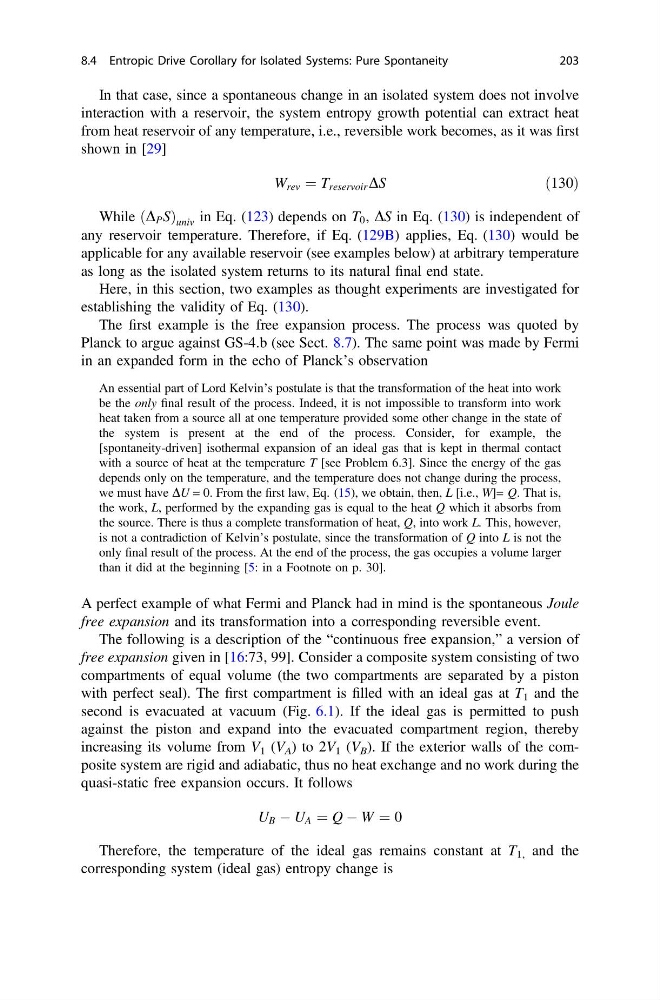
W rev ¼ T reservoir DS
ð130Þ
While D P S
ð
Þ univ in Eq. (123) depends on T 0 , DS in Eq. (130) is independent of
any reservoir temperature. Therefore, if Eq. (129B) applies, Eq. (130) would be
applicable for any available reservoir (see examples below) at arbitrary temperature
as long as the isolated system returns to its natural final end state.
Here, in this section, two examples as thought experiments are investigated for
establishing the validity of Eq. (130).
The first example is the free expansion process. The process was quoted by
Planck to argue against GS-4.b (see Sect. 8.7). The same point was made by Fermi
in an expanded form in the echo of Planck’s observation
An essential part of Lord Kelvin’s postulate is that the transformation of the heat into work
be the only final result of the process. Indeed, it is not impossible to transform into work
heat taken from a source all at one temperature provided some other change in the state of
the system is present at the end of the process. Consider, for example, the
[spontaneity-driven] isothermal expansion of an ideal gas that is kept in thermal contact
with a source of heat at the temperature T [see Problem 6.3]. Since the energy of the gas
depends only on the temperature, and the temperature does not change during the process,
we must have DU = 0. From the first law, Eq. (15), we obtain, then, L [i.e., W]= Q. That is,
the work, L, performed by the expanding gas is equal to the heat Q which it absorbs from
the source. There is thus a complete transformation of heat, Q, into work L. This, however,
is not a contradiction of Kelvin’s postulate, since the transformation of Q into L is not the
only final result of the process. At the end of the process, the gas occupies a volume larger
than it did at the beginning [5: in a Footnote on p. 30].
A perfect example of what Fermi and Planck had in mind is the spontaneous Joule
free expansion and its transformation into a corresponding reversible event.
The following is a description of the “continuous free expansion,” a version of
free expansion given in [16:73, 99]. Consider a composite system consisting of two
compartments of equal volume (the two compartments are separated by a piston
with perfect seal). The first compartment is filled with an ideal gas at T 1 and the
second is evacuated at vacuum (Fig. 6.1). If the ideal gas is permitted to push
against the piston and expand into the evacuated compartment region, thereby
increasing its volume from V 1 (V A ) to 2V 1 (V B ). If the exterior walls of the composite system are rigid and adiabatic, thus no heat exchange and no work during the
quasi-static free expansion occurs. It follows
U B À U A ¼ Q À W ¼ 0
Therefore, the temperature of the ideal gas remains constant at T 1, and the
corresponding system (ideal gas) entropy change is
8.4 Entropic Drive Corollary for Isolated Systems: Pure Spontaneity
203
interaction with a reservoir, the system entropy growth potential can extract heat
from heat reservoir of any temperature, i.e., reversible work becomes, as it was first
shown in [29]
W rev ¼ T reservoir DS
ð130Þ
While D P S
ð
Þ univ in Eq. (123) depends on T 0 , DS in Eq. (130) is independent of
any reservoir temperature. Therefore, if Eq. (129B) applies, Eq. (130) would be
applicable for any available reservoir (see examples below) at arbitrary temperature
as long as the isolated system returns to its natural final end state.
Here, in this section, two examples as thought experiments are investigated for
establishing the validity of Eq. (130).
The first example is the free expansion process. The process was quoted by
Planck to argue against GS-4.b (see Sect. 8.7). The same point was made by Fermi
in an expanded form in the echo of Planck’s observation
An essential part of Lord Kelvin’s postulate is that the transformation of the heat into work
be the only final result of the process. Indeed, it is not impossible to transform into work
heat taken from a source all at one temperature provided some other change in the state of
the system is present at the end of the process. Consider, for example, the
[spontaneity-driven] isothermal expansion of an ideal gas that is kept in thermal contact
with a source of heat at the temperature T [see Problem 6.3]. Since the energy of the gas
depends only on the temperature, and the temperature does not change during the process,
we must have DU = 0. From the first law, Eq. (15), we obtain, then, L [i.e., W]= Q. That is,
the work, L, performed by the expanding gas is equal to the heat Q which it absorbs from
the source. There is thus a complete transformation of heat, Q, into work L. This, however,
is not a contradiction of Kelvin’s postulate, since the transformation of Q into L is not the
only final result of the process. At the end of the process, the gas occupies a volume larger
than it did at the beginning [5: in a Footnote on p. 30].
A perfect example of what Fermi and Planck had in mind is the spontaneous Joule
free expansion and its transformation into a corresponding reversible event.
The following is a description of the “continuous free expansion,” a version of
free expansion given in [16:73, 99]. Consider a composite system consisting of two
compartments of equal volume (the two compartments are separated by a piston
with perfect seal). The first compartment is filled with an ideal gas at T 1 and the
second is evacuated at vacuum (Fig. 6.1). If the ideal gas is permitted to push
against the piston and expand into the evacuated compartment region, thereby
increasing its volume from V 1 (V A ) to 2V 1 (V B ). If the exterior walls of the composite system are rigid and adiabatic, thus no heat exchange and no work during the
quasi-static free expansion occurs. It follows
U B À U A ¼ Q À W ¼ 0
Therefore, the temperature of the ideal gas remains constant at T 1, and the
corresponding system (ideal gas) entropy change is
8.4 Entropic Drive Corollary for Isolated Systems: Pure Spontaneity
203