

21
the anode through the proton exchange membrane gives H 2 O as the reaction product. These reactions are described in more detail in the following chapters.
The cell voltage, even at zero current generated, is rarely equal to the difference
in reversible electrode potentials. Other reactions can occur in parallel with the main
reaction, which leads to the mixed electrode potentials that are usually lower than
the reversible potential. Under current flow, additional losses of cell voltage take
place that correspond to the electrical work done. These losses further reduce the
cell efficiency. Finite rates of the electrode reactions cause the overpotentials, i.e.,
deviation of potential from equilibrium mainly by charge transfer kinetics for small
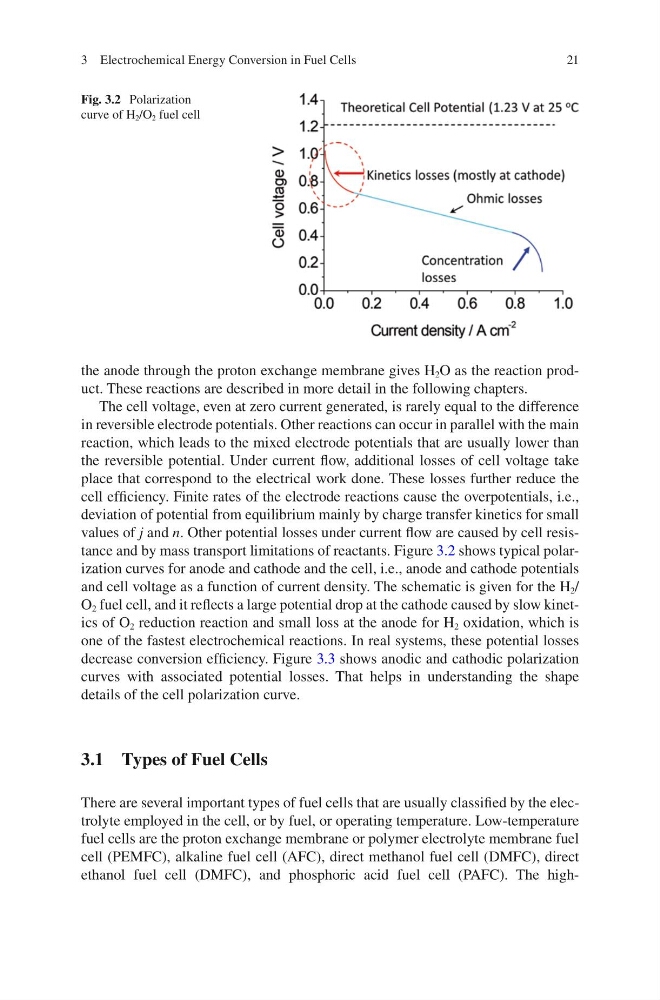
values of j and n. Other potential losses under current flow are caused by cell resistance and by mass transport limitations of reactants. Figure 3.2 shows typical polarization curves for anode and cathode and the cell, i.e., anode and cathode potentials
and cell voltage as a function of current density. The schematic is given for the H 2 /
O 2 fuel cell, and it reflects a large potential drop at the cathode caused by slow kinetics of O 2 reduction reaction and small loss at the anode for H 2 oxidation, which is
one of the fastest electrochemical reactions. In real systems, these potential losses
decrease conversion efficiency. Figure 3.3 shows anodic and cathodic polarization
curves with associated potential losses. That helps in understanding the shape
details of the cell polarization curve.
3.1 Types of Fuel Cells
There are several important types of fuel cells that are usually classified by the electrolyte employed in the cell, or by fuel, or operating temperature. Low-temperature
fuel cells are the proton exchange membrane or polymer electrolyte membrane fuel
cell (PEMFC), alkaline fuel cell (AFC), direct methanol fuel cell (DMFC), direct
ethanol fuel cell (DMFC), and phosphoric acid fuel cell (PAFC). The highFig. 3.2 Polarization
curve of H 2 /O 2 fuel cell
3 Electrochemical Energy Conversion in Fuel Cells
the anode through the proton exchange membrane gives H 2 O as the reaction product. These reactions are described in more detail in the following chapters.
The cell voltage, even at zero current generated, is rarely equal to the difference
in reversible electrode potentials. Other reactions can occur in parallel with the main
reaction, which leads to the mixed electrode potentials that are usually lower than
the reversible potential. Under current flow, additional losses of cell voltage take
place that correspond to the electrical work done. These losses further reduce the
cell efficiency. Finite rates of the electrode reactions cause the overpotentials, i.e.,
deviation of potential from equilibrium mainly by charge transfer kinetics for small
values of j and n. Other potential losses under current flow are caused by cell resistance and by mass transport limitations of reactants. Figure 3.2 shows typical polarization curves for anode and cathode and the cell, i.e., anode and cathode potentials
and cell voltage as a function of current density. The schematic is given for the H 2 /
O 2 fuel cell, and it reflects a large potential drop at the cathode caused by slow kinetics of O 2 reduction reaction and small loss at the anode for H 2 oxidation, which is
one of the fastest electrochemical reactions. In real systems, these potential losses
decrease conversion efficiency. Figure 3.3 shows anodic and cathodic polarization
curves with associated potential losses. That helps in understanding the shape
details of the cell polarization curve.
3.1 Types of Fuel Cells
There are several important types of fuel cells that are usually classified by the electrolyte employed in the cell, or by fuel, or operating temperature. Low-temperature
fuel cells are the proton exchange membrane or polymer electrolyte membrane fuel
cell (PEMFC), alkaline fuel cell (AFC), direct methanol fuel cell (DMFC), direct
ethanol fuel cell (DMFC), and phosphoric acid fuel cell (PAFC). The highFig. 3.2 Polarization
curve of H 2 /O 2 fuel cell
3 Electrochemical Energy Conversion in Fuel Cells