

20
Since ΔG is close to ΔH, the efficiency of fuel cell if it operates at reversible
voltage should be close to unity. Efficiency of energy conversion in internal combustion engines is determined by Carnot cycle, which limits it to only 20–30%. The
large difference in efficiency is one of the main reasons for developing electric
vehicles with fuel cells as the energy source.
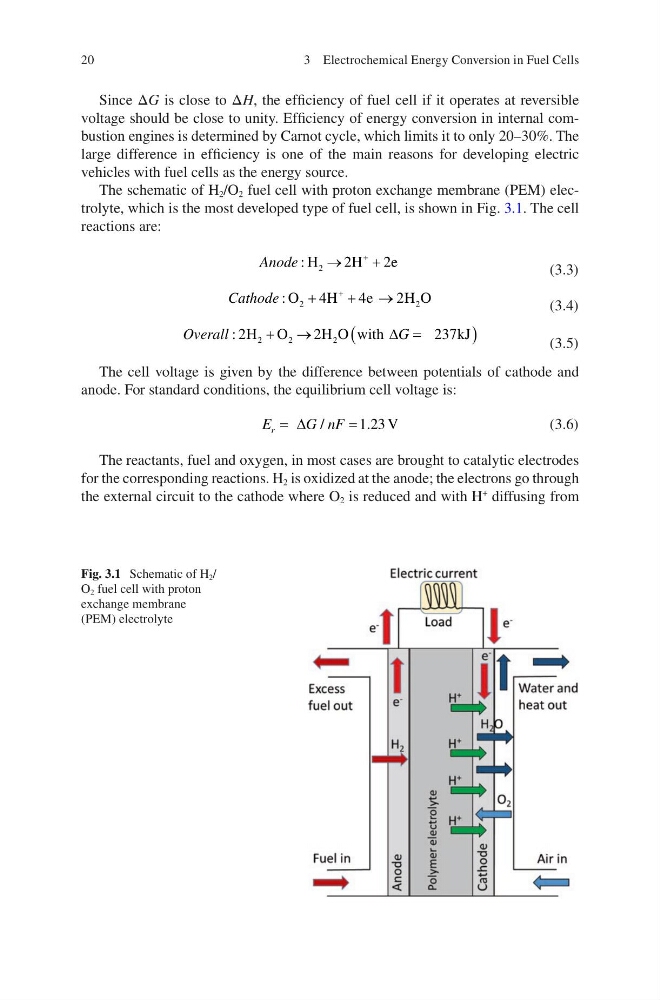
The schematic of H 2 /O 2 fuel cell with proton exchange membrane (PEM) electrolyte, which is the most developed type of fuel cell, is shown in Fig. 3.1. The cell
reactions are:
Anode : H
H
e
2
2
2
→
+
+
(3.3)
Cathode : O
H
e
H O
2
2
4
4
2
+
+
+
→
(3.4)
Overall
G
: 2
2
237
2
2
2
H O
H O with
kJ
+
=
(
)
→
∆
(3.5)
The cell voltage is given by the difference between potentials of cathode and
anode. For standard conditions, the equilibrium cell voltage is:
E
G
r =
=
∆ /
.
nF 1 23 V
(3.6)
The reactants, fuel and oxygen, in most cases are brought to catalytic electrodes
for the corresponding reactions. H 2 is oxidized at the anode; the electrons go through
the external circuit to the cathode where O 2 is reduced and with H
+
diffusing from
Fig. 3.1 Schematic of H 2 /
O 2 fuel cell with proton
exchange membrane
(PEM) electrolyte
3 Electrochemical Energy Conversion in Fuel Cells
Since ΔG is close to ΔH, the efficiency of fuel cell if it operates at reversible
voltage should be close to unity. Efficiency of energy conversion in internal combustion engines is determined by Carnot cycle, which limits it to only 20–30%. The
large difference in efficiency is one of the main reasons for developing electric
vehicles with fuel cells as the energy source.
The schematic of H 2 /O 2 fuel cell with proton exchange membrane (PEM) electrolyte, which is the most developed type of fuel cell, is shown in Fig. 3.1. The cell
reactions are:
Anode : H
H
e
2
2
2
→
+
+
(3.3)
Cathode : O
H
e
H O
2
2
4
4
2
+
+
+
→
(3.4)
Overall
G
: 2
2
237
2
2
2
H O
H O with
kJ
+
=
(
)
→
∆
(3.5)
The cell voltage is given by the difference between potentials of cathode and
anode. For standard conditions, the equilibrium cell voltage is:
E
G
r =
=
∆ /
.
nF 1 23 V
(3.6)
The reactants, fuel and oxygen, in most cases are brought to catalytic electrodes
for the corresponding reactions. H 2 is oxidized at the anode; the electrons go through
the external circuit to the cathode where O 2 is reduced and with H
+
diffusing from
Fig. 3.1 Schematic of H 2 /
O 2 fuel cell with proton
exchange membrane
(PEM) electrolyte
3 Electrochemical Energy Conversion in Fuel Cells