

22
temperature fuel cells operate at temperatures approximately 600–1000 °C, and two
different types have been developed: molten carbonate fuel cell (MCFC) and solid
oxide fuel cell (SOFC). An overview of the properties of low-temperature fuel cells
is given in Table 3.1 [1].
3.1.1 Proton Exchange Membrane Fuel Cell (PEMFC)
PEM fuel cells operating between 85 and 105 °C use a proton exchange membrane
as an electrolyte. This fuel cell was used in the Gemini program as an auxiliary
power source and the source of drinking water. The proton-conducting polymer
electrolyte membrane is mainly based on perfluorosulfonic acid (PFSA) ionomers.
Its thickness is from 20 to 100 μm.
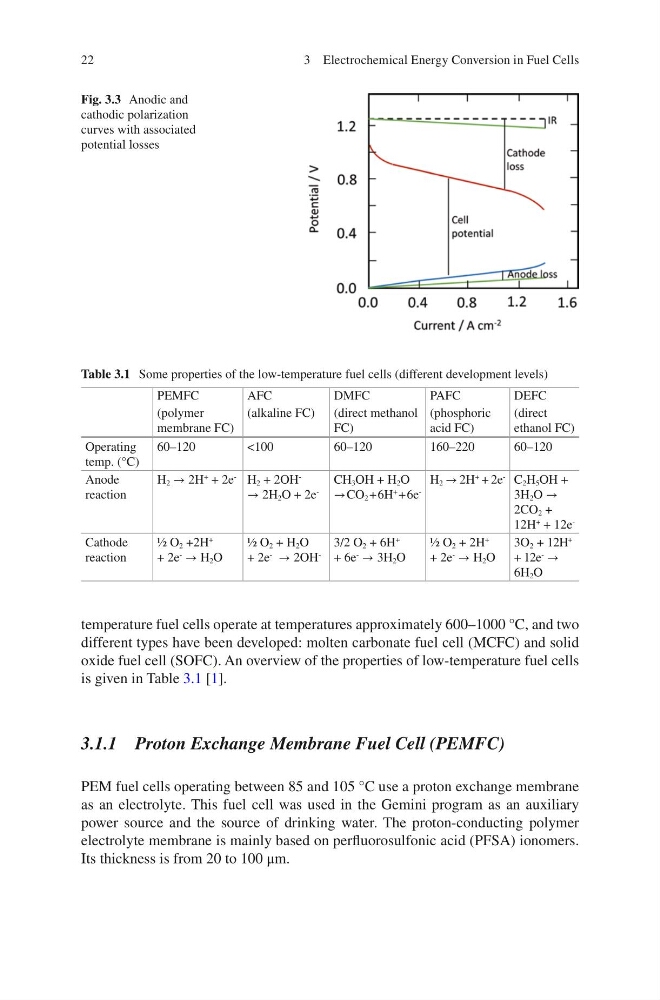
Fig. 3.3 Anodic and
cathodic polarization
curves with associated
potential losses
Table 3.1 Some properties of the low-temperature fuel cells (different development levels)
PEMFC
AFC
DMFC
PAFC
DEFC
(polymer
membrane FC)
(alkaline FC) (direct methanol
FC)
(phosphoric
acid FC)
(direct
ethanol FC)
Operating
temp. (°C)
60–120
<100
60–120
160–220
60–120
Anode
reaction
H 2 → 2H
+ + 2e
- H 2 + 2OH
-
→ 2H 2 O + 2e
-
CH 3 OH + H 2 O
→ CO 2 + 6H
+ + 6e
-
H 2 → 2H
+
+ 2e
- C 2 H 5 OH +
3H 2 O →
2CO 2 +
12H
+ + 12e
-
Cathode
reaction
½ O 2 +2H
+
+ 2e
-
→ H 2 O
½ O 2 + H 2 O
+ 2e
-
→ 2OH
-
3/2 O 2 + 6H
+
+ 6e
-
→ 3H 2 O
½ O 2 + 2H
+
+ 2e
-
→ H 2 O
3O 2 + 12H
+
+ 12e
-
→
6H 2 O
3 Electrochemical Energy Conversion in Fuel Cells
temperature fuel cells operate at temperatures approximately 600–1000 °C, and two
different types have been developed: molten carbonate fuel cell (MCFC) and solid
oxide fuel cell (SOFC). An overview of the properties of low-temperature fuel cells
is given in Table 3.1 [1].
3.1.1 Proton Exchange Membrane Fuel Cell (PEMFC)
PEM fuel cells operating between 85 and 105 °C use a proton exchange membrane
as an electrolyte. This fuel cell was used in the Gemini program as an auxiliary
power source and the source of drinking water. The proton-conducting polymer
electrolyte membrane is mainly based on perfluorosulfonic acid (PFSA) ionomers.
Its thickness is from 20 to 100 μm.
Fig. 3.3 Anodic and
cathodic polarization
curves with associated
potential losses
Table 3.1 Some properties of the low-temperature fuel cells (different development levels)
PEMFC
AFC
DMFC
PAFC
DEFC
(polymer
membrane FC)
(alkaline FC) (direct methanol
FC)
(phosphoric
acid FC)
(direct
ethanol FC)
Operating
temp. (°C)
60–120
<100
60–120
160–220
60–120
Anode
reaction
H 2 → 2H
+ + 2e
- H 2 + 2OH
-
→ 2H 2 O + 2e
-
CH 3 OH + H 2 O
→ CO 2 + 6H
+ + 6e
-
H 2 → 2H
+
+ 2e
- C 2 H 5 OH +
3H 2 O →
2CO 2 +
12H
+ + 12e
-
Cathode
reaction
½ O 2 +2H
+
+ 2e
-
→ H 2 O
½ O 2 + H 2 O
+ 2e
-
→ 2OH
-
3/2 O 2 + 6H
+
+ 6e
-
→ 3H 2 O
½ O 2 + 2H
+
+ 2e
-
→ H 2 O
3O 2 + 12H
+
+ 12e
-
→
6H 2 O
3 Electrochemical Energy Conversion in Fuel Cells