

11
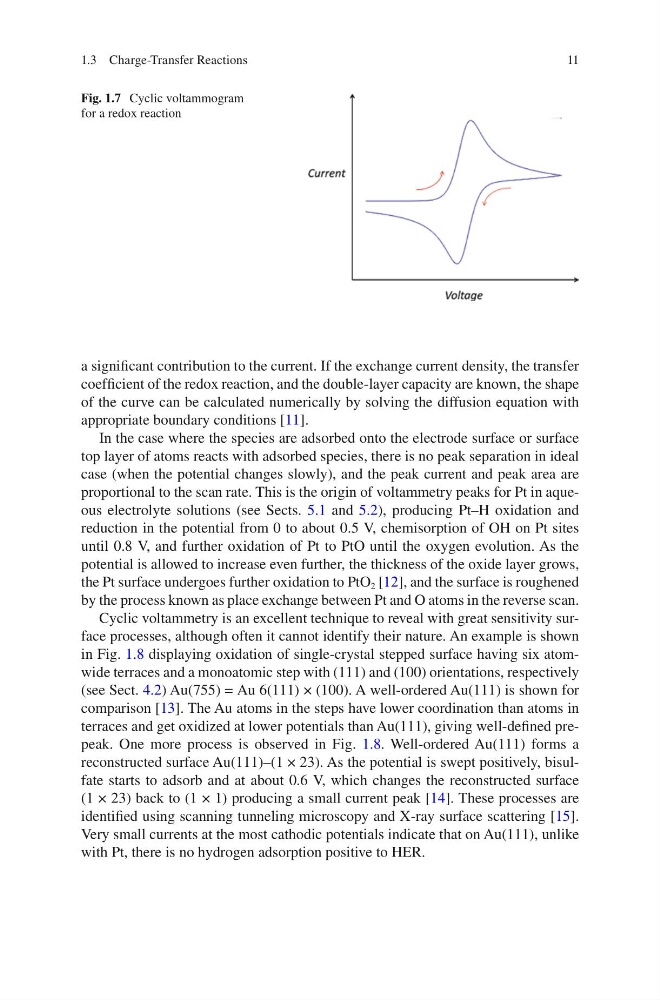
a significant contribution to the current. If the exchange current density, the transfer
coefficient of the redox reaction, and the double-layer capacity are known, the shape
of the curve can be calculated numerically by solving the diffusion equation with
appropriate boundary conditions [11].
In the case where the species are adsorbed onto the electrode surface or surface
top layer of atoms reacts with adsorbed species, there is no peak separation in ideal
case (when the potential changes slowly), and the peak current and peak area are
proportional to the scan rate. This is the origin of voltammetry peaks for Pt in aqueous electrolyte solutions (see Sects. 5.1 and 5.2), producing Pt–H oxidation and
reduction in the potential from 0 to about 0.5 V, chemisorption of OH on Pt sites
until 0.8 V, and further oxidation of Pt to PtO until the oxygen evolution. As the
potential is allowed to increase even further, the thickness of the oxide layer grows,
the Pt surface undergoes further oxidation to PtO 2 [12], and the surface is roughened
by the process known as place exchange between Pt and O atoms in the reverse scan.
Cyclic voltammetry is an excellent technique to reveal with great sensitivity surface processes, although often it cannot identify their nature. An example is shown
in Fig. 1.8 displaying oxidation of single-crystal stepped surface having six atomwide terraces and a monoatomic step with (111) and (100) orientations, respectively
(see Sect. 4.2) Au(755) = Au 6(111) × (100). A well-ordered Au(111) is shown for
comparison [13]. The Au atoms in the steps have lower coordination than atoms in
terraces and get oxidized at lower potentials than Au(111), giving well-defined prepeak. One more process is observed in Fig. 1.8. Well-ordered Au(111) forms a
reconstructed surface Au(111)–(1 × 23). As the potential is swept positively, bisulfate starts to adsorb and at about 0.6 V, which changes the reconstructed surface
(1 × 23) back to (1 × 1) producing a small current peak [14]. These processes are
identified using scanning tunneling microscopy and X-ray surface scattering [15].
Very small currents at the most cathodic potentials indicate that on Au(111), unlike
with Pt, there is no hydrogen adsorption positive to HER.
Fig. 1.7 Cyclic voltammogram
for a redox reaction
1.3 Charge-Transfer Reactions
a significant contribution to the current. If the exchange current density, the transfer
coefficient of the redox reaction, and the double-layer capacity are known, the shape
of the curve can be calculated numerically by solving the diffusion equation with
appropriate boundary conditions [11].
In the case where the species are adsorbed onto the electrode surface or surface
top layer of atoms reacts with adsorbed species, there is no peak separation in ideal
case (when the potential changes slowly), and the peak current and peak area are
proportional to the scan rate. This is the origin of voltammetry peaks for Pt in aqueous electrolyte solutions (see Sects. 5.1 and 5.2), producing Pt–H oxidation and
reduction in the potential from 0 to about 0.5 V, chemisorption of OH on Pt sites
until 0.8 V, and further oxidation of Pt to PtO until the oxygen evolution. As the
potential is allowed to increase even further, the thickness of the oxide layer grows,
the Pt surface undergoes further oxidation to PtO 2 [12], and the surface is roughened
by the process known as place exchange between Pt and O atoms in the reverse scan.
Cyclic voltammetry is an excellent technique to reveal with great sensitivity surface processes, although often it cannot identify their nature. An example is shown
in Fig. 1.8 displaying oxidation of single-crystal stepped surface having six atomwide terraces and a monoatomic step with (111) and (100) orientations, respectively
(see Sect. 4.2) Au(755) = Au 6(111) × (100). A well-ordered Au(111) is shown for
comparison [13]. The Au atoms in the steps have lower coordination than atoms in
terraces and get oxidized at lower potentials than Au(111), giving well-defined prepeak. One more process is observed in Fig. 1.8. Well-ordered Au(111) forms a
reconstructed surface Au(111)–(1 × 23). As the potential is swept positively, bisulfate starts to adsorb and at about 0.6 V, which changes the reconstructed surface
(1 × 23) back to (1 × 1) producing a small current peak [14]. These processes are
identified using scanning tunneling microscopy and X-ray surface scattering [15].
Very small currents at the most cathodic potentials indicate that on Au(111), unlike
with Pt, there is no hydrogen adsorption positive to HER.
Fig. 1.7 Cyclic voltammogram
for a redox reaction
1.3 Charge-Transfer Reactions