

12
1.3.3 Theories of Charge Transfers
Theoretical descriptions of charge transfer (electrons or protons) in electrochemical
reactions have been a subject of much interest since the work of Gurney [16], who
interpreted reactions at electrodes as well as between redox couples in solutions in
terms of electron tunneling. Microscopic aspects of the charge transfer in the phenomenological treatment are contained in the rate constants k and the transfer coefficient a. There have been two main approaches to the problem. In the first, which
can be termed “molecular,” attention is focused on the behavior of one chemical
bond that is modified in the interfacial reaction. The theory assumes that the energy
of activation is determined by the distribution of thermal energy in the various internal modes of the reacting species but ignores the dynamic behavior and dielectric
relaxation properties of the solvent [17, 18].
The second approach, referred to as a “continuum theory,” has been pursuit by
theorists using classical or quantum statistical mechanics with the common focus on
solvent dipole fluctuations as a major factor controlling charge transfer [19]. The
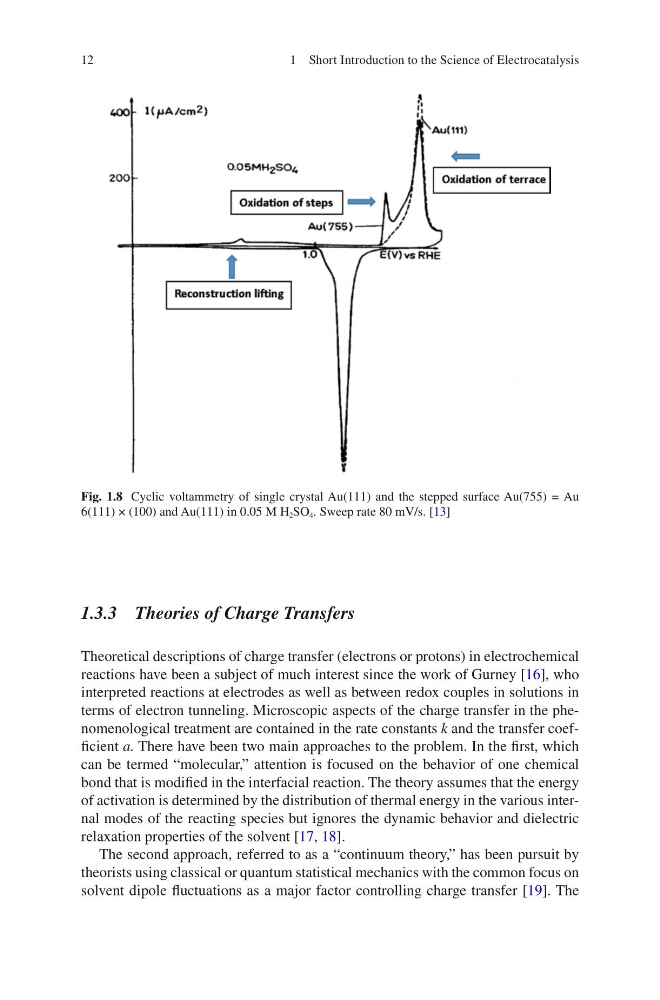
Fig. 1.8 Cyclic voltammetry of single crystal Au(111) and the stepped surface Au(755) = Au
6(111) × (100) and Au(111) in 0.05 M H 2 SO 4 . Sweep rate 80 mV/s. [13]
1 Short Introduction to the Science of Electrocatalysis
1.3.3 Theories of Charge Transfers
Theoretical descriptions of charge transfer (electrons or protons) in electrochemical
reactions have been a subject of much interest since the work of Gurney [16], who
interpreted reactions at electrodes as well as between redox couples in solutions in
terms of electron tunneling. Microscopic aspects of the charge transfer in the phenomenological treatment are contained in the rate constants k and the transfer coefficient a. There have been two main approaches to the problem. In the first, which
can be termed “molecular,” attention is focused on the behavior of one chemical
bond that is modified in the interfacial reaction. The theory assumes that the energy
of activation is determined by the distribution of thermal energy in the various internal modes of the reacting species but ignores the dynamic behavior and dielectric
relaxation properties of the solvent [17, 18].
The second approach, referred to as a “continuum theory,” has been pursuit by
theorists using classical or quantum statistical mechanics with the common focus on
solvent dipole fluctuations as a major factor controlling charge transfer [19]. The
Fig. 1.8 Cyclic voltammetry of single crystal Au(111) and the stepped surface Au(755) = Au
6(111) × (100) and Au(111) in 0.05 M H 2 SO 4 . Sweep rate 80 mV/s. [13]
1 Short Introduction to the Science of Electrocatalysis