

145
very efficient with Au, this problem may be solved. Li et al. [44] recently developed
the PdAuM core-shell-structured nanoparticles, which have PdAu shell and nonnoble core of Ni, Co, or Fe. These nanoparticles show interesting properties such as
lower cost, high stability due to the protection of nonnoble core by the noble metal
shell, as well as the enhancing performance of the oxygen reduction reaction (ORR).
Such nanoparticles were used as substrates for Pt ML . As seen from anodic polarization curves (Fig. 8.34a), all three Pt ML /PdAuM/C provided much higher activity for
methanol oxidation compared to Pt/C. In addition, Pt ML /PdAuCo/C and Pt ML /
PdAuFe/C delivered over three times higher peak current densities. At 0.7 V vs
RHE, Pt ML /PdAuFe/C delivered three times of Pt area specific activity and six times
of Pt mass specific activity, compared to Pt/C. These catalysts can be further
improved by the addition of co-catalysts such as Ru and fine-tuning the structure
and composition of PdAuM.
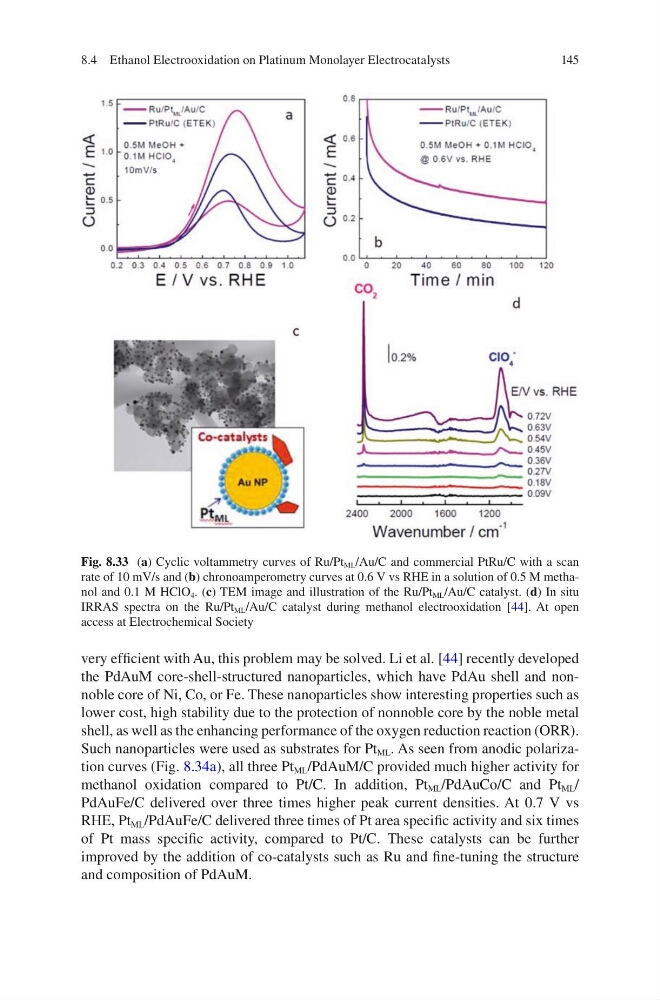
Fig. 8.33 (a) Cyclic voltammetry curves of Ru/Pt ML /Au/C and commercial PtRu/C with a scan
rate of 10 mV/s and (b) chronoamperometry curves at 0.6 V vs RHE in a solution of 0.5 M methanol and 0.1 M HClO 4 . (c) TEM image and illustration of the Ru/Pt ML /Au/C catalyst. (d) In situ
IRRAS spectra on the Ru/Pt ML /Au/C catalyst during methanol electrooxidation [44]. At open
access at Electrochemical Society
8.4 Ethanol Electrooxidation on Platinum Monolayer Electrocatalysts
very efficient with Au, this problem may be solved. Li et al. [44] recently developed
the PdAuM core-shell-structured nanoparticles, which have PdAu shell and nonnoble core of Ni, Co, or Fe. These nanoparticles show interesting properties such as
lower cost, high stability due to the protection of nonnoble core by the noble metal
shell, as well as the enhancing performance of the oxygen reduction reaction (ORR).
Such nanoparticles were used as substrates for Pt ML . As seen from anodic polarization curves (Fig. 8.34a), all three Pt ML /PdAuM/C provided much higher activity for
methanol oxidation compared to Pt/C. In addition, Pt ML /PdAuCo/C and Pt ML /
PdAuFe/C delivered over three times higher peak current densities. At 0.7 V vs
RHE, Pt ML /PdAuFe/C delivered three times of Pt area specific activity and six times
of Pt mass specific activity, compared to Pt/C. These catalysts can be further
improved by the addition of co-catalysts such as Ru and fine-tuning the structure
and composition of PdAuM.
Fig. 8.33 (a) Cyclic voltammetry curves of Ru/Pt ML /Au/C and commercial PtRu/C with a scan
rate of 10 mV/s and (b) chronoamperometry curves at 0.6 V vs RHE in a solution of 0.5 M methanol and 0.1 M HClO 4 . (c) TEM image and illustration of the Ru/Pt ML /Au/C catalyst. (d) In situ
IRRAS spectra on the Ru/Pt ML /Au/C catalyst during methanol electrooxidation [44]. At open
access at Electrochemical Society
8.4 Ethanol Electrooxidation on Platinum Monolayer Electrocatalysts