

144
8.4.1 Oxidation of Methanol and Ethanol on Modified Pt
Monolayer Electrocatalysts Surfaces
Further improving the activity, especially in the low overpotential region of Pt ML
during oxidation of small organic molecules may be obtained by the modification of
the platinum monolayer by the addition of another component. Pt ML was first deposited on the carbon-supported Au nanoparticles, and then Ru nanoclusters were
deposited on the Pt ML to serve as a co-catalyst (see insert in Fig. 8.33c). As discussed
above, Ru can activate water and provide OH, which is essential for removing
adsorbed CO at a much lower potential compared to that on Pt. As shown in
Fig. 8.33a, the resulting Ru/Pt ML /Au/C showed a better activity compared to the
state-of-the-art PtRu/C catalyst. At 0.6 V vs RHE, the Ru/Pt ML /Au/C delivered
almost double of the MOR current on PtRu/C after 2 h of reaction [44].
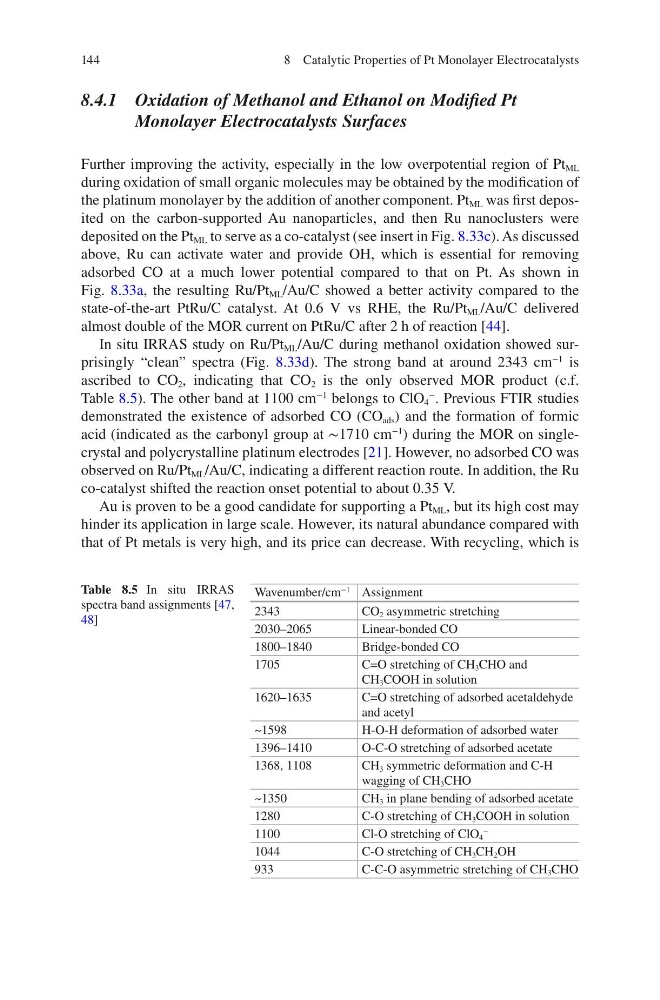
In situ IRRAS study on Ru/Pt ML /Au/C during methanol oxidation showed surprisingly “clean” spectra (Fig. 8.33d). The strong band at around 2343 cm
−1
is
ascribed to CO 2 , indicating that CO 2 is the only observed MOR product (c.f.
Table 8.5). The other band at 1100 cm
−1
belongs to ClO 4
−
. Previous FTIR studies
demonstrated the existence of adsorbed CO (CO ads ) and the formation of formic
acid (indicated as the carbonyl group at ∼1710 cm
−1
) during the MOR on singlecrystal and polycrystalline platinum electrodes [21]. However, no adsorbed CO was
observed on Ru/Pt ML /Au/C, indicating a different reaction route. In addition, the Ru
co-catalyst shifted the reaction onset potential to about 0.35 V.
Au is proven to be a good candidate for supporting a Pt ML , but its high cost may
hinder its application in large scale. However, its natural abundance compared with
that of Pt metals is very high, and its price can decrease. With recycling, which is
Table 8.5 In situ IRRAS
spectra band assignments [47,
48]
Wavenumber/cm
−1
Assignment
2343
CO 2 asymmetric stretching
2030–2065
Linear-bonded CO
1800–1840
Bridge-bonded CO
1705
C=O stretching of CH 3 CHO and
CH 3 COOH in solution
1620–1635
C=O stretching of adsorbed acetaldehyde
and acetyl
~1598
H-O-H deformation of adsorbed water
1396–1410
O-C-O stretching of adsorbed acetate
1368, 1108
CH 3 symmetric deformation and C-H
wagging of CH 3 CHO
~1350
CH 3 in plane bending of adsorbed acetate
1280
C-O stretching of CH 3 COOH in solution
1100
Cl-O stretching of ClO 4
−
1044
C-O stretching of CH 3 CH 2 OH
933
C-C-O asymmetric stretching of CH 3 CHO
8 Catalytic Properties of Pt Monolayer Electrocatalysts
8.4.1 Oxidation of Methanol and Ethanol on Modified Pt
Monolayer Electrocatalysts Surfaces
Further improving the activity, especially in the low overpotential region of Pt ML
during oxidation of small organic molecules may be obtained by the modification of
the platinum monolayer by the addition of another component. Pt ML was first deposited on the carbon-supported Au nanoparticles, and then Ru nanoclusters were
deposited on the Pt ML to serve as a co-catalyst (see insert in Fig. 8.33c). As discussed
above, Ru can activate water and provide OH, which is essential for removing
adsorbed CO at a much lower potential compared to that on Pt. As shown in
Fig. 8.33a, the resulting Ru/Pt ML /Au/C showed a better activity compared to the
state-of-the-art PtRu/C catalyst. At 0.6 V vs RHE, the Ru/Pt ML /Au/C delivered
almost double of the MOR current on PtRu/C after 2 h of reaction [44].
In situ IRRAS study on Ru/Pt ML /Au/C during methanol oxidation showed surprisingly “clean” spectra (Fig. 8.33d). The strong band at around 2343 cm
−1
is
ascribed to CO 2 , indicating that CO 2 is the only observed MOR product (c.f.
Table 8.5). The other band at 1100 cm
−1
belongs to ClO 4
−
. Previous FTIR studies
demonstrated the existence of adsorbed CO (CO ads ) and the formation of formic
acid (indicated as the carbonyl group at ∼1710 cm
−1
) during the MOR on singlecrystal and polycrystalline platinum electrodes [21]. However, no adsorbed CO was
observed on Ru/Pt ML /Au/C, indicating a different reaction route. In addition, the Ru
co-catalyst shifted the reaction onset potential to about 0.35 V.
Au is proven to be a good candidate for supporting a Pt ML , but its high cost may
hinder its application in large scale. However, its natural abundance compared with
that of Pt metals is very high, and its price can decrease. With recycling, which is
Table 8.5 In situ IRRAS
spectra band assignments [47,
48]
Wavenumber/cm
−1
Assignment
2343
CO 2 asymmetric stretching
2030–2065
Linear-bonded CO
1800–1840
Bridge-bonded CO
1705
C=O stretching of CH 3 CHO and
CH 3 COOH in solution
1620–1635
C=O stretching of adsorbed acetaldehyde
and acetyl
~1598
H-O-H deformation of adsorbed water
1396–1410
O-C-O stretching of adsorbed acetate
1368, 1108
CH 3 symmetric deformation and C-H
wagging of CH 3 CHO
~1350
CH 3 in plane bending of adsorbed acetate
1280
C-O stretching of CH 3 COOH in solution
1100
Cl-O stretching of ClO 4
−
1044
C-O stretching of CH 3 CH 2 OH
933
C-C-O asymmetric stretching of CH 3 CHO
8 Catalytic Properties of Pt Monolayer Electrocatalysts