

146
8.4.2 Subsurface Modification of Cores
This approach introduces a second metal to the subsurface of Pd core and thus generates a Pd-interlayer which alters both the electronic and geometric properties of
the core and also affects the catalytic activity of the Pt monolayer. Ir under the Pd
surface serves to influence the Pt-Pd interaction in order to improve the ORR activity of the already-established highly active Pt ML Pd/C [19]. Also, since Ir has a much
higher dissolution potential than Pd (1.16 V for Ir and 0.99 V for Pd) [49], the addition of subsurface Ir can enhance Pd stability under fuel cell operating conditions.
Figure 8.35 depicts the process of introducing Ir to the subsurface of Pd core for Pt
monolayer. In brief, an Ir layer was first placed on Pd/C via the Cu UPD method and
then was subsequently annealed at elevated temperatures to enable a thin layer of Pd
to segregate to the surface. After that, a Pt monolayer was deposited via the Cu
UPD. The Ir loading in IrPd/C is estimated to be 4.1 wt%, and there is 11wt% of Ir
in IrPd.
In Fig. 8.35a, the voltammetry curve of Pt ML PdIr/C (red line) is compared to
Pt ML Pd/C (blue line) and Pt/C (black line) in deaerated 0.1 M HClO 4 , while
Fig. 8.35b illustrates a set of polarization curves for the ORR on the same samples
with the addition of the nonannealed sample (Pt ML /IrPd/C, green line) at 1600 rpm
in oxygenated 0.1 M HClO 4 [19]. From the above CVs, the segregated Pd surface
layer on PdIr nanoparticles exhibits different electrochemical behavior compared to
that of Pd/C electrodes. The influence of Ir is revealed in the oxidation region. The
oxidation of Pt ML on PdIr/C is delayed compared to that of Pt ML /Pd/C and Pt/C. This
is in qualitative agreement with DFT calculations predicting weaker Pd–O interaction on Pd/Ir(111) than on Pd(111) [19]. As shown in Fig. 8.35b, Pt ML PdIr/C has
higher ORR activity than Pt/C and Pt ML Pd/C even though it has a smaller surface
area. The Pt-specific activity for Pt ML PdIr/C is three times and 25% higher than that
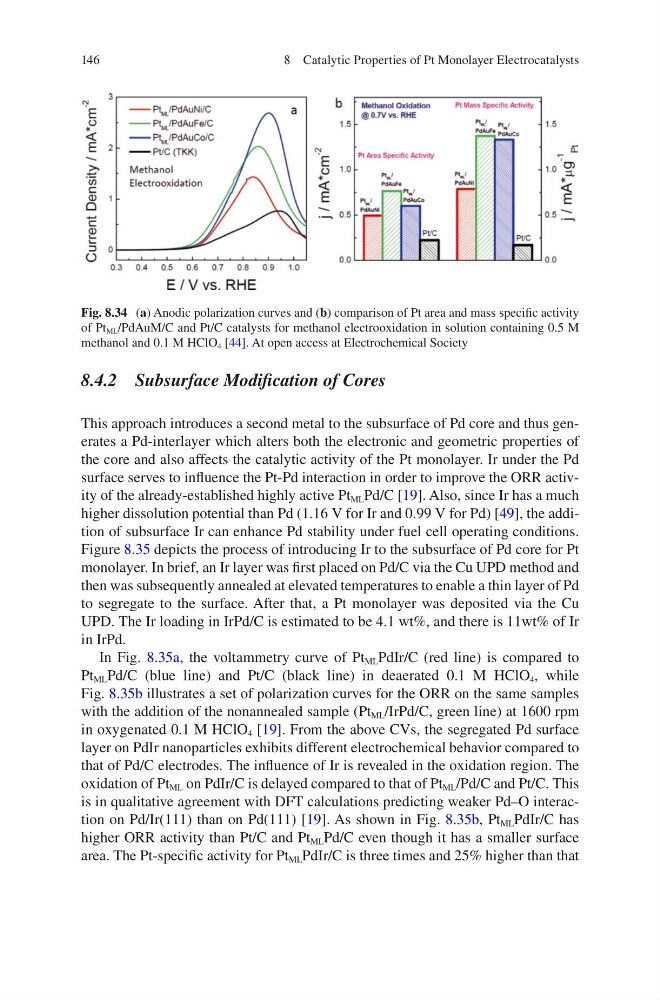
Fig. 8.34 (a) Anodic polarization curves and (b) comparison of Pt area and mass specific activity
of Pt ML /PdAuM/C and Pt/C catalysts for methanol electrooxidation in solution containing 0.5 M
methanol and 0.1 M HClO 4 [44]. At open access at Electrochemical Society
8 Catalytic Properties of Pt Monolayer Electrocatalysts
8.4.2 Subsurface Modification of Cores
This approach introduces a second metal to the subsurface of Pd core and thus generates a Pd-interlayer which alters both the electronic and geometric properties of
the core and also affects the catalytic activity of the Pt monolayer. Ir under the Pd
surface serves to influence the Pt-Pd interaction in order to improve the ORR activity of the already-established highly active Pt ML Pd/C [19]. Also, since Ir has a much
higher dissolution potential than Pd (1.16 V for Ir and 0.99 V for Pd) [49], the addition of subsurface Ir can enhance Pd stability under fuel cell operating conditions.
Figure 8.35 depicts the process of introducing Ir to the subsurface of Pd core for Pt
monolayer. In brief, an Ir layer was first placed on Pd/C via the Cu UPD method and
then was subsequently annealed at elevated temperatures to enable a thin layer of Pd
to segregate to the surface. After that, a Pt monolayer was deposited via the Cu
UPD. The Ir loading in IrPd/C is estimated to be 4.1 wt%, and there is 11wt% of Ir
in IrPd.
In Fig. 8.35a, the voltammetry curve of Pt ML PdIr/C (red line) is compared to
Pt ML Pd/C (blue line) and Pt/C (black line) in deaerated 0.1 M HClO 4 , while
Fig. 8.35b illustrates a set of polarization curves for the ORR on the same samples
with the addition of the nonannealed sample (Pt ML /IrPd/C, green line) at 1600 rpm
in oxygenated 0.1 M HClO 4 [19]. From the above CVs, the segregated Pd surface
layer on PdIr nanoparticles exhibits different electrochemical behavior compared to
that of Pd/C electrodes. The influence of Ir is revealed in the oxidation region. The
oxidation of Pt ML on PdIr/C is delayed compared to that of Pt ML /Pd/C and Pt/C. This
is in qualitative agreement with DFT calculations predicting weaker Pd–O interaction on Pd/Ir(111) than on Pd(111) [19]. As shown in Fig. 8.35b, Pt ML PdIr/C has
higher ORR activity than Pt/C and Pt ML Pd/C even though it has a smaller surface
area. The Pt-specific activity for Pt ML PdIr/C is three times and 25% higher than that
Fig. 8.34 (a) Anodic polarization curves and (b) comparison of Pt area and mass specific activity
of Pt ML /PdAuM/C and Pt/C catalysts for methanol electrooxidation in solution containing 0.5 M
methanol and 0.1 M HClO 4 [44]. At open access at Electrochemical Society
8 Catalytic Properties of Pt Monolayer Electrocatalysts