

140
yield and uniformity of products allow for the octahedral NCs self-assembling into
ordered and well-packed two-dimensional structure [44].
Cyclic voltammogram in 0.1 M HClO 4 and Cu UPD curves of Au octahedra (not
shown here) also resembled the features of Au(111) and indicated that the exposed
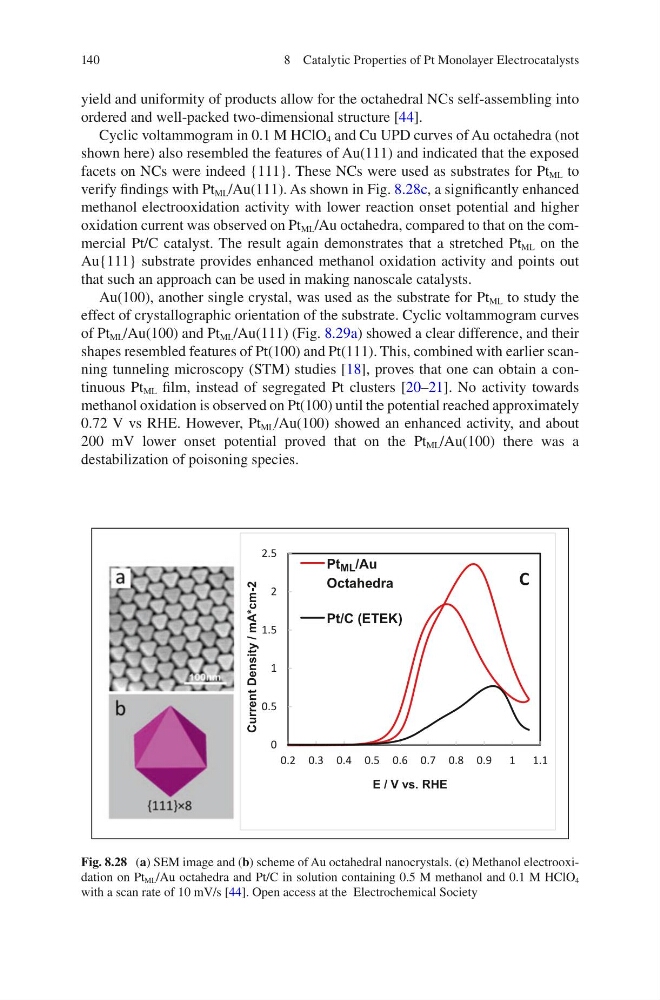
facets on NCs were indeed {111}. These NCs were used as substrates for Pt ML to
verify findings with Pt ML /Au(111). As shown in Fig. 8.28c, a significantly enhanced
methanol electrooxidation activity with lower reaction onset potential and higher
oxidation current was observed on Pt ML /Au octahedra, compared to that on the commercial Pt/C catalyst. The result again demonstrates that a stretched Pt ML on the
Au{111} substrate provides enhanced methanol oxidation activity and points out
that such an approach can be used in making nanoscale catalysts.
Au(100), another single crystal, was used as the substrate for Pt ML to study the
effect of crystallographic orientation of the substrate. Cyclic voltammogram curves
of Pt ML /Au(100) and Pt ML /Au(111) (Fig. 8.29a) showed a clear difference, and their
shapes resembled features of Pt(100) and Pt(111). This, combined with earlier scanning tunneling microscopy (STM) studies [18], proves that one can obtain a continuous Pt ML film, instead of segregated Pt clusters [20–21]. No activity towards
methanol oxidation is observed on Pt(100) until the potential reached approximately
0.72 V vs RHE. However, Pt ML /Au(100) showed an enhanced activity, and about
200 mV lower onset potential proved that on the Pt ML /Au(100) there was a
destabilization of poisoning species.
0
0.5
1
1.5
2
2.5
0.2 0.3 0.4 0.5 0.6 0.7 0.8 0.9 1 1.1
Current Density / mA*cm-2
E / V vs. RHE
C
Pt ML /Au
Octahedra
Pt/C (ETEK)
Fig. 8.28 (a) SEM image and (b) scheme of Au octahedral nanocrystals. (c) Methanol electrooxidation on Pt ML /Au octahedra and Pt/C in solution containing 0.5 M methanol and 0.1 M HClO 4
with a scan rate of 10 mV/s [44]. Open access at the Electrochemical Society
8 Catalytic Properties of Pt Monolayer Electrocatalysts
yield and uniformity of products allow for the octahedral NCs self-assembling into
ordered and well-packed two-dimensional structure [44].
Cyclic voltammogram in 0.1 M HClO 4 and Cu UPD curves of Au octahedra (not
shown here) also resembled the features of Au(111) and indicated that the exposed
facets on NCs were indeed {111}. These NCs were used as substrates for Pt ML to
verify findings with Pt ML /Au(111). As shown in Fig. 8.28c, a significantly enhanced
methanol electrooxidation activity with lower reaction onset potential and higher
oxidation current was observed on Pt ML /Au octahedra, compared to that on the commercial Pt/C catalyst. The result again demonstrates that a stretched Pt ML on the
Au{111} substrate provides enhanced methanol oxidation activity and points out
that such an approach can be used in making nanoscale catalysts.
Au(100), another single crystal, was used as the substrate for Pt ML to study the
effect of crystallographic orientation of the substrate. Cyclic voltammogram curves
of Pt ML /Au(100) and Pt ML /Au(111) (Fig. 8.29a) showed a clear difference, and their
shapes resembled features of Pt(100) and Pt(111). This, combined with earlier scanning tunneling microscopy (STM) studies [18], proves that one can obtain a continuous Pt ML film, instead of segregated Pt clusters [20–21]. No activity towards
methanol oxidation is observed on Pt(100) until the potential reached approximately
0.72 V vs RHE. However, Pt ML /Au(100) showed an enhanced activity, and about
200 mV lower onset potential proved that on the Pt ML /Au(100) there was a
destabilization of poisoning species.
0
0.5
1
1.5
2
2.5
0.2 0.3 0.4 0.5 0.6 0.7 0.8 0.9 1 1.1
Current Density / mA*cm-2
E / V vs. RHE
C
Pt ML /Au
Octahedra
Pt/C (ETEK)
Fig. 8.28 (a) SEM image and (b) scheme of Au octahedral nanocrystals. (c) Methanol electrooxidation on Pt ML /Au octahedra and Pt/C in solution containing 0.5 M methanol and 0.1 M HClO 4
with a scan rate of 10 mV/s [44]. Open access at the Electrochemical Society
8 Catalytic Properties of Pt Monolayer Electrocatalysts