

139
sters were deposited on Pt ML /Au/C by galvanic displacement of a partial Cu UPD
monolayer.
Nanostructured catalysts were examined by scanning electron microscopy
(SEM) and transmission electron microscopy (TEM). Selected area electron
diffraction (SAED) was carried out on the Au octahedra NCs (see more details in
Ref. 15).
Cyclic voltammetry of Pt ML /Au and Pt ML (100) in 0.05 M H 2 SO 4 and methanol
electrooxidation in solution containing 0.5 M methanol and 0.1 M HClO 4 were
carried out at room temperature to determine specific current density by normalizing
the current with the electrochemical active surface area (ECSA). The latter was
determined by the charge of stripping one Cu UPD monolayer on Pt ML (assuming
480 μC/cm
2
) (substrate-induced strain) and ligand effect (the electronic interaction
between Pt ML and the substrate). These findings can be applied in designing practical nanoparticle catalysts.
The effectiveness of stretching Pt ML was probed by using Au octahedra NCs
enclosed with Au{111} facets and an Au(100) single crystal as substrates for
Pt ML . Then two classes of nanostructured catalysts that hold potential for practical
application in DMFCs were synthesized. In one nanocatalyst, a co-catalyst approach
was used and Ru nanoclusters were deposited on Pt ML /Au/C, resulting in the Ru/
Pt ML /Au/C catalyst. In the other class of nanocatalysts, core-shell-structured PdAuM
(M = Co, Fe, Ni) nanoparticles served as substrates for Pt ML , and an enhancement in
activity and reduction in cost were successfully achieved.
As shown in Fig. 8.28a, b, the obtained NCs are single-crystal Au octahedra
enclosed with Au{111} facets and have an edge length of about 35 nm [15]. High
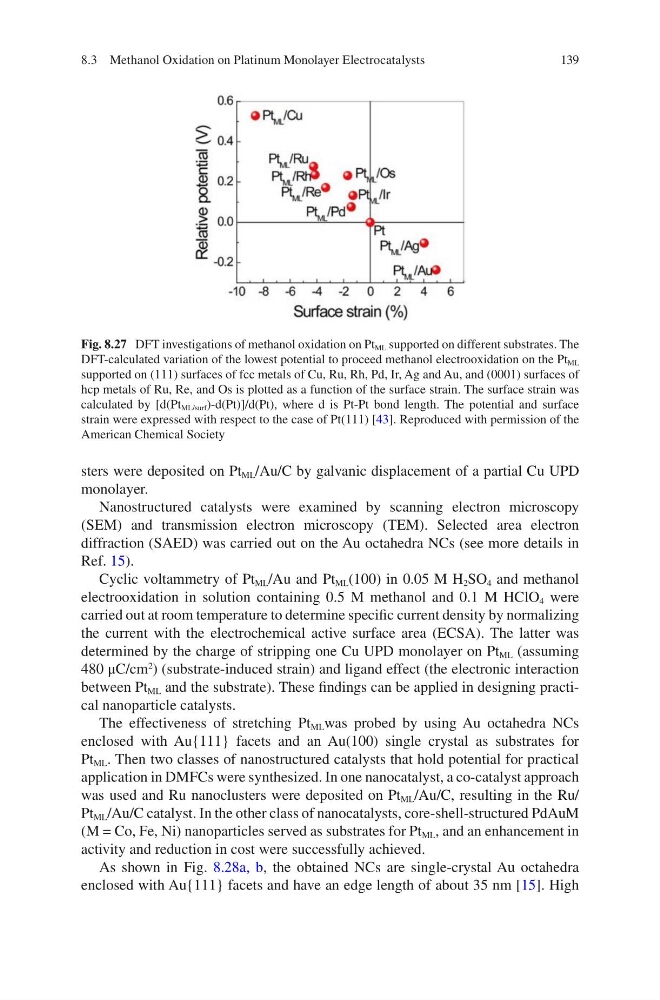
Fig. 8.27 DFT investigations of methanol oxidation on Pt ML supported on different substrates. The
DFT-calculated variation of the lowest potential to proceed methanol electrooxidation on the Pt ML
supported on (111) surfaces of fcc metals of Cu, Ru, Rh, Pd, Ir, Ag and Au, and (0001) surfaces of
hcp metals of Ru, Re, and Os is plotted as a function of the surface strain. The surface strain was
calculated by [d(Pt ML/surf )-d(Pt)]/d(Pt), where d is Pt-Pt bond length. The potential and surface
strain were expressed with respect to the case of Pt(111) [43]. Reproduced with permission of the
American Chemical Society
8.3 Methanol Oxidation on Platinum Monolayer Electrocatalysts
sters were deposited on Pt ML /Au/C by galvanic displacement of a partial Cu UPD
monolayer.
Nanostructured catalysts were examined by scanning electron microscopy
(SEM) and transmission electron microscopy (TEM). Selected area electron
diffraction (SAED) was carried out on the Au octahedra NCs (see more details in
Ref. 15).
Cyclic voltammetry of Pt ML /Au and Pt ML (100) in 0.05 M H 2 SO 4 and methanol
electrooxidation in solution containing 0.5 M methanol and 0.1 M HClO 4 were
carried out at room temperature to determine specific current density by normalizing
the current with the electrochemical active surface area (ECSA). The latter was
determined by the charge of stripping one Cu UPD monolayer on Pt ML (assuming
480 μC/cm
2
) (substrate-induced strain) and ligand effect (the electronic interaction
between Pt ML and the substrate). These findings can be applied in designing practical nanoparticle catalysts.
The effectiveness of stretching Pt ML was probed by using Au octahedra NCs
enclosed with Au{111} facets and an Au(100) single crystal as substrates for
Pt ML . Then two classes of nanostructured catalysts that hold potential for practical
application in DMFCs were synthesized. In one nanocatalyst, a co-catalyst approach
was used and Ru nanoclusters were deposited on Pt ML /Au/C, resulting in the Ru/
Pt ML /Au/C catalyst. In the other class of nanocatalysts, core-shell-structured PdAuM
(M = Co, Fe, Ni) nanoparticles served as substrates for Pt ML , and an enhancement in
activity and reduction in cost were successfully achieved.
As shown in Fig. 8.28a, b, the obtained NCs are single-crystal Au octahedra
enclosed with Au{111} facets and have an edge length of about 35 nm [15]. High
Fig. 8.27 DFT investigations of methanol oxidation on Pt ML supported on different substrates. The
DFT-calculated variation of the lowest potential to proceed methanol electrooxidation on the Pt ML
supported on (111) surfaces of fcc metals of Cu, Ru, Rh, Pd, Ir, Ag and Au, and (0001) surfaces of
hcp metals of Ru, Re, and Os is plotted as a function of the surface strain. The surface strain was
calculated by [d(Pt ML/surf )-d(Pt)]/d(Pt), where d is Pt-Pt bond length. The potential and surface
strain were expressed with respect to the case of Pt(111) [43]. Reproduced with permission of the
American Chemical Society
8.3 Methanol Oxidation on Platinum Monolayer Electrocatalysts