

141
8.4 Ethanol Electrooxidation on Platinum Monolayer
Electrocatalysts
Li et al. reported particularly exciting results with ethanol oxidation to CO 2 on a Pt
monolayer under tensile strain [43]. This example showed the role of the substrate
lattice on the catalytic properties of Pt ML , which is enhanced when Pt ML is under
tensile strain on Au(111) electrode and decreased when the Pt monolayer is compressed as on (111) electrodes of Pd, Ir, Rh, and Ru (Fig. 8.30). Similar enhancement of methanol oxidation is described in Sect. 8.3. These Pt ML electrocatalysts can
also be synthesized by depositing a Pt monolayer on different substrates via the
galvanic displacement of a UPD Cu monolayer.
Scanning tunneling microscopy (STM) study of the resulting Pt ML /Ru(1010) surface revealed that Pt was deposited as a small three-dimensional (3D) island on Ru
[17]. In some other Pt-M binary systems, for instance Pt on Pd, a pseudomorphic
monolayer of Pt was formed by the displacement of a Cu UPD layer.
For example, a Pt ML /Au(111) surface, where Au exerts on Pt a tensile strain, and
a Pt ML /Pd(111) surface, where Pt is under compressive strain, a significant enhancement in the catalytic activity associated with the tensile strain, and decreased activity associates with the compressive strain, during the ethanol oxidation, the stretched
10
0
–10
–20
30 0
0.2
0.4
0.6
0.2
0.4
0.6
0.6
1
0.
E / V vs. RHE
E / V vs. RHE
Pt ML /Au(100)
Pt ML /Au(100)
Pt ML /Au(111)
Current / µA
Current Density /
mA* cm –2
5
4
3
2
1
0
(a)
(b)
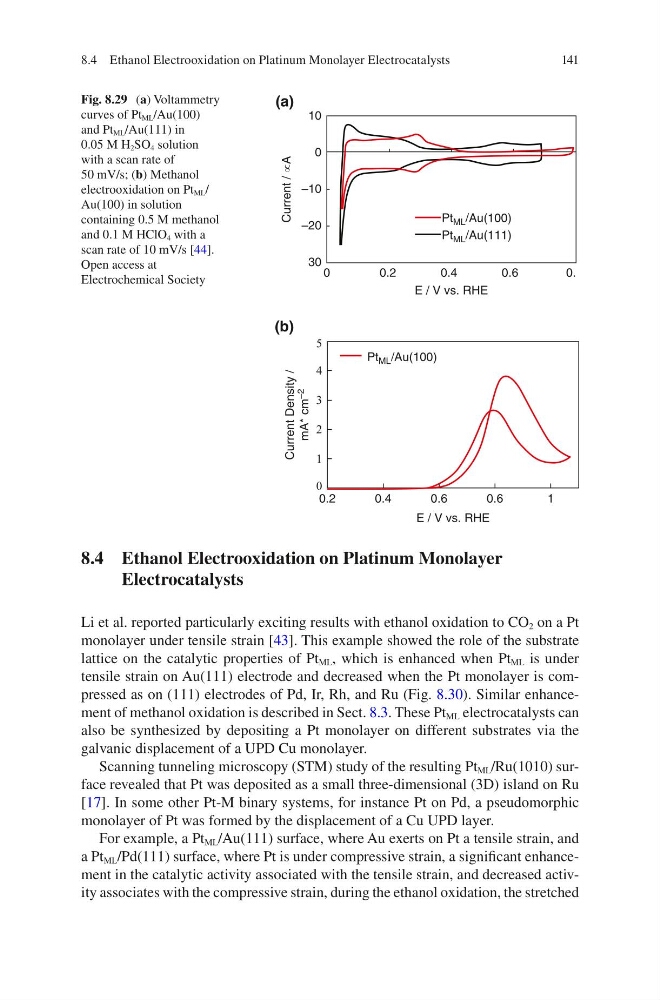
Fig. 8.29 (a) Voltammetry
curves of Pt ML /Au(100)
and Pt ML /Au(111) in
0.05 M H 2 SO 4 solution
with a scan rate of
50 mV/s; (b) Methanol
electrooxidation on Pt ML /
Au(100) in solution
containing 0.5 M methanol
and 0.1 M HClO 4 with a
scan rate of 10 mV/s [44].
Open access at
Electrochemical Society
8.4 Ethanol Electrooxidation on Platinum Monolayer Electrocatalysts
8.4 Ethanol Electrooxidation on Platinum Monolayer
Electrocatalysts
Li et al. reported particularly exciting results with ethanol oxidation to CO 2 on a Pt
monolayer under tensile strain [43]. This example showed the role of the substrate
lattice on the catalytic properties of Pt ML , which is enhanced when Pt ML is under
tensile strain on Au(111) electrode and decreased when the Pt monolayer is compressed as on (111) electrodes of Pd, Ir, Rh, and Ru (Fig. 8.30). Similar enhancement of methanol oxidation is described in Sect. 8.3. These Pt ML electrocatalysts can
also be synthesized by depositing a Pt monolayer on different substrates via the
galvanic displacement of a UPD Cu monolayer.
Scanning tunneling microscopy (STM) study of the resulting Pt ML /Ru(1010) surface revealed that Pt was deposited as a small three-dimensional (3D) island on Ru
[17]. In some other Pt-M binary systems, for instance Pt on Pd, a pseudomorphic
monolayer of Pt was formed by the displacement of a Cu UPD layer.
For example, a Pt ML /Au(111) surface, where Au exerts on Pt a tensile strain, and
a Pt ML /Pd(111) surface, where Pt is under compressive strain, a significant enhancement in the catalytic activity associated with the tensile strain, and decreased activity associates with the compressive strain, during the ethanol oxidation, the stretched
10
0
–10
–20
30 0
0.2
0.4
0.6
0.2
0.4
0.6
0.6
1
0.
E / V vs. RHE
E / V vs. RHE
Pt ML /Au(100)
Pt ML /Au(100)
Pt ML /Au(111)
Current / µA
Current Density /
mA* cm –2
5
4
3
2
1
0
(a)
(b)
Fig. 8.29 (a) Voltammetry
curves of Pt ML /Au(100)
and Pt ML /Au(111) in
0.05 M H 2 SO 4 solution
with a scan rate of
50 mV/s; (b) Methanol
electrooxidation on Pt ML /
Au(100) in solution
containing 0.5 M methanol
and 0.1 M HClO 4 with a
scan rate of 10 mV/s [44].
Open access at
Electrochemical Society
8.4 Ethanol Electrooxidation on Platinum Monolayer Electrocatalysts