

128
8.1.5 Modified Alloy Surfaces as Support for Pt Monolayers
The fine-tuning of the Pt monolayer-support interaction can be applied to alloy supports. There exists the great potential for designing electrocatalysts with alloy
nanoparticles used as cores for Pt monolayer catalysts. An annealed Pd 3 Fe(111)
single-crystal alloy support has a segregated Pd layer that was verified using lowenergy ion scattering and low-energy electron diffraction techniques. This segregated
Pd layer, with the same structure as Pd (111), is formed on the surface of hightemperature- annealed Pd 3 Fe(111). It has somewhat different electronic properties
(i.e. −0.25 eV downshift of the d-band center compared to Pt(111)), and it is considerably more active than Pd(111); its ORR kinetics are comparable to those of a
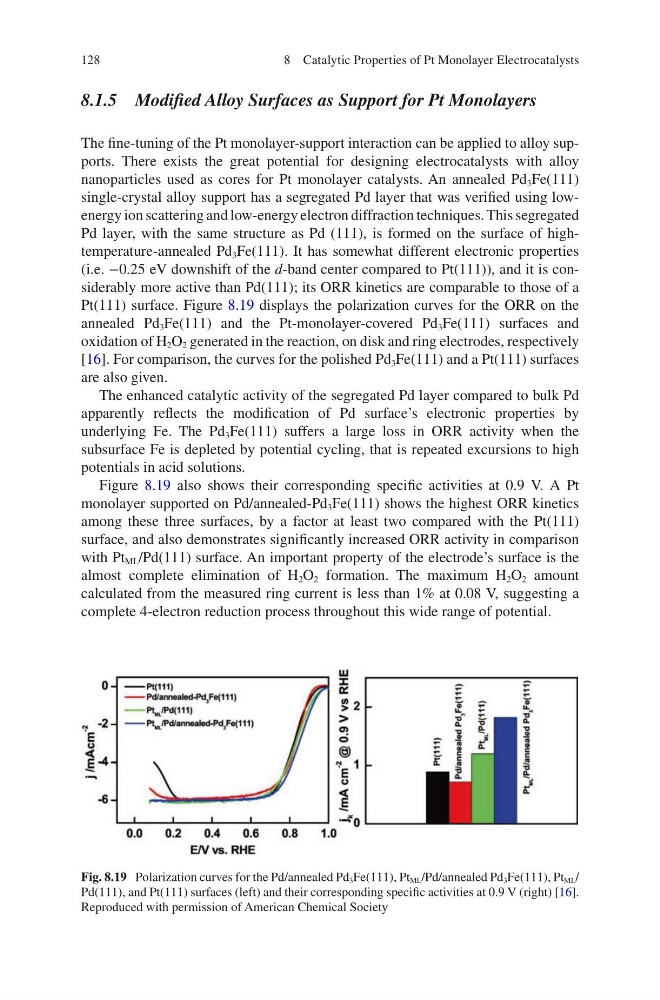
Pt(111) surface. Figure 8.19 displays the polarization curves for the ORR on the
annealed Pd 3 Fe(111) and the Pt-monolayer-covered Pd 3 Fe(111) surfaces and
oxidation of H 2 O 2 generated in the reaction, on disk and ring electrodes, respectively
[16]. For comparison, the curves for the polished Pd 3 Fe(111) and a Pt(111) surfaces
are also given.
The enhanced catalytic activity of the segregated Pd layer compared to bulk Pd
apparently reflects the modification of Pd surface’s electronic properties by
underlying Fe. The Pd 3 Fe(111) suffers a large loss in ORR activity when the
subsurface Fe is depleted by potential cycling, that is repeated excursions to high
potentials in acid solutions.
Figure 8.19 also shows their corresponding specific activities at 0.9 V. A Pt
monolayer supported on Pd/annealed-Pd 3 Fe(111) shows the highest ORR kinetics
among these three surfaces, by a factor at least two compared with the Pt(111)
surface, and also demonstrates significantly increased ORR activity in comparison
with Pt ML /Pd(111) surface. An important property of the electrode’s surface is the
almost complete elimination of H 2 O 2 formation. The maximum H 2 O 2 amount
calculated from the measured ring current is less than 1% at 0.08 V, suggesting a
complete 4-electron reduction process throughout this wide range of potential.
Fig. 8.19 Polarization curves for the Pd/annealed Pd 3 Fe(111), Pt ML /Pd/annealed Pd 3 Fe(111), Pt ML /
Pd(111), and Pt(111) surfaces (left) and their corresponding specific activities at 0.9 V (right) [16].
Reproduced with permission of American Chemical Society
8 Catalytic Properties of Pt Monolayer Electrocatalysts
8.1.5 Modified Alloy Surfaces as Support for Pt Monolayers
The fine-tuning of the Pt monolayer-support interaction can be applied to alloy supports. There exists the great potential for designing electrocatalysts with alloy
nanoparticles used as cores for Pt monolayer catalysts. An annealed Pd 3 Fe(111)
single-crystal alloy support has a segregated Pd layer that was verified using lowenergy ion scattering and low-energy electron diffraction techniques. This segregated
Pd layer, with the same structure as Pd (111), is formed on the surface of hightemperature- annealed Pd 3 Fe(111). It has somewhat different electronic properties
(i.e. −0.25 eV downshift of the d-band center compared to Pt(111)), and it is considerably more active than Pd(111); its ORR kinetics are comparable to those of a
Pt(111) surface. Figure 8.19 displays the polarization curves for the ORR on the
annealed Pd 3 Fe(111) and the Pt-monolayer-covered Pd 3 Fe(111) surfaces and
oxidation of H 2 O 2 generated in the reaction, on disk and ring electrodes, respectively
[16]. For comparison, the curves for the polished Pd 3 Fe(111) and a Pt(111) surfaces
are also given.
The enhanced catalytic activity of the segregated Pd layer compared to bulk Pd
apparently reflects the modification of Pd surface’s electronic properties by
underlying Fe. The Pd 3 Fe(111) suffers a large loss in ORR activity when the
subsurface Fe is depleted by potential cycling, that is repeated excursions to high
potentials in acid solutions.
Figure 8.19 also shows their corresponding specific activities at 0.9 V. A Pt
monolayer supported on Pd/annealed-Pd 3 Fe(111) shows the highest ORR kinetics
among these three surfaces, by a factor at least two compared with the Pt(111)
surface, and also demonstrates significantly increased ORR activity in comparison
with Pt ML /Pd(111) surface. An important property of the electrode’s surface is the
almost complete elimination of H 2 O 2 formation. The maximum H 2 O 2 amount
calculated from the measured ring current is less than 1% at 0.08 V, suggesting a
complete 4-electron reduction process throughout this wide range of potential.
Fig. 8.19 Polarization curves for the Pd/annealed Pd 3 Fe(111), Pt ML /Pd/annealed Pd 3 Fe(111), Pt ML /
Pd(111), and Pt(111) surfaces (left) and their corresponding specific activities at 0.9 V (right) [16].
Reproduced with permission of American Chemical Society
8 Catalytic Properties of Pt Monolayer Electrocatalysts