

129
The high activity of the Pd layer is ascribed to the modification of the Pd surface’s electronic properties by subsurface Fe. This is in agreement with directly
relating the position of the d-band center to adsorption energies according to the
d-band center theory of Norskov and co-workers [6]. DFT studies suggest that the
observed enhancement of ORR activity originates mainly from the destabilization
of OH binding and the decreased Pt-OH coverage on the Pt/Pd/Pd 3 Fe(111) surface.
The activity of Pt ML /Pd(111) and Pt(111) is limited by OH removal, while the activity of Pt ML /Pd/Pd 3 Fe(111) is limited by the O-O bond scission, which places these
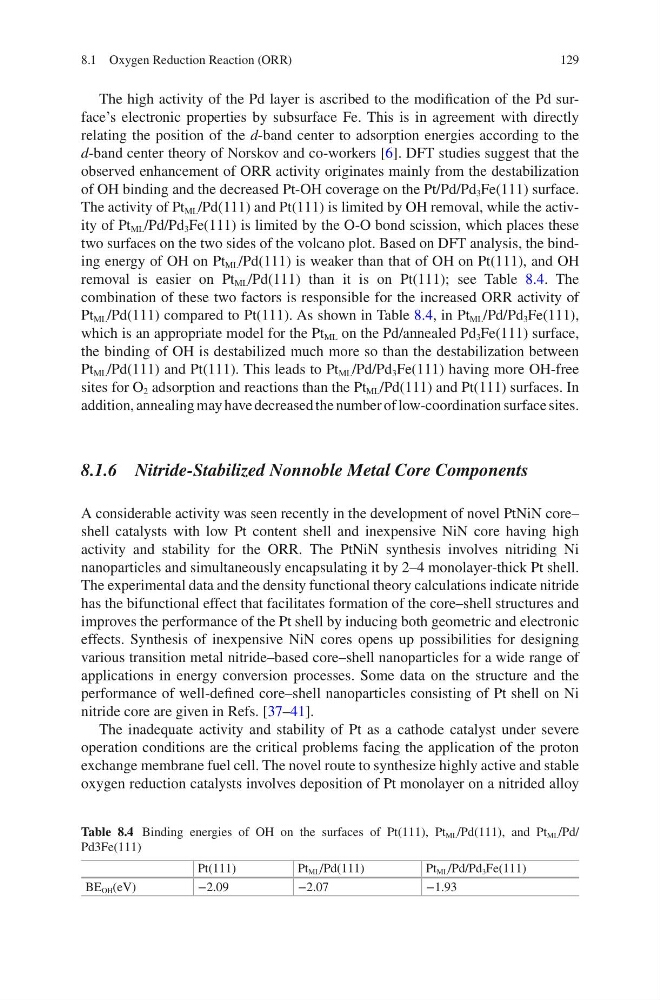
two surfaces on the two sides of the volcano plot. Based on DFT analysis, the binding energy of OH on Pt ML /Pd(111) is weaker than that of OH on Pt(111), and OH
removal is easier on Pt ML /Pd(111) than it is on Pt(111); see Table 8.4. The
combination of these two factors is responsible for the increased ORR activity of
Pt ML /Pd(111) compared to Pt(111). As shown in Table 8.4, in Pt ML /Pd/Pd 3 Fe(111),
which is an appropriate model for the Pt ML on the Pd/annealed Pd 3 Fe(111) surface,
the binding of OH is destabilized much more so than the destabilization between
Pt ML /Pd(111) and Pt(111). This leads to Pt ML /Pd/Pd 3 Fe(111) having more OH-free
sites for O 2 adsorption and reactions than the Pt ML /Pd(111) and Pt(111) surfaces. In
addition, annealing may have decreased the number of low-coordination surface sites.
8.1.6 Nitride-Stabilized Nonnoble Metal Core Components
A considerable activity was seen recently in the development of novel PtNiN core–
shell catalysts with low Pt content shell and inexpensive NiN core having high
activity and stability for the ORR. The PtNiN synthesis involves nitriding Ni
nanoparticles and simultaneously encapsulating it by 2–4 monolayer-thick Pt shell.
The experimental data and the density functional theory calculations indicate nitride
has the bifunctional effect that facilitates formation of the core–shell structures and
improves the performance of the Pt shell by inducing both geometric and electronic
effects. Synthesis of inexpensive NiN cores opens up possibilities for designing
various transition metal nitride–based core–shell nanoparticles for a wide range of
applications in energy conversion processes. Some data on the structure and the
performance of well-defined core–shell nanoparticles consisting of Pt shell on Ni
nitride core are given in Refs. [37–41].
The inadequate activity and stability of Pt as a cathode catalyst under severe
operation conditions are the critical problems facing the application of the proton
exchange membrane fuel cell. The novel route to synthesize highly active and stable
oxygen reduction catalysts involves deposition of Pt monolayer on a nitrided alloy
Table 8.4 Binding energies of OH on the surfaces of Pt(111), Pt ML /Pd(111), and Pt ML /Pd/
Pd3Fe(111)
Pt(111)
Pt ML /Pd(111)
Pt ML /Pd/Pd 3 Fe(111)
BE OH (eV)
−2.09
−2.07
−1.93
8.1 Oxygen Reduction Reaction (ORR)
The high activity of the Pd layer is ascribed to the modification of the Pd surface’s electronic properties by subsurface Fe. This is in agreement with directly
relating the position of the d-band center to adsorption energies according to the
d-band center theory of Norskov and co-workers [6]. DFT studies suggest that the
observed enhancement of ORR activity originates mainly from the destabilization
of OH binding and the decreased Pt-OH coverage on the Pt/Pd/Pd 3 Fe(111) surface.
The activity of Pt ML /Pd(111) and Pt(111) is limited by OH removal, while the activity of Pt ML /Pd/Pd 3 Fe(111) is limited by the O-O bond scission, which places these
two surfaces on the two sides of the volcano plot. Based on DFT analysis, the binding energy of OH on Pt ML /Pd(111) is weaker than that of OH on Pt(111), and OH
removal is easier on Pt ML /Pd(111) than it is on Pt(111); see Table 8.4. The
combination of these two factors is responsible for the increased ORR activity of
Pt ML /Pd(111) compared to Pt(111). As shown in Table 8.4, in Pt ML /Pd/Pd 3 Fe(111),
which is an appropriate model for the Pt ML on the Pd/annealed Pd 3 Fe(111) surface,
the binding of OH is destabilized much more so than the destabilization between
Pt ML /Pd(111) and Pt(111). This leads to Pt ML /Pd/Pd 3 Fe(111) having more OH-free
sites for O 2 adsorption and reactions than the Pt ML /Pd(111) and Pt(111) surfaces. In
addition, annealing may have decreased the number of low-coordination surface sites.
8.1.6 Nitride-Stabilized Nonnoble Metal Core Components
A considerable activity was seen recently in the development of novel PtNiN core–
shell catalysts with low Pt content shell and inexpensive NiN core having high
activity and stability for the ORR. The PtNiN synthesis involves nitriding Ni
nanoparticles and simultaneously encapsulating it by 2–4 monolayer-thick Pt shell.
The experimental data and the density functional theory calculations indicate nitride
has the bifunctional effect that facilitates formation of the core–shell structures and
improves the performance of the Pt shell by inducing both geometric and electronic
effects. Synthesis of inexpensive NiN cores opens up possibilities for designing
various transition metal nitride–based core–shell nanoparticles for a wide range of
applications in energy conversion processes. Some data on the structure and the
performance of well-defined core–shell nanoparticles consisting of Pt shell on Ni
nitride core are given in Refs. [37–41].
The inadequate activity and stability of Pt as a cathode catalyst under severe
operation conditions are the critical problems facing the application of the proton
exchange membrane fuel cell. The novel route to synthesize highly active and stable
oxygen reduction catalysts involves deposition of Pt monolayer on a nitrided alloy
Table 8.4 Binding energies of OH on the surfaces of Pt(111), Pt ML /Pd(111), and Pt ML /Pd/
Pd3Fe(111)
Pt(111)
Pt ML /Pd(111)
Pt ML /Pd/Pd 3 Fe(111)
BE OH (eV)
−2.09
−2.07
−1.93
8.1 Oxygen Reduction Reaction (ORR)