

127
layer are Ru(0001) and Re(0001). Pt monolayer on Re(0001) is compressed by
0.5% compared to Pt(111), while on Ru(0001) the compression is considerably
larger, amounting to 2.5%. The activity of Pt ML on these surfaces with a Pd interlayer is much larger than without it. For Ru(0001), the interlayer partially removes
compressive strain caused by the large lattice constant mismatch between Pt and
Ru. For Re(0001), the strain on a Pt monolayer is small, similar to that caused by Pd
lattice. Thus, an electronic effect seems to be operative in the case of Re. This is
quite feasible, given the low activity of Re(0001) and its position on the volcano
curve. Similar improvements were obtained with nanoparticle electrocatalysts.
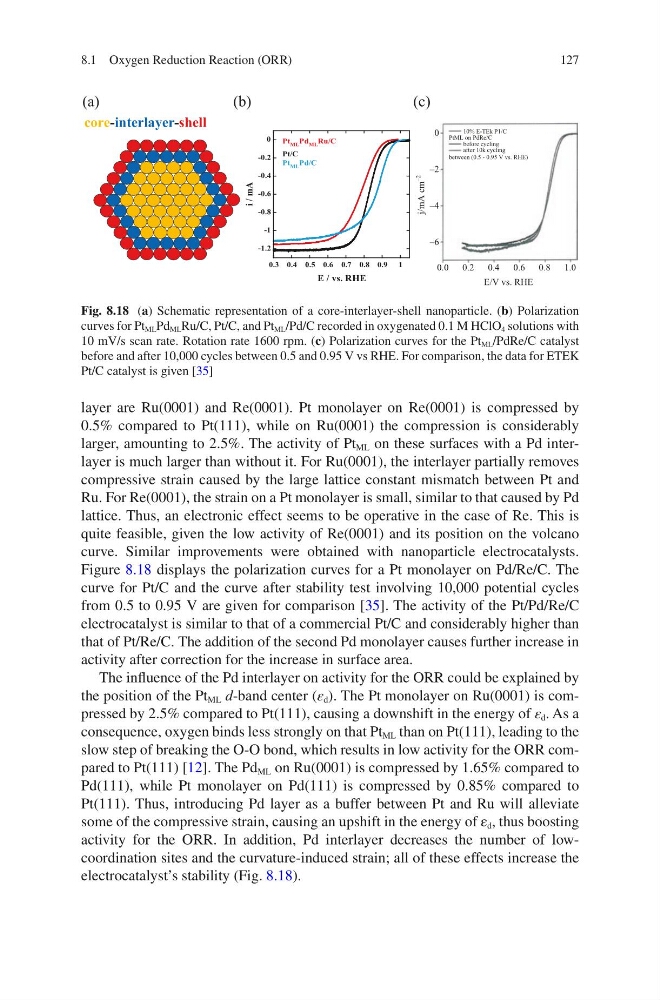
Figure 8.18 displays the polarization curves for a Pt monolayer on Pd/Re/C. The
curve for Pt/C and the curve after stability test involving 10,000 potential cycles
from 0.5 to 0.95 V are given for comparison [35]. The activity of the Pt/Pd/Re/C
electrocatalyst is similar to that of a commercial Pt/C and considerably higher than
that of Pt/Re/C. The addition of the second Pd monolayer causes further increase in
activity after correction for the increase in surface area.
The influence of the Pd interlayer on activity for the ORR could be explained by
the position of the Pt ML d-band center (ε d ). The Pt monolayer on Ru(0001) is compressed by 2.5% compared to Pt(111), causing a downshift in the energy of ε d . As a
consequence, oxygen binds less strongly on that Pt ML than on Pt(111), leading to the
slow step of breaking the O-O bond, which results in low activity for the ORR compared to Pt(111) [12]. The Pd ML on Ru(0001) is compressed by 1.65% compared to
Pd(111), while Pt monolayer on Pd(111) is compressed by 0.85% compared to
Pt(111). Thus, introducing Pd layer as a buffer between Pt and Ru will alleviate
some of the compressive strain, causing an upshift in the energy of ε d , thus boosting
activity for the ORR. In addition, Pd interlayer decreases the number of lowcoordination sites and the curvature-induced strain; all of these effects increase the
electrocatalyst’s stability (Fig. 8.18).
-1.2
-1
-0.8
-0.6
-0.4
-0.2
0
0.3 0.4 0.5 0.6 0.7 0.8 0.9 1
Pt ML Pd ML Ru/C
Pt/C
Pt ML Pd/C
A
m
/
i
E / vs. RHE
core-interlayer-shell
(a)
(b)
(c)
0
–2
10% E-TEk P1/C
before cycling
after 10k cycling
PtML on PdRe/C
between (0.5 - 0.95 V vs. RHE)
–4
j/mA cm
–2
–6
0.0 0.2 0.4
E/V vs. RHE
0.6 0.8 1.0
Fig. 8.18 (a) Schematic representation of a core-interlayer-shell nanoparticle. (b) Polarization
curves for Pt ML Pd ML Ru/C, Pt/C, and Pt ML /Pd/C recorded in oxygenated 0.1 M HClO 4 solutions with
10 mV/s scan rate. Rotation rate 1600 rpm. (c) Polarization curves for the Pt ML /PdRe/C catalyst
before and after 10,000 cycles between 0.5 and 0.95 V vs RHE. For comparison, the data for ETEK
Pt/C catalyst is given [35]
8.1 Oxygen Reduction Reaction (ORR)
layer are Ru(0001) and Re(0001). Pt monolayer on Re(0001) is compressed by
0.5% compared to Pt(111), while on Ru(0001) the compression is considerably
larger, amounting to 2.5%. The activity of Pt ML on these surfaces with a Pd interlayer is much larger than without it. For Ru(0001), the interlayer partially removes
compressive strain caused by the large lattice constant mismatch between Pt and
Ru. For Re(0001), the strain on a Pt monolayer is small, similar to that caused by Pd
lattice. Thus, an electronic effect seems to be operative in the case of Re. This is
quite feasible, given the low activity of Re(0001) and its position on the volcano
curve. Similar improvements were obtained with nanoparticle electrocatalysts.
Figure 8.18 displays the polarization curves for a Pt monolayer on Pd/Re/C. The
curve for Pt/C and the curve after stability test involving 10,000 potential cycles
from 0.5 to 0.95 V are given for comparison [35]. The activity of the Pt/Pd/Re/C
electrocatalyst is similar to that of a commercial Pt/C and considerably higher than
that of Pt/Re/C. The addition of the second Pd monolayer causes further increase in
activity after correction for the increase in surface area.
The influence of the Pd interlayer on activity for the ORR could be explained by
the position of the Pt ML d-band center (ε d ). The Pt monolayer on Ru(0001) is compressed by 2.5% compared to Pt(111), causing a downshift in the energy of ε d . As a
consequence, oxygen binds less strongly on that Pt ML than on Pt(111), leading to the
slow step of breaking the O-O bond, which results in low activity for the ORR compared to Pt(111) [12]. The Pd ML on Ru(0001) is compressed by 1.65% compared to
Pd(111), while Pt monolayer on Pd(111) is compressed by 0.85% compared to
Pt(111). Thus, introducing Pd layer as a buffer between Pt and Ru will alleviate
some of the compressive strain, causing an upshift in the energy of ε d , thus boosting
activity for the ORR. In addition, Pd interlayer decreases the number of lowcoordination sites and the curvature-induced strain; all of these effects increase the
electrocatalyst’s stability (Fig. 8.18).
-1.2
-1
-0.8
-0.6
-0.4
-0.2
0
0.3 0.4 0.5 0.6 0.7 0.8 0.9 1
Pt ML Pd ML Ru/C
Pt/C
Pt ML Pd/C
A
m
/
i
E / vs. RHE
core-interlayer-shell
(a)
(b)
(c)
0
–2
10% E-TEk P1/C
before cycling
after 10k cycling
PtML on PdRe/C
between (0.5 - 0.95 V vs. RHE)
–4
j/mA cm
–2
–6
0.0 0.2 0.4
E/V vs. RHE
0.6 0.8 1.0
Fig. 8.18 (a) Schematic representation of a core-interlayer-shell nanoparticle. (b) Polarization
curves for Pt ML Pd ML Ru/C, Pt/C, and Pt ML /Pd/C recorded in oxygenated 0.1 M HClO 4 solutions with
10 mV/s scan rate. Rotation rate 1600 rpm. (c) Polarization curves for the Pt ML /PdRe/C catalyst
before and after 10,000 cycles between 0.5 and 0.95 V vs RHE. For comparison, the data for ETEK
Pt/C catalyst is given [35]
8.1 Oxygen Reduction Reaction (ORR)