

122
these catalysts of 5000 h, larger Pt particles that can sustain sizeable Pt dissolution
losses are needed. These particles, however, have high price and low Pt mass activity. The electrocatalysts with high activity and very high stability have been developed with new Pd and Pd 9 Au 1 alloy core-Pt monolayer shell (Fig. 8.15). These
electrocatalysts can facilitate their use in automotive fuel cells. Sasaki et al. demonstrated that Pt ML on Pd nanoparticle a core-shell catalyst has better activity and
durability than standard Pt on carbon support catalyst [33].
The Pd 9 Au 1 alloy core-Pt monolayer shell electrocatalysts have even better activity and better stability such that they can facilitate their use in automotive fuel cells.
Pt monolayer catalysts with such properties can address the future challenges of
limited Pt resources [11]. The number and variety of alloys that can be suitable
cores is unlimited, as it can be inferred from Sect. 8.1.3. Here two important alloys
are described in some detail.
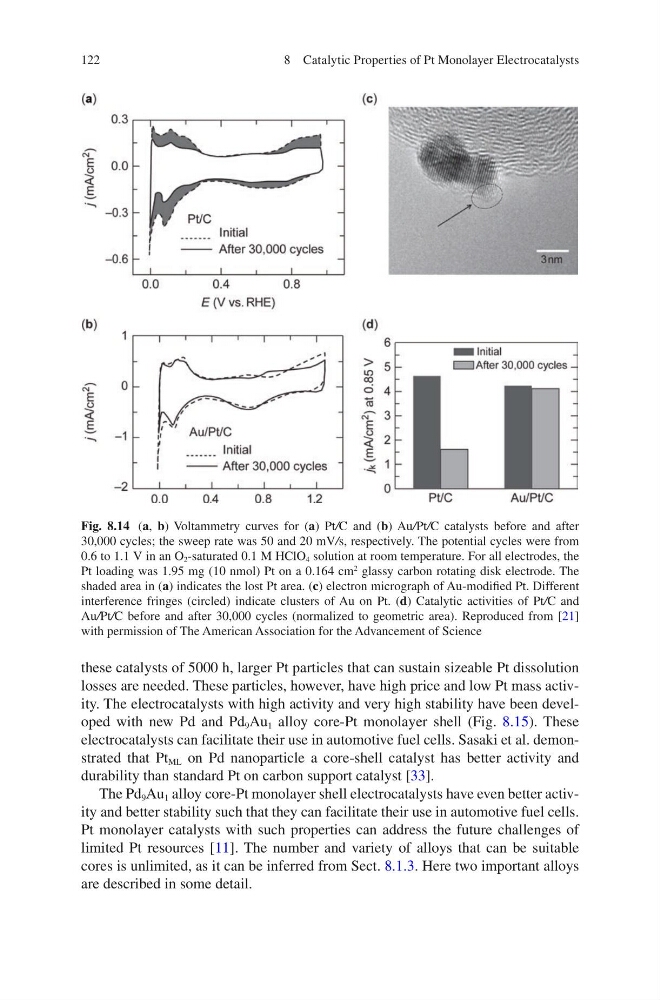
Fig. 8.14 (a, b) Voltammetry curves for (a) Pt/C and (b) Au/Pt/C catalysts before and after
30,000 cycles; the sweep rate was 50 and 20 mV/s, respectively. The potential cycles were from
0.6 to 1.1 V in an O 2 -saturated 0.1 M HClO 4 solution at room temperature. For all electrodes, the
Pt loading was 1.95 mg (10 nmol) Pt on a 0.164 cm
2 glassy carbon rotating disk electrode. The
shaded area in (a) indicates the lost Pt area. (c) electron micrograph of Au-modified Pt. Different
interference fringes (circled) indicate clusters of Au on Pt. (d) Catalytic activities of Pt/C and
Au/Pt/C before and after 30,000 cycles (normalized to geometric area). Reproduced from [21]
with permission of The American Association for the Advancement of Science
8 Catalytic Properties of Pt Monolayer Electrocatalysts
these catalysts of 5000 h, larger Pt particles that can sustain sizeable Pt dissolution
losses are needed. These particles, however, have high price and low Pt mass activity. The electrocatalysts with high activity and very high stability have been developed with new Pd and Pd 9 Au 1 alloy core-Pt monolayer shell (Fig. 8.15). These
electrocatalysts can facilitate their use in automotive fuel cells. Sasaki et al. demonstrated that Pt ML on Pd nanoparticle a core-shell catalyst has better activity and
durability than standard Pt on carbon support catalyst [33].
The Pd 9 Au 1 alloy core-Pt monolayer shell electrocatalysts have even better activity and better stability such that they can facilitate their use in automotive fuel cells.
Pt monolayer catalysts with such properties can address the future challenges of
limited Pt resources [11]. The number and variety of alloys that can be suitable
cores is unlimited, as it can be inferred from Sect. 8.1.3. Here two important alloys
are described in some detail.
Fig. 8.14 (a, b) Voltammetry curves for (a) Pt/C and (b) Au/Pt/C catalysts before and after
30,000 cycles; the sweep rate was 50 and 20 mV/s, respectively. The potential cycles were from
0.6 to 1.1 V in an O 2 -saturated 0.1 M HClO 4 solution at room temperature. For all electrodes, the
Pt loading was 1.95 mg (10 nmol) Pt on a 0.164 cm
2 glassy carbon rotating disk electrode. The
shaded area in (a) indicates the lost Pt area. (c) electron micrograph of Au-modified Pt. Different
interference fringes (circled) indicate clusters of Au on Pt. (d) Catalytic activities of Pt/C and
Au/Pt/C before and after 30,000 cycles (normalized to geometric area). Reproduced from [21]
with permission of The American Association for the Advancement of Science
8 Catalytic Properties of Pt Monolayer Electrocatalysts