

123
Accelerated fuel-cell tests of the electrocatalyst stability during 100,000 and
200,000 potential cycles with Pt ML /Pd/C and Pt ML /Pd 9 Au 1 /C, respectively, are shown
in Fig. 8.16. The data illustrate that the Pd core protects the Pt shell from dissolution. After 100,000 or 200,000 potential cycles, the electrocatalysts showed a small
loss of ECSA and of catalytic activity, and a negligible loss of Pt (Table 8.3). Under
the same conditions, Pt/C catalysts suffer very large losses.
Highly active and stable ORR catalyst, consisting of PdNi core–shell nanoparticles, was protected against decomposition in acid by Au atoms and activated for
oxygen reduction with a Pt monolayer. The roles of each component in the catalyst
are investigated, and in the best case the catalyst showed a Pt group metal mass
activity that was approximately 3 times higher than that of the commercial Pt/C
electrocatalyst. The Au-protected PdNi core–shell nanoparticles were found to be a
stable support for Pt under high oxidizing conditions.
160
120
80
40
00
/
0
2
4
6
8
d /mn
Pd
Pd
Pd
Pd
Pt
Pt
(a)
(c)
(b)
(d)
2 nm
10 nm
2 nm
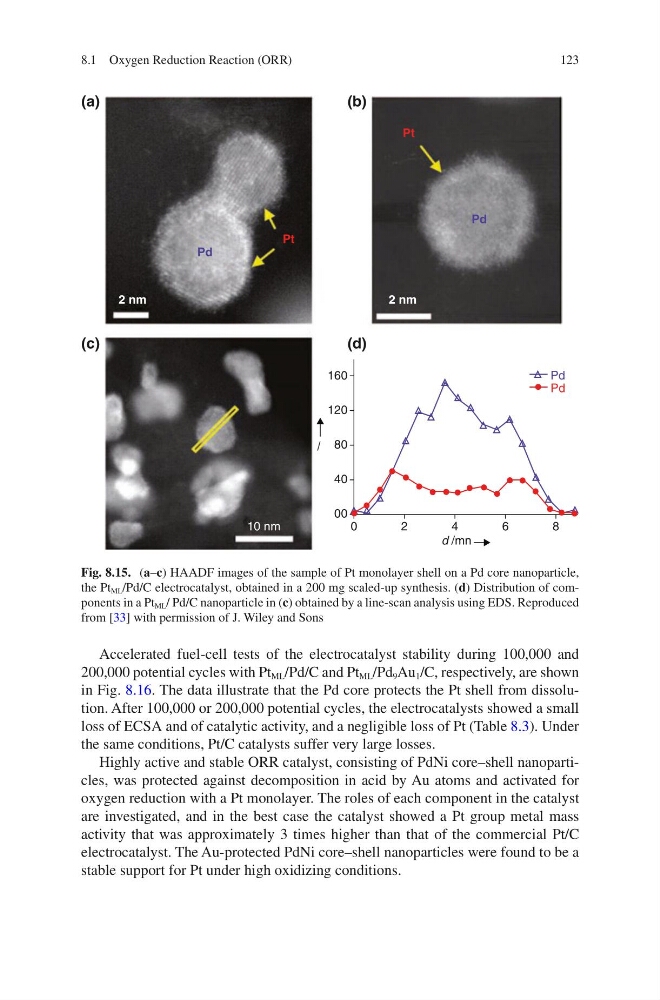
Fig. 8.15. (a–c) HAADF images of the sample of Pt monolayer shell on a Pd core nanoparticle,
the Pt ML /Pd/C electrocatalyst, obtained in a 200 mg scaled-up synthesis. (d) Distribution of components in a Pt ML / Pd/C nanoparticle in (c) obtained by a line-scan analysis using EDS. Reproduced
from [33] with permission of J. Wiley and Sons
8.1 Oxygen Reduction Reaction (ORR)
Accelerated fuel-cell tests of the electrocatalyst stability during 100,000 and
200,000 potential cycles with Pt ML /Pd/C and Pt ML /Pd 9 Au 1 /C, respectively, are shown
in Fig. 8.16. The data illustrate that the Pd core protects the Pt shell from dissolution. After 100,000 or 200,000 potential cycles, the electrocatalysts showed a small
loss of ECSA and of catalytic activity, and a negligible loss of Pt (Table 8.3). Under
the same conditions, Pt/C catalysts suffer very large losses.
Highly active and stable ORR catalyst, consisting of PdNi core–shell nanoparticles, was protected against decomposition in acid by Au atoms and activated for
oxygen reduction with a Pt monolayer. The roles of each component in the catalyst
are investigated, and in the best case the catalyst showed a Pt group metal mass
activity that was approximately 3 times higher than that of the commercial Pt/C
electrocatalyst. The Au-protected PdNi core–shell nanoparticles were found to be a
stable support for Pt under high oxidizing conditions.
160
120
80
40
00
/
0
2
4
6
8
d /mn
Pd
Pd
Pd
Pd
Pt
Pt
(a)
(c)
(b)
(d)
2 nm
10 nm
2 nm
Fig. 8.15. (a–c) HAADF images of the sample of Pt monolayer shell on a Pd core nanoparticle,
the Pt ML /Pd/C electrocatalyst, obtained in a 200 mg scaled-up synthesis. (d) Distribution of components in a Pt ML / Pd/C nanoparticle in (c) obtained by a line-scan analysis using EDS. Reproduced
from [33] with permission of J. Wiley and Sons
8.1 Oxygen Reduction Reaction (ORR)