

121
alter the properties of other metals may have other scientific and technological
applications, although further research is needed to explore such effects.
There were insignificant changes in the activity and surface area of Au-modified
Pt over the course of cycling, in contrast to sizable losses observed with the pure Pt
catalyst under the same conditions. In situ XANES and voltammetry data suggest
that the Au clusters confer stability by raising the Pt oxidation potential by clusters’
distinct electronic or chemical properties. Au clusters have a stabilizing effect on an
underlying Pt metal surface under highly oxidizing conditions and suppress Pt
dissolution during the O 2 reduction reaction (ORR) during potential cycling, without
decreasing the oxygen reduction kinetics.
Given platinum price and its natural abundance, Pt-based catalysts have to have
a good stability and low Pt content. Durability is particularly critical for fuel-cell
cathodes considering highly aggressive operating conditions that form at low pH,
dissolved molecular oxygen, and the high positive potentials. The durability of the
existing platinum catalysts is unsatisfactory. To satisfy the required lifetime for
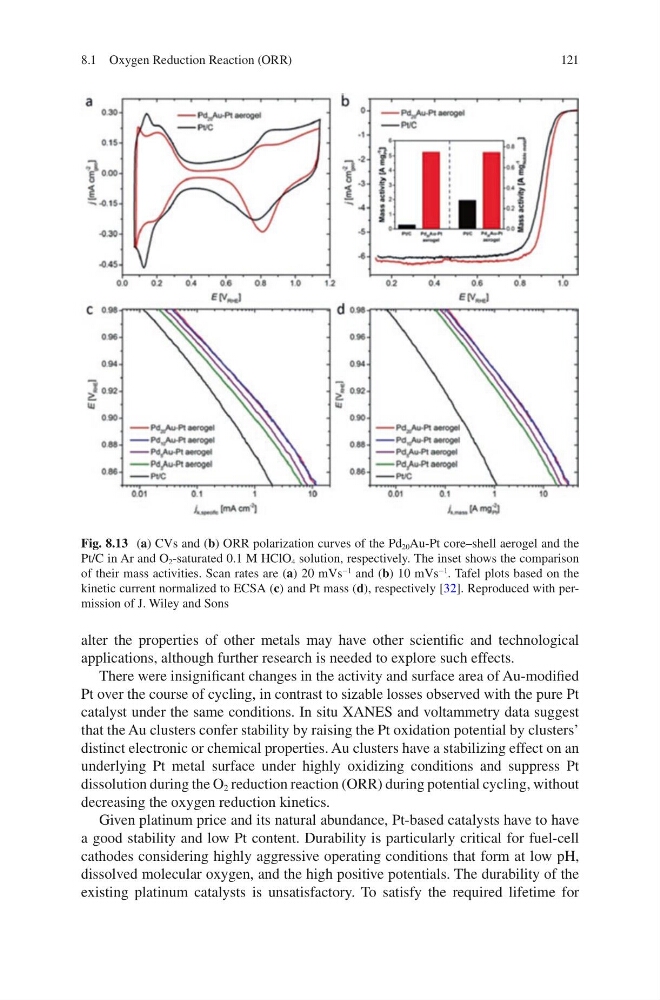
Fig. 8.13 (a) CVs and (b) ORR polarization curves of the Pd 20 Au-Pt core–shell aerogel and the
Pt/C in Ar and O 2 -saturated 0.1 M HClO 4 solution, respectively. The inset shows the comparison
of their mass activities. Scan rates are (a) 20 mVs
−1 and (b) 10 mVs
−1 . Tafel plots based on the
kinetic current normalized to ECSA (c) and Pt mass (d), respectively [32]. Reproduced with permission of J. Wiley and Sons
8.1 Oxygen Reduction Reaction (ORR)
alter the properties of other metals may have other scientific and technological
applications, although further research is needed to explore such effects.
There were insignificant changes in the activity and surface area of Au-modified
Pt over the course of cycling, in contrast to sizable losses observed with the pure Pt
catalyst under the same conditions. In situ XANES and voltammetry data suggest
that the Au clusters confer stability by raising the Pt oxidation potential by clusters’
distinct electronic or chemical properties. Au clusters have a stabilizing effect on an
underlying Pt metal surface under highly oxidizing conditions and suppress Pt
dissolution during the O 2 reduction reaction (ORR) during potential cycling, without
decreasing the oxygen reduction kinetics.
Given platinum price and its natural abundance, Pt-based catalysts have to have
a good stability and low Pt content. Durability is particularly critical for fuel-cell
cathodes considering highly aggressive operating conditions that form at low pH,
dissolved molecular oxygen, and the high positive potentials. The durability of the
existing platinum catalysts is unsatisfactory. To satisfy the required lifetime for
Fig. 8.13 (a) CVs and (b) ORR polarization curves of the Pd 20 Au-Pt core–shell aerogel and the
Pt/C in Ar and O 2 -saturated 0.1 M HClO 4 solution, respectively. The inset shows the comparison
of their mass activities. Scan rates are (a) 20 mVs
−1 and (b) 10 mVs
−1 . Tafel plots based on the
kinetic current normalized to ECSA (c) and Pt mass (d), respectively [32]. Reproduced with permission of J. Wiley and Sons
8.1 Oxygen Reduction Reaction (ORR)