

120
Zhang et al. demonstrated that Pt oxygen reduction fuel cell electrocatalysts can
be stabilized against dissolution under potential cycling regimes by modifying the
Pt nanoparticles with small Au clusters [21]. The stabilizing effect of Au clusters
was assessed in an accelerated stability test by continuously applying linear potential
sweeps from 0.6 to 1.1 V. After 30,000 cycles, Pt/C suffered a loss of 39 mV halfwave potential and 45% in active surface area under the same conditions (Fig. 8.14).
The same experiment with the Au/Pt/C electrode at 60 C showed negligible change
in the Pt surface area and electrocatalytic activity. In situ X-ray absorption nearedge spectroscopy (XANES) and voltammetry data suggest that the Au clusters
confer stability by raising the oxidation potential of Pt [21]. Possibly, Au atoms
block the kink and step sites of Pt where dissolution starts. The same effect was
observed with the aforementioned Pt monolayer-on-Pd nanoparticle electrocatalysts
(Table 8.3). This finding has the potential to solve one of the major problems for fuel
cell application in transportation. Apart from fuel cells, the ability of Au clusters to
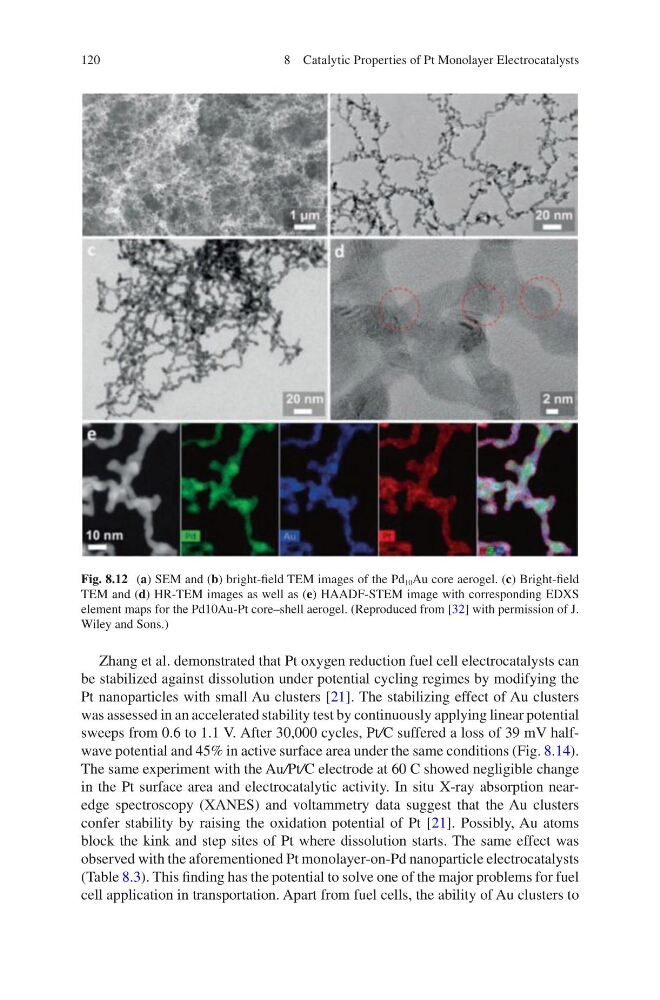
Fig. 8.12 (a) SEM and (b) bright-field TEM images of the Pd 10 Au core aerogel. (c) Bright-field
TEM and (d) HR-TEM images as well as (e) HAADF-STEM image with corresponding EDXS
element maps for the Pd10Au-Pt core–shell aerogel. (Reproduced from [32] with permission of J.
Wiley and Sons.)
8 Catalytic Properties of Pt Monolayer Electrocatalysts
Zhang et al. demonstrated that Pt oxygen reduction fuel cell electrocatalysts can
be stabilized against dissolution under potential cycling regimes by modifying the
Pt nanoparticles with small Au clusters [21]. The stabilizing effect of Au clusters
was assessed in an accelerated stability test by continuously applying linear potential
sweeps from 0.6 to 1.1 V. After 30,000 cycles, Pt/C suffered a loss of 39 mV halfwave potential and 45% in active surface area under the same conditions (Fig. 8.14).
The same experiment with the Au/Pt/C electrode at 60 C showed negligible change
in the Pt surface area and electrocatalytic activity. In situ X-ray absorption nearedge spectroscopy (XANES) and voltammetry data suggest that the Au clusters
confer stability by raising the oxidation potential of Pt [21]. Possibly, Au atoms
block the kink and step sites of Pt where dissolution starts. The same effect was
observed with the aforementioned Pt monolayer-on-Pd nanoparticle electrocatalysts
(Table 8.3). This finding has the potential to solve one of the major problems for fuel
cell application in transportation. Apart from fuel cells, the ability of Au clusters to
Fig. 8.12 (a) SEM and (b) bright-field TEM images of the Pd 10 Au core aerogel. (c) Bright-field
TEM and (d) HR-TEM images as well as (e) HAADF-STEM image with corresponding EDXS
element maps for the Pd10Au-Pt core–shell aerogel. (Reproduced from [32] with permission of J.
Wiley and Sons.)
8 Catalytic Properties of Pt Monolayer Electrocatalysts