

117
droplet before the immersion in 0.1 M HClO 4 solution. Then 20–30 potential cycles
from 0.05 to 1.1 V (vs. reversible hydrogen electrode, RHE) were applied at room
temperature for a complete removal of the Ni atoms from inside the noble metal
shells. Platinum monolayer shell was placed on hollow nanoparticles using galvanic
replacement of an underpotentially deposited Cu monolayer [7].
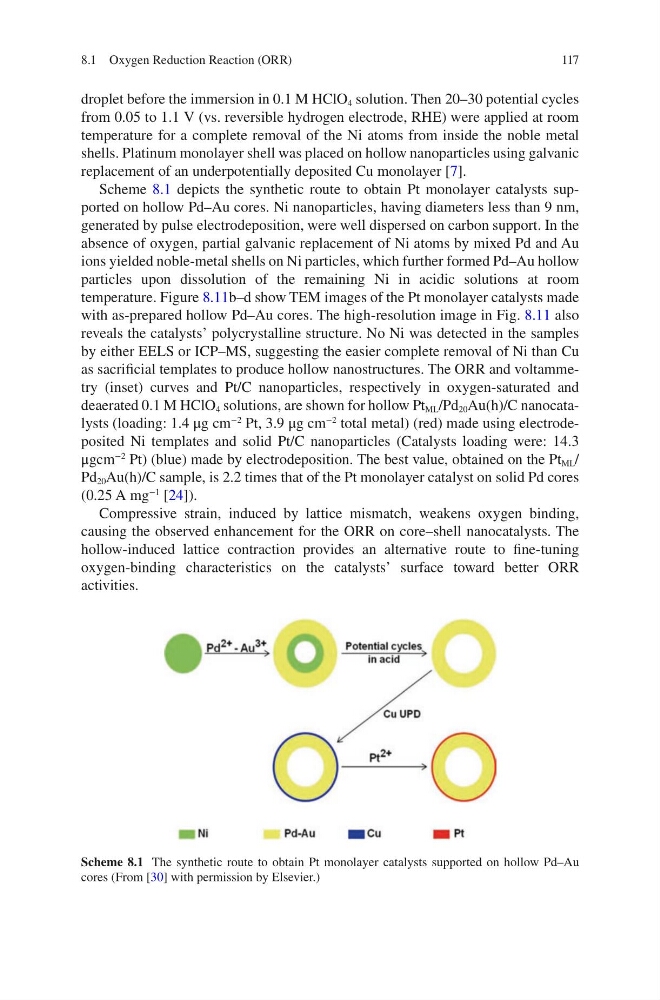
Scheme 8.1 depicts the synthetic route to obtain Pt monolayer catalysts supported on hollow Pd–Au cores. Ni nanoparticles, having diameters less than 9 nm,
generated by pulse electrodeposition, were well dispersed on carbon support. In the
absence of oxygen, partial galvanic replacement of Ni atoms by mixed Pd and Au
ions yielded noble-metal shells on Ni particles, which further formed Pd–Au hollow
particles upon dissolution of the remaining Ni in acidic solutions at room
temperature. Figure 8.11b–d show TEM images of the Pt monolayer catalysts made
with as-prepared hollow Pd–Au cores. The high-resolution image in Fig. 8.11 also
reveals the catalysts’ polycrystalline structure. No Ni was detected in the samples
by either EELS or ICP–MS, suggesting the easier complete removal of Ni than Cu
as sacrificial templates to produce hollow nanostructures. The ORR and voltammetry (inset) curves and Pt/C nanoparticles, respectively in oxygen-saturated and
deaerated 0.1 M HClO 4 solutions, are shown for hollow Pt ML /Pd 20 Au(h)/C nanocatalysts (loading: 1.4 μg cm
−2
Pt, 3.9 μg cm
−2
total metal) (red) made using electrodeposited Ni templates and solid Pt/C nanoparticles (Catalysts loading were: 14.3
μgcm
−2
Pt) (blue) made by electrodeposition. The best value, obtained on the Pt ML /
Pd 20 Au(h)/C sample, is 2.2 times that of the Pt monolayer catalyst on solid Pd cores
(0.25 A mg
−1
[24]).
Compressive strain, induced by lattice mismatch, weakens oxygen binding,
causing the observed enhancement for the ORR on core–shell nanocatalysts. The
hollow-induced lattice contraction provides an alternative route to fine-tuning
oxygen-binding characteristics on the catalysts’ surface toward better ORR
activities.
Scheme 8.1 The synthetic route to obtain Pt monolayer catalysts supported on hollow Pd–Au
cores (From [30] with permission by Elsevier.)
8.1 Oxygen Reduction Reaction (ORR)
droplet before the immersion in 0.1 M HClO 4 solution. Then 20–30 potential cycles
from 0.05 to 1.1 V (vs. reversible hydrogen electrode, RHE) were applied at room
temperature for a complete removal of the Ni atoms from inside the noble metal
shells. Platinum monolayer shell was placed on hollow nanoparticles using galvanic
replacement of an underpotentially deposited Cu monolayer [7].
Scheme 8.1 depicts the synthetic route to obtain Pt monolayer catalysts supported on hollow Pd–Au cores. Ni nanoparticles, having diameters less than 9 nm,
generated by pulse electrodeposition, were well dispersed on carbon support. In the
absence of oxygen, partial galvanic replacement of Ni atoms by mixed Pd and Au
ions yielded noble-metal shells on Ni particles, which further formed Pd–Au hollow
particles upon dissolution of the remaining Ni in acidic solutions at room
temperature. Figure 8.11b–d show TEM images of the Pt monolayer catalysts made
with as-prepared hollow Pd–Au cores. The high-resolution image in Fig. 8.11 also
reveals the catalysts’ polycrystalline structure. No Ni was detected in the samples
by either EELS or ICP–MS, suggesting the easier complete removal of Ni than Cu
as sacrificial templates to produce hollow nanostructures. The ORR and voltammetry (inset) curves and Pt/C nanoparticles, respectively in oxygen-saturated and
deaerated 0.1 M HClO 4 solutions, are shown for hollow Pt ML /Pd 20 Au(h)/C nanocatalysts (loading: 1.4 μg cm
−2
Pt, 3.9 μg cm
−2
total metal) (red) made using electrodeposited Ni templates and solid Pt/C nanoparticles (Catalysts loading were: 14.3
μgcm
−2
Pt) (blue) made by electrodeposition. The best value, obtained on the Pt ML /
Pd 20 Au(h)/C sample, is 2.2 times that of the Pt monolayer catalyst on solid Pd cores
(0.25 A mg
−1
[24]).
Compressive strain, induced by lattice mismatch, weakens oxygen binding,
causing the observed enhancement for the ORR on core–shell nanocatalysts. The
hollow-induced lattice contraction provides an alternative route to fine-tuning
oxygen-binding characteristics on the catalysts’ surface toward better ORR
activities.
Scheme 8.1 The synthetic route to obtain Pt monolayer catalysts supported on hollow Pd–Au
cores (From [30] with permission by Elsevier.)
8.1 Oxygen Reduction Reaction (ORR)