

116
This enhanced activity is attributed to the smooth surface morphology and hollowinduced lattice contraction, in addition to the mass-saving geometry of hollow particles [30].
Typically, an aqueous suspension of carbon powder (1 mg mL
−1
) was sonicated
in ice bath and placed onto the polished glassy carbon surface of a rotating disk
electrode to form dry, uniform carbon thin film. In a deaerated solution of 0.1 M
NiSO 4 and 0.5 M H 3 BO 3 , a double potential pulse (at −1.4 V and at −0.8 V (v. Ag/
AgCl, 3 M NaCl)) was applied to deposit Ni nanoparticles on carbon film support
(Ni/C). Varying first pulse was used to vary the nucleation density of Ni particles,
while varying second pulse altered the particle size. Under Ar, the Ni/C electrode
was transferred into 0.5 mM Pd(NH 3 ) 4 Cl 2 with or without HAuCl 4 , where the
galvanic replacement of Ni by Pd and Au took place. To remove the remaining Ni,
the electrode was rotated in pure water to get rid of the metal ions in the attached
0
E (V) vs. RHE
E (V) vs. RHE
j (mA/cm
2
)
J k (mA/cm
2 )
–1
–2
–3
–4
–5
–6
0.95
0.90
0.85
0.80
0.1
1
1 0
0.2
0.4
0.6
0.8
1.0
3.0
2.5
2.0
1.5
1.0
0.5
0.0
Units
Pt NP/C
Pt~Pd
Pt~Pd 9 Au Pt~Pd 8 Au 2
Pt~Pd 8 Au 2 NW
Pt~Pd 7 Au 3 NW
Pt~Pd 9 Au NW
Pt~Pd 9 Au
Pt~Pd
Pt~Pd 7 Au 3
Surface Area Activity (mA/cm
2H Charge )
Mass Activity (A/mg Pt )
(a)
(b)
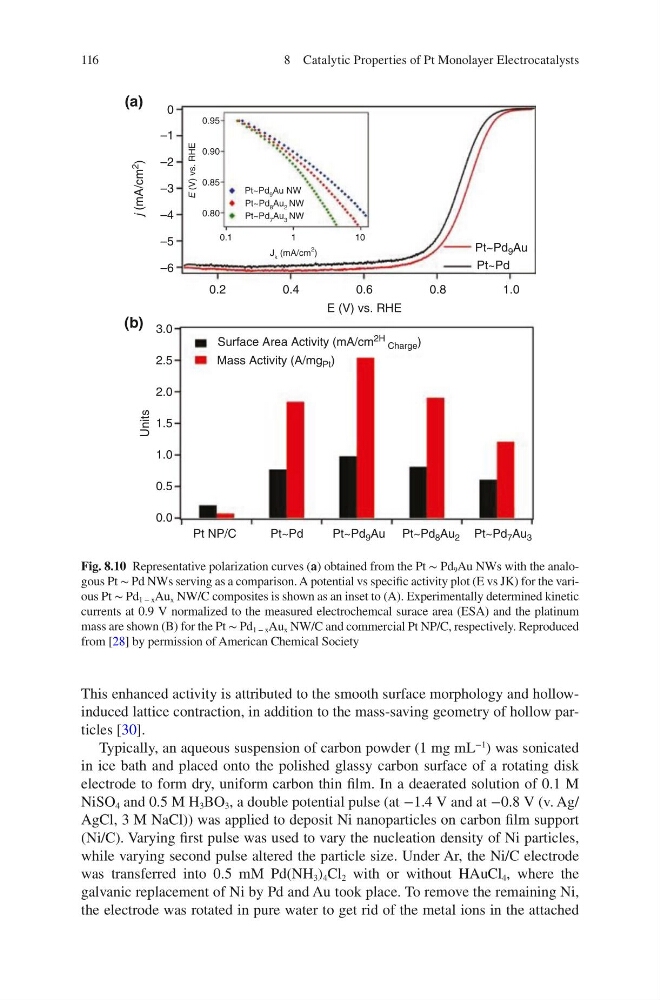
Fig. 8.10 Representative polarization curves (a) obtained from the Pt ∼ Pd 9 Au NWs with the analogous Pt ∼ Pd NWs serving as a comparison. A potential vs specific activity plot (E vs JK) for the various Pt ∼ Pd 1 − x Au x NW/C composites is shown as an inset to (A). Experimentally determined kinetic
currents at 0.9 V normalized to the measured electrochemcal surace area (ESA) and the platinum
mass are shown (B) for the Pt ∼ Pd 1 − x Au x NW/C and commercial Pt NP/C, respectively. Reproduced
from [28] by permission of American Chemical Society
8 Catalytic Properties of Pt Monolayer Electrocatalysts
This enhanced activity is attributed to the smooth surface morphology and hollowinduced lattice contraction, in addition to the mass-saving geometry of hollow particles [30].
Typically, an aqueous suspension of carbon powder (1 mg mL
−1
) was sonicated
in ice bath and placed onto the polished glassy carbon surface of a rotating disk
electrode to form dry, uniform carbon thin film. In a deaerated solution of 0.1 M
NiSO 4 and 0.5 M H 3 BO 3 , a double potential pulse (at −1.4 V and at −0.8 V (v. Ag/
AgCl, 3 M NaCl)) was applied to deposit Ni nanoparticles on carbon film support
(Ni/C). Varying first pulse was used to vary the nucleation density of Ni particles,
while varying second pulse altered the particle size. Under Ar, the Ni/C electrode
was transferred into 0.5 mM Pd(NH 3 ) 4 Cl 2 with or without HAuCl 4 , where the
galvanic replacement of Ni by Pd and Au took place. To remove the remaining Ni,
the electrode was rotated in pure water to get rid of the metal ions in the attached
0
E (V) vs. RHE
E (V) vs. RHE
j (mA/cm
2
)
J k (mA/cm
2 )
–1
–2
–3
–4
–5
–6
0.95
0.90
0.85
0.80
0.1
1
1 0
0.2
0.4
0.6
0.8
1.0
3.0
2.5
2.0
1.5
1.0
0.5
0.0
Units
Pt NP/C
Pt~Pd
Pt~Pd 9 Au Pt~Pd 8 Au 2
Pt~Pd 8 Au 2 NW
Pt~Pd 7 Au 3 NW
Pt~Pd 9 Au NW
Pt~Pd 9 Au
Pt~Pd
Pt~Pd 7 Au 3
Surface Area Activity (mA/cm
2H Charge )
Mass Activity (A/mg Pt )
(a)
(b)
Fig. 8.10 Representative polarization curves (a) obtained from the Pt ∼ Pd 9 Au NWs with the analogous Pt ∼ Pd NWs serving as a comparison. A potential vs specific activity plot (E vs JK) for the various Pt ∼ Pd 1 − x Au x NW/C composites is shown as an inset to (A). Experimentally determined kinetic
currents at 0.9 V normalized to the measured electrochemcal surace area (ESA) and the platinum
mass are shown (B) for the Pt ∼ Pd 1 − x Au x NW/C and commercial Pt NP/C, respectively. Reproduced
from [28] by permission of American Chemical Society
8 Catalytic Properties of Pt Monolayer Electrocatalysts