

118
The formation of hollow structures in these systems was governed by both galvanic replacement and Kirkendall effect. The driving force for the galvanic replacement reaction is the reduction potential difference between two metals. While in the
Kirkendall diffusion process the net flux of compensating vacancies is proportional
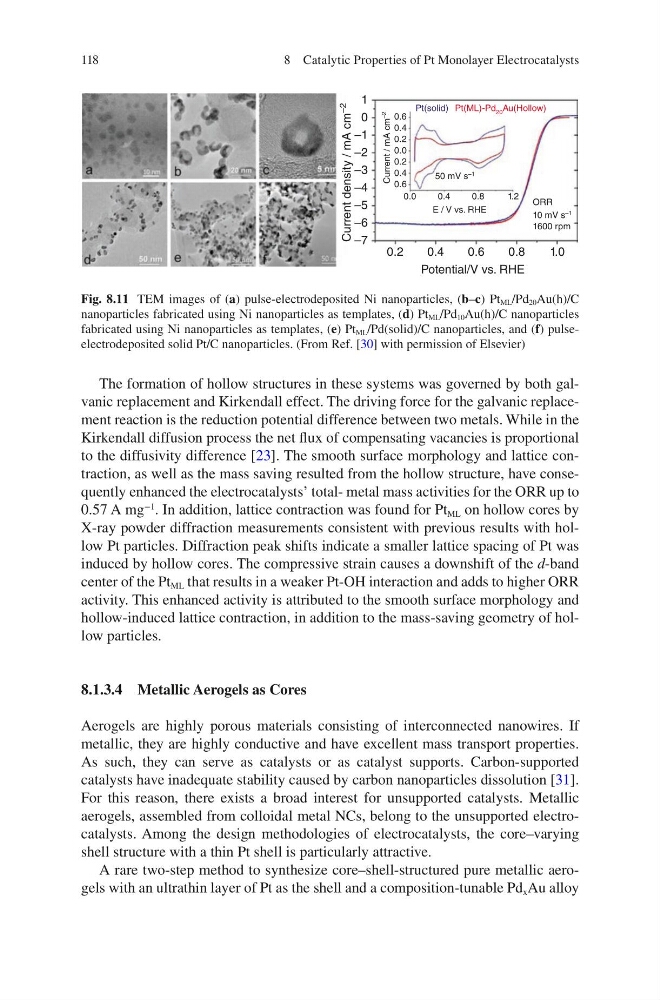
to the diffusivity difference [23]. The smooth surface morphology and lattice contraction, as well as the mass saving resulted from the hollow structure, have consequently enhanced the electrocatalysts’ total- metal mass activities for the ORR up to
0.57 A mg
−1
. In addition, lattice contraction was found for Pt ML on hollow cores by
X-ray powder diffraction measurements consistent with previous results with hollow Pt particles. Diffraction peak shifts indicate a smaller lattice spacing of Pt was
induced by hollow cores. The compressive strain causes a downshift of the d-band
center of the Pt ML that results in a weaker Pt-OH interaction and adds to higher ORR
activity. This enhanced activity is attributed to the smooth surface morphology and
hollow-induced lattice contraction, in addition to the mass- saving geometry of hollow particles.
8.1.3.4 Metallic Aerogels as Cores
Aerogels are highly porous materials consisting of interconnected nanowires. If
metallic, they are highly conductive and have excellent mass transport properties.
As such, they can serve as catalysts or as catalyst supports. Carbon-supported
catalysts have inadequate stability caused by carbon nanoparticles dissolution [31].
For this reason, there exists a broad interest for unsupported catalysts. Metallic
aerogels, assembled from colloidal metal NCs, belong to the unsupported electrocatalysts. Among the design methodologies of electrocatalysts, the core–varying
shell structure with a thin Pt shell is particularly attractive.
A rare two-step method to synthesize core–shell-structured pure metallic aerogels with an ultrathin layer of Pt as the shell and a composition-tunable Pd x Au alloy
0.2
1
0.4
0.6
Potential/V vs. RHE
Current density / mA cm
–2
Current / mA cm
–2
0.8
1.0
ORR
10 mV s
–1
1600 rpm
0.0
0.6
0.4
50 mV s –1
Pt(solid) Pt(ML)-Pd 20 Au(Hollow)
E / V vs. RHE
0.8
1.2
0
–1
–2
–3
–4
–5
–6
–7
0.4
0.2
0.0
0.2
0.4
0.6
Fig. 8.11 TEM images of (a) pulse-electrodeposited Ni nanoparticles, (b–c) Pt ML /Pd 20 Au(h)/C
nanoparticles fabricated using Ni nanoparticles as templates, (d) Pt ML /Pd 10 Au(h)/C nanoparticles
fabricated using Ni nanoparticles as templates, (e) Pt ML /Pd(solid)/C nanoparticles, and (f) pulseelectrodeposited solid Pt/C nanoparticles. (From Ref. [30] with permission of Elsevier)
8 Catalytic Properties of Pt Monolayer Electrocatalysts
The formation of hollow structures in these systems was governed by both galvanic replacement and Kirkendall effect. The driving force for the galvanic replacement reaction is the reduction potential difference between two metals. While in the
Kirkendall diffusion process the net flux of compensating vacancies is proportional
to the diffusivity difference [23]. The smooth surface morphology and lattice contraction, as well as the mass saving resulted from the hollow structure, have consequently enhanced the electrocatalysts’ total- metal mass activities for the ORR up to
0.57 A mg
−1
. In addition, lattice contraction was found for Pt ML on hollow cores by
X-ray powder diffraction measurements consistent with previous results with hollow Pt particles. Diffraction peak shifts indicate a smaller lattice spacing of Pt was
induced by hollow cores. The compressive strain causes a downshift of the d-band
center of the Pt ML that results in a weaker Pt-OH interaction and adds to higher ORR
activity. This enhanced activity is attributed to the smooth surface morphology and
hollow-induced lattice contraction, in addition to the mass- saving geometry of hollow particles.
8.1.3.4 Metallic Aerogels as Cores
Aerogels are highly porous materials consisting of interconnected nanowires. If
metallic, they are highly conductive and have excellent mass transport properties.
As such, they can serve as catalysts or as catalyst supports. Carbon-supported
catalysts have inadequate stability caused by carbon nanoparticles dissolution [31].
For this reason, there exists a broad interest for unsupported catalysts. Metallic
aerogels, assembled from colloidal metal NCs, belong to the unsupported electrocatalysts. Among the design methodologies of electrocatalysts, the core–varying
shell structure with a thin Pt shell is particularly attractive.
A rare two-step method to synthesize core–shell-structured pure metallic aerogels with an ultrathin layer of Pt as the shell and a composition-tunable Pd x Au alloy
0.2
1
0.4
0.6
Potential/V vs. RHE
Current density / mA cm
–2
Current / mA cm
–2
0.8
1.0
ORR
10 mV s
–1
1600 rpm
0.0
0.6
0.4
50 mV s –1
Pt(solid) Pt(ML)-Pd 20 Au(Hollow)
E / V vs. RHE
0.8
1.2
0
–1
–2
–3
–4
–5
–6
–7
0.4
0.2
0.0
0.2
0.4
0.6
Fig. 8.11 TEM images of (a) pulse-electrodeposited Ni nanoparticles, (b–c) Pt ML /Pd 20 Au(h)/C
nanoparticles fabricated using Ni nanoparticles as templates, (d) Pt ML /Pd 10 Au(h)/C nanoparticles
fabricated using Ni nanoparticles as templates, (e) Pt ML /Pd(solid)/C nanoparticles, and (f) pulseelectrodeposited solid Pt/C nanoparticles. (From Ref. [30] with permission of Elsevier)
8 Catalytic Properties of Pt Monolayer Electrocatalysts