

70
4 Mechanical characterization on constituent level
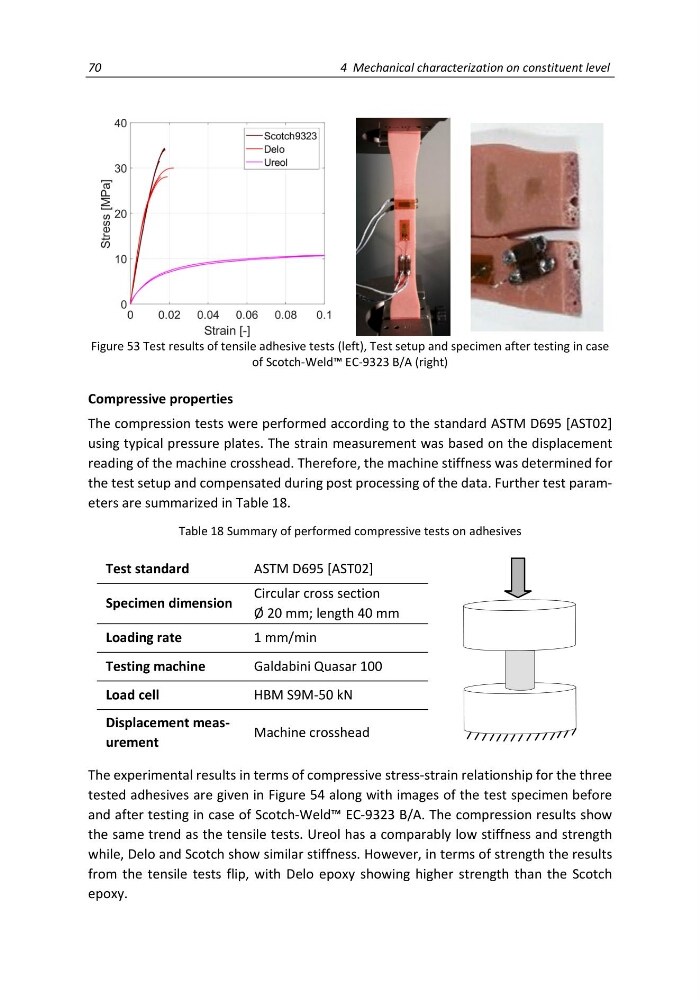
Figure 53 Test results of tensile adhesive tests (left), Test setup and specimen after testing in case
of Scotch-Weld™ EC-9323 B/A (right)
Compressive properties
The compression tests were performed according to the standard ASTM D695 [AST02]
using typical pressure plates. The strain measurement was based on the displacement
reading of the machine crosshead. Therefore, the machine stiffness was determined for
the test setup and compensated during post processing of the data. Further test parameters are summarized in Table 18.
Table 18 Summary of performed compressive tests on adhesives
Test standard
ASTM D695 [AST02]
Specimen dimension
Circular cross section
Ø 20 mm; length 40 mm
Loading rate
1 mm/min
Testing machine
Galdabini Quasar 100
Load cell
HBM S9M-50 kN
Displacement measurement
Machine crosshead
The experimental results in terms of compressive stress-strain relationship for the three
tested adhesives are given in Figure 54 along with images of the test specimen before
and after testing in case of Scotch-Weld™ EC-9323 B/A. The compression results show
the same trend as the tensile tests. Ureol has a comparably low stiffness and strength
while, Delo and Scotch show similar stiffness. However, in terms of strength the results
from the tensile tests flip, with Delo epoxy showing higher strength than the Scotch
epoxy.
4 Mechanical characterization on constituent level
Figure 53 Test results of tensile adhesive tests (left), Test setup and specimen after testing in case
of Scotch-Weld™ EC-9323 B/A (right)
Compressive properties
The compression tests were performed according to the standard ASTM D695 [AST02]
using typical pressure plates. The strain measurement was based on the displacement
reading of the machine crosshead. Therefore, the machine stiffness was determined for
the test setup and compensated during post processing of the data. Further test parameters are summarized in Table 18.
Table 18 Summary of performed compressive tests on adhesives
Test standard
ASTM D695 [AST02]
Specimen dimension
Circular cross section
Ø 20 mm; length 40 mm
Loading rate
1 mm/min
Testing machine
Galdabini Quasar 100
Load cell
HBM S9M-50 kN
Displacement measurement
Machine crosshead
The experimental results in terms of compressive stress-strain relationship for the three
tested adhesives are given in Figure 54 along with images of the test specimen before
and after testing in case of Scotch-Weld™ EC-9323 B/A. The compression results show
the same trend as the tensile tests. Ureol has a comparably low stiffness and strength
while, Delo and Scotch show similar stiffness. However, in terms of strength the results
from the tensile tests flip, with Delo epoxy showing higher strength than the Scotch
epoxy.