

4.3 Adhesives
69
EC-9323 B/A adhesive. The specimens were manufactured using molds, which were custom made to represent the specimen geometry according to the respective ASTM standard. The molds were fabricated using a 3D-printer (Designjet Color 3D printer; HewlettPackard Development Company, Palo Alto, California). The adhesives were cured at
room temperature for a minimum of 14 days. After unmolding, the cured specimens
were grinded using sandpaper, in order to smoothen the outer surfaces. For all investigated adhesives, three specimens each were fabricated for compression and tension
tests. The outer dimensions of all specimens were measured to determine the crosssectional area of the specimens. The performed tests are described in the following.
Tensile properties
The tension tests were performed based on the ASTM standard for plastics ASTM D638
[AST02]. The specimens were clamped using self-tightening wedge grips. Accurate strain
measurement was ensured by uniaxial strain gauges. In case of Scotch-Weld™ EC-9323
B/A transverse strain gauges were applied along with axial ones in order to determine
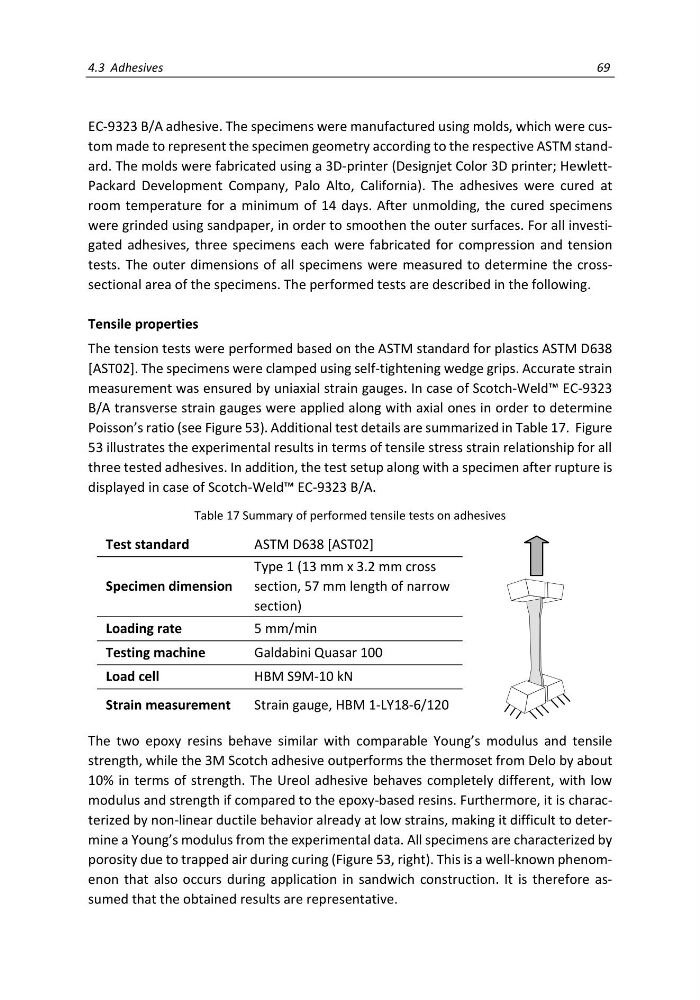
Poisson’s ratio (see Figure 53). Additional test details are summarized in Table 17. Figure
53 illustrates the experimental results in terms of tensile stress strain relationship for all
three tested adhesives. In addition, the test setup along with a specimen after rupture is
displayed in case of Scotch-Weld™ EC-9323 B/A.
Table 17 Summary of performed tensile tests on adhesives
Test standard
ASTM D638 [AST02]
Specimen dimension
Type 1 (13 mm x 3.2 mm cross
section, 57 mm length of narrow
section)
Loading rate
5 mm/min
Testing machine
Galdabini Quasar 100
Load cell
HBM S9M-10 kN
Strain measurement
Strain gauge, HBM 1-LY18-6/120
The two epoxy resins behave similar with comparable Young’s modulus and tensile
strength, while the 3M Scotch adhesive outperforms the thermoset from Delo by about
10% in terms of strength. The Ureol adhesive behaves completely different, with low
modulus and strength if compared to the epoxy-based resins. Furthermore, it is characterized by non-linear ductile behavior already at low strains, making it difficult to determine a Young’s modulus from the experimental data. All specimens are characterized by
porosity due to trapped air during curing (Figure 53, right). This is a well-known phenomenon that also occurs during application in sandwich construction. It is therefore assumed that the obtained results are representative.
69
EC-9323 B/A adhesive. The specimens were manufactured using molds, which were custom made to represent the specimen geometry according to the respective ASTM standard. The molds were fabricated using a 3D-printer (Designjet Color 3D printer; HewlettPackard Development Company, Palo Alto, California). The adhesives were cured at
room temperature for a minimum of 14 days. After unmolding, the cured specimens
were grinded using sandpaper, in order to smoothen the outer surfaces. For all investigated adhesives, three specimens each were fabricated for compression and tension
tests. The outer dimensions of all specimens were measured to determine the crosssectional area of the specimens. The performed tests are described in the following.
Tensile properties
The tension tests were performed based on the ASTM standard for plastics ASTM D638
[AST02]. The specimens were clamped using self-tightening wedge grips. Accurate strain
measurement was ensured by uniaxial strain gauges. In case of Scotch-Weld™ EC-9323
B/A transverse strain gauges were applied along with axial ones in order to determine
Poisson’s ratio (see Figure 53). Additional test details are summarized in Table 17. Figure
53 illustrates the experimental results in terms of tensile stress strain relationship for all
three tested adhesives. In addition, the test setup along with a specimen after rupture is
displayed in case of Scotch-Weld™ EC-9323 B/A.
Table 17 Summary of performed tensile tests on adhesives
Test standard
ASTM D638 [AST02]
Specimen dimension
Type 1 (13 mm x 3.2 mm cross
section, 57 mm length of narrow
section)
Loading rate
5 mm/min
Testing machine
Galdabini Quasar 100
Load cell
HBM S9M-10 kN
Strain measurement
Strain gauge, HBM 1-LY18-6/120
The two epoxy resins behave similar with comparable Young’s modulus and tensile
strength, while the 3M Scotch adhesive outperforms the thermoset from Delo by about
10% in terms of strength. The Ureol adhesive behaves completely different, with low
modulus and strength if compared to the epoxy-based resins. Furthermore, it is characterized by non-linear ductile behavior already at low strains, making it difficult to determine a Young’s modulus from the experimental data. All specimens are characterized by
porosity due to trapped air during curing (Figure 53, right). This is a well-known phenomenon that also occurs during application in sandwich construction. It is therefore assumed that the obtained results are representative.