

68
4 Mechanical characterization on constituent level
4.3 Adhesives
As described in section 2.2, adhesives are used to locally reinforce sandwich panels. In
this function, the added adhesive essentially forms a plastic component, which is bonded
to the face and the core after curing. Since this plastic component is in the load path, its
mechanical properties are of interest. However, adhesive manufacturers often do not
provide basic mechanical properties, such as Young’s modulus or yield strength of cured
adhesives. Therefore, the mechanical characterization of this material is necessary on
constituent level. This is presented in the following.
Materials
In the framework of the present thesis three different types of adhesive are investigated,
all of which are two component thermoset systems which are qualified for use as structural adhesive in aircraft construction. These adhesives have in common, that they are
suitable for bonding a wide variety of metals, plastics, foams, composites and rubber and
that they cure at room temperature. As such they are commonly used for bonding in
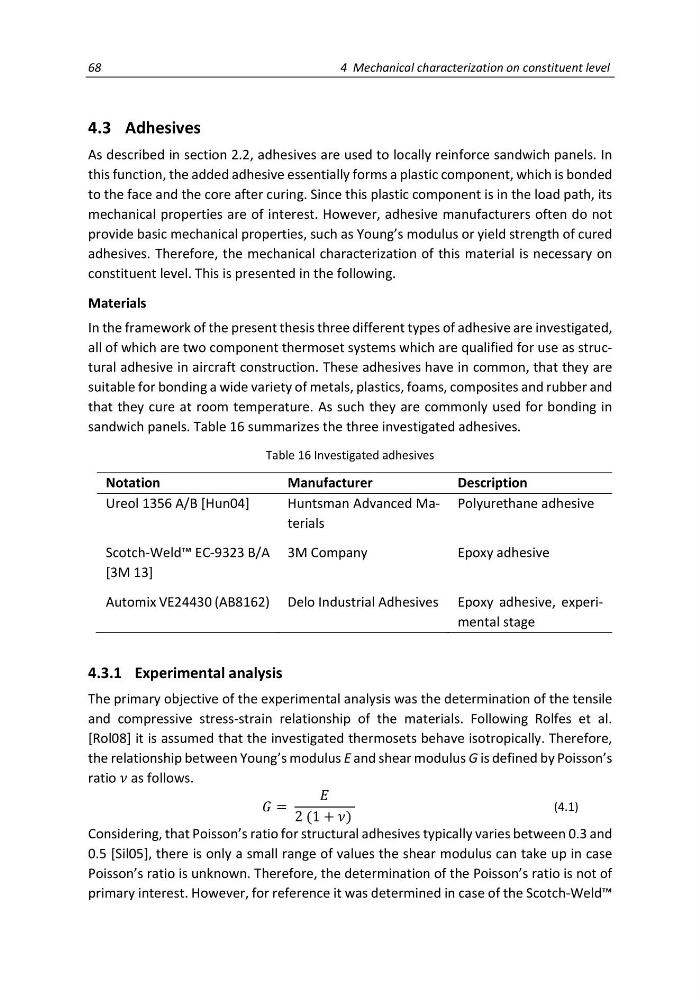
sandwich panels. Table 16 summarizes the three investigated adhesives.
Table 16 Investigated adhesives
Notation
Manufacturer
Description
Ureol 1356 A/B [Hun04]
Huntsman Advanced Materials
Polyurethane adhesive
Scotch-Weld™ EC-9323 B/A
[3M 13]
3M Company
Epoxy adhesive
Automix VE24430 (AB8162) Delo Industrial Adhesives Epoxy adhesive, experimental stage
4.3.1 Experimental analysis
The primary objective of the experimental analysis was the determination of the tensile
and compressive stress-strain relationship of the materials. Following Rolfes et al.
[Rol08] it is assumed that the investigated thermosets behave isotropically. Therefore,
the relationship between Young’s modulus E and shear modulus G is defined by Poisson’s
ratio as follows.
2 21 1 11
(4.1)
Considering, that Poisson’s ratio for structural adhesives typically varies between 0.3 and
0.5 [Sil05], there is only a small range of values the shear modulus can take up in case
Poisson’s ratio is unknown. Therefore, the determination of the Poisson’s ratio is not of
primary interest. However, for reference it was determined in case of the Scotch-Weld™
4 Mechanical characterization on constituent level
4.3 Adhesives
As described in section 2.2, adhesives are used to locally reinforce sandwich panels. In
this function, the added adhesive essentially forms a plastic component, which is bonded
to the face and the core after curing. Since this plastic component is in the load path, its
mechanical properties are of interest. However, adhesive manufacturers often do not
provide basic mechanical properties, such as Young’s modulus or yield strength of cured
adhesives. Therefore, the mechanical characterization of this material is necessary on
constituent level. This is presented in the following.
Materials
In the framework of the present thesis three different types of adhesive are investigated,
all of which are two component thermoset systems which are qualified for use as structural adhesive in aircraft construction. These adhesives have in common, that they are
suitable for bonding a wide variety of metals, plastics, foams, composites and rubber and
that they cure at room temperature. As such they are commonly used for bonding in
sandwich panels. Table 16 summarizes the three investigated adhesives.
Table 16 Investigated adhesives
Notation
Manufacturer
Description
Ureol 1356 A/B [Hun04]
Huntsman Advanced Materials
Polyurethane adhesive
Scotch-Weld™ EC-9323 B/A
[3M 13]
3M Company
Epoxy adhesive
Automix VE24430 (AB8162) Delo Industrial Adhesives Epoxy adhesive, experimental stage
4.3.1 Experimental analysis
The primary objective of the experimental analysis was the determination of the tensile
and compressive stress-strain relationship of the materials. Following Rolfes et al.
[Rol08] it is assumed that the investigated thermosets behave isotropically. Therefore,
the relationship between Young’s modulus E and shear modulus G is defined by Poisson’s
ratio as follows.
2 21 1 11
(4.1)
Considering, that Poisson’s ratio for structural adhesives typically varies between 0.3 and
0.5 [Sil05], there is only a small range of values the shear modulus can take up in case
Poisson’s ratio is unknown. Therefore, the determination of the Poisson’s ratio is not of
primary interest. However, for reference it was determined in case of the Scotch-Weld™