

38
4 Mechanical characterization on constituent level
therefore determined by averaging 50 measurements across different specimens. Lastly,
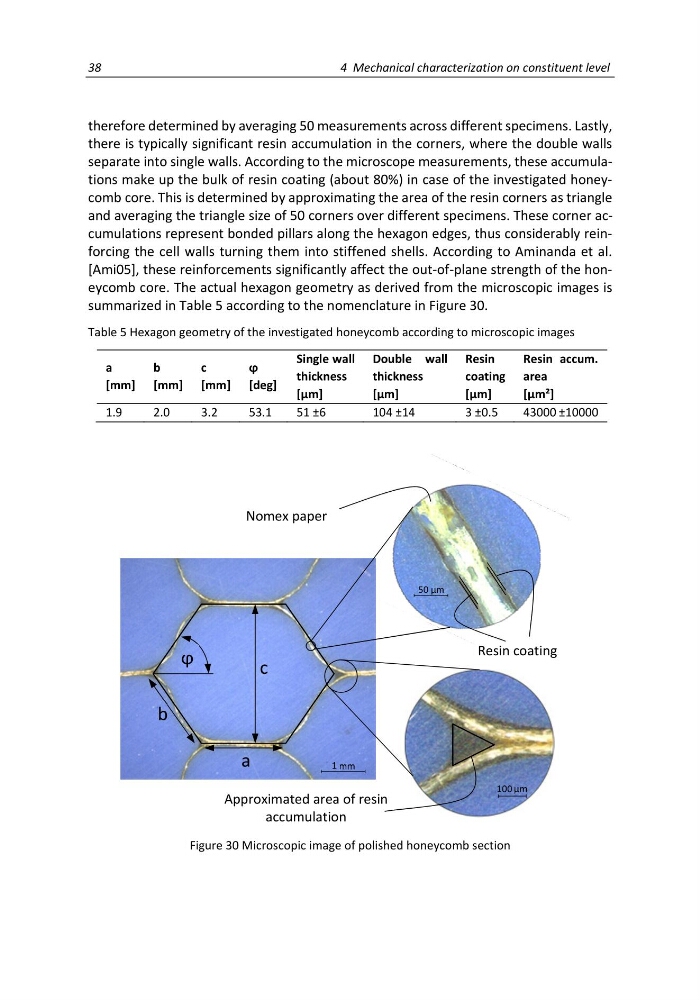
there is typically significant resin accumulation in the corners, where the double walls
separate into single walls. According to the microscope measurements, these accumulations make up the bulk of resin coating (about 80%) in case of the investigated honeycomb core. This is determined by approximating the area of the resin corners as triangle
and averaging the triangle size of 50 corners over different specimens. These corner accumulations represent bonded pillars along the hexagon edges, thus considerably reinforcing the cell walls turning them into stiffened shells. According to Aminanda et al.
[Ami05], these reinforcements significantly affect the out-of-plane strength of the honeycomb core. The actual hexagon geometry as derived from the microscopic images is
summarized in Table 5 according to the nomenclature in Figure 30.
Table 5 Hexagon geometry of the investigated honeycomb according to microscopic images
a
[mm]
b
[mm]
c
[mm]
ϕ
[deg]
Single wall
thickness
[µm]
Double wall
thickness
[µm]
Resin
coating
[µm]
Resin accum.
area
[µm²]
1.9
2.0
3.2
53.1
51 ±6
104 ±14
3 ±0.5
43000 ±10000
Figure 30 Microscopic image of polished honeycomb section
a
c
ϕ
b
50 µm
Resin coating
Approximated area of resin
accumulation
Nomex paper
4 Mechanical characterization on constituent level
therefore determined by averaging 50 measurements across different specimens. Lastly,
there is typically significant resin accumulation in the corners, where the double walls
separate into single walls. According to the microscope measurements, these accumulations make up the bulk of resin coating (about 80%) in case of the investigated honeycomb core. This is determined by approximating the area of the resin corners as triangle
and averaging the triangle size of 50 corners over different specimens. These corner accumulations represent bonded pillars along the hexagon edges, thus considerably reinforcing the cell walls turning them into stiffened shells. According to Aminanda et al.
[Ami05], these reinforcements significantly affect the out-of-plane strength of the honeycomb core. The actual hexagon geometry as derived from the microscopic images is
summarized in Table 5 according to the nomenclature in Figure 30.
Table 5 Hexagon geometry of the investigated honeycomb according to microscopic images
a
[mm]
b
[mm]
c
[mm]
ϕ
[deg]
Single wall
thickness
[µm]
Double wall
thickness
[µm]
Resin
coating
[µm]
Resin accum.
area
[µm²]
1.9
2.0
3.2
53.1
51 ±6
104 ±14
3 ±0.5
43000 ±10000
Figure 30 Microscopic image of polished honeycomb section
a
c
ϕ
b
50 µm
Resin coating
Approximated area of resin
accumulation
Nomex paper