

4.1 Sandwich core
37
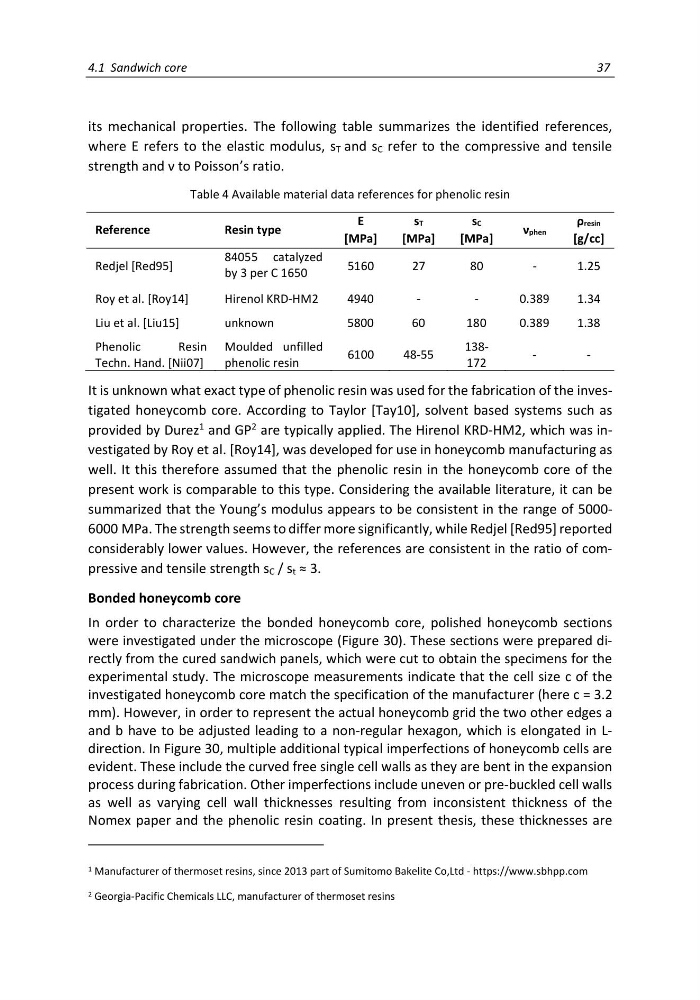
its mechanical properties. The following table summarizes the identified references,
where E refers to the elastic modulus, s T and s C refer to the compressive and tensile
strength and ν to Poisson’s ratio.
Table 4 Available material data references for phenolic resin
Reference
Resin type
E
[MPa]
sT
[MPa]
sC
[MPa]
νphen
ρresin
[g/cc]
Redjel [Red95]
84055 catalyzed
by 3 per C 1650
5160
27
80
-
1.25
Roy et al. [Roy14]
Hirenol KRD-HM2
4940
-
-
0.389
1.34
Liu et al. [Liu15]
unknown
5800
60
180
0.389
1.38
Phenolic
Resin
Techn. Hand. [Nii07]
Moulded unfilled
phenolic resin
6100
48-55
138172
-
-
It is unknown what exact type of phenolic resin was used for the fabrication of the investigated honeycomb core. According to Taylor [Tay10], solvent based systems such as
provided by Durez
1 and GP
2 are typically applied. The Hirenol KRD-HM2, which was investigated by Roy et al. [Roy14], was developed for use in honeycomb manufacturing as
well. It this therefore assumed that the phenolic resin in the honeycomb core of the
present work is comparable to this type. Considering the available literature, it can be
summarized that the Young’s modulus appears to be consistent in the range of 50006000 MPa. The strength seems to differ more significantly, while Redjel [Red95] reported
considerably lower values. However, the references are consistent in the ratio of compressive and tensile strength s C / s t ≈ 3.
Bonded honeycomb core
In order to characterize the bonded honeycomb core, polished honeycomb sections
were investigated under the microscope (Figure 30). These sections were prepared directly from the cured sandwich panels, which were cut to obtain the specimens for the
experimental study. The microscope measurements indicate that the cell size c of the
investigated honeycomb core match the specification of the manufacturer (here c = 3.2
mm). However, in order to represent the actual honeycomb grid the two other edges a
and b have to be adjusted leading to a non-regular hexagon, which is elongated in Ldirection. In Figure 30, multiple additional typical imperfections of honeycomb cells are
evident. These include the curved free single cell walls as they are bent in the expansion
process during fabrication. Other imperfections include uneven or pre-buckled cell walls
as well as varying cell wall thicknesses resulting from inconsistent thickness of the
Nomex paper and the phenolic resin coating. In present thesis, these thicknesses are
1 Manufacturer of thermoset resins, since 2013 part of Sumitomo Bakelite Co,Ltd - https://www.sbhpp.com
2 Georgia-Pacific Chemicals LLC, manufacturer of thermoset resins
37
its mechanical properties. The following table summarizes the identified references,
where E refers to the elastic modulus, s T and s C refer to the compressive and tensile
strength and ν to Poisson’s ratio.
Table 4 Available material data references for phenolic resin
Reference
Resin type
E
[MPa]
sT
[MPa]
sC
[MPa]
νphen
ρresin
[g/cc]
Redjel [Red95]
84055 catalyzed
by 3 per C 1650
5160
27
80
-
1.25
Roy et al. [Roy14]
Hirenol KRD-HM2
4940
-
-
0.389
1.34
Liu et al. [Liu15]
unknown
5800
60
180
0.389
1.38
Phenolic
Resin
Techn. Hand. [Nii07]
Moulded unfilled
phenolic resin
6100
48-55
138172
-
-
It is unknown what exact type of phenolic resin was used for the fabrication of the investigated honeycomb core. According to Taylor [Tay10], solvent based systems such as
provided by Durez
1 and GP
2 are typically applied. The Hirenol KRD-HM2, which was investigated by Roy et al. [Roy14], was developed for use in honeycomb manufacturing as
well. It this therefore assumed that the phenolic resin in the honeycomb core of the
present work is comparable to this type. Considering the available literature, it can be
summarized that the Young’s modulus appears to be consistent in the range of 50006000 MPa. The strength seems to differ more significantly, while Redjel [Red95] reported
considerably lower values. However, the references are consistent in the ratio of compressive and tensile strength s C / s t ≈ 3.
Bonded honeycomb core
In order to characterize the bonded honeycomb core, polished honeycomb sections
were investigated under the microscope (Figure 30). These sections were prepared directly from the cured sandwich panels, which were cut to obtain the specimens for the
experimental study. The microscope measurements indicate that the cell size c of the
investigated honeycomb core match the specification of the manufacturer (here c = 3.2
mm). However, in order to represent the actual honeycomb grid the two other edges a
and b have to be adjusted leading to a non-regular hexagon, which is elongated in Ldirection. In Figure 30, multiple additional typical imperfections of honeycomb cells are
evident. These include the curved free single cell walls as they are bent in the expansion
process during fabrication. Other imperfections include uneven or pre-buckled cell walls
as well as varying cell wall thicknesses resulting from inconsistent thickness of the
Nomex paper and the phenolic resin coating. In present thesis, these thicknesses are
1 Manufacturer of thermoset resins, since 2013 part of Sumitomo Bakelite Co,Ltd - https://www.sbhpp.com
2 Georgia-Pacific Chemicals LLC, manufacturer of thermoset resins