

156
8 Development of novel sandwich panel joints
Firstly, this solution requires an additional manufacturing step for removing the core.
Secondly, filling the cavity with potting can considerably increase the mass of the panel
considering that there may be dozens of inserts in a single panel. To overcome these
drawbacks a novel insert design, which attempts to utilize the design freedom of additive
manufacturing (AM), is proposed. The idea behind this design is to increase the potting
radius by increasing the radius of the insert itself, while the load from the insert center
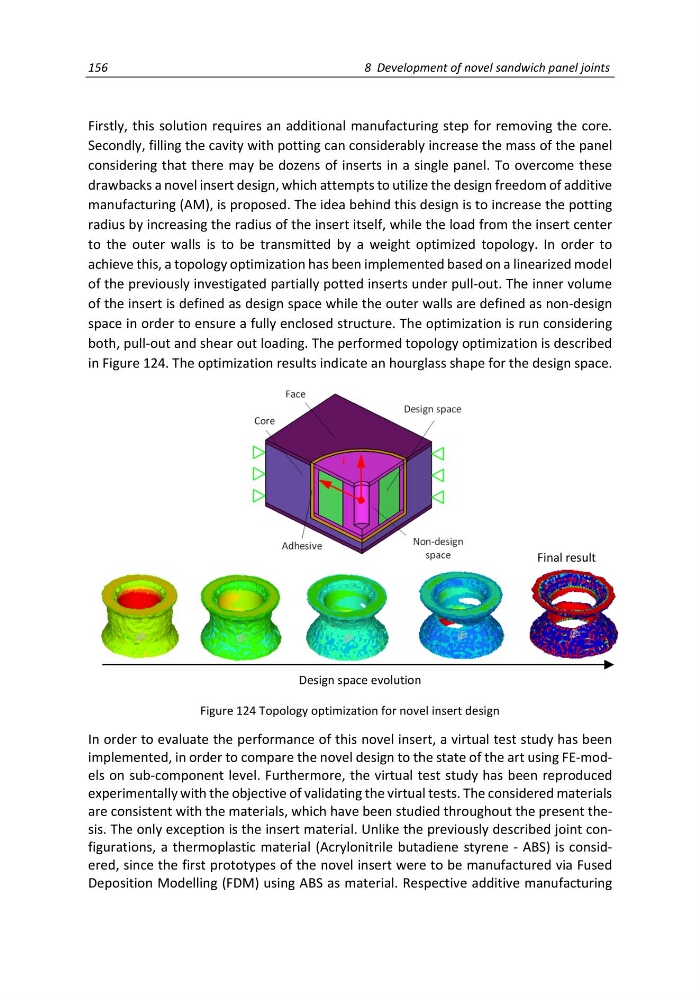
to the outer walls is to be transmitted by a weight optimized topology. In order to
achieve this, a topology optimization has been implemented based on a linearized model
of the previously investigated partially potted inserts under pull-out. The inner volume
of the insert is defined as design space while the outer walls are defined as non-design
space in order to ensure a fully enclosed structure. The optimization is run considering
both, pull-out and shear out loading. The performed topology optimization is described
in Figure 124. The optimization results indicate an hourglass shape for the design space.
Figure 124 Topology optimization for novel insert design
In order to evaluate the performance of this novel insert, a virtual test study has been
implemented, in order to compare the novel design to the state of the art using FE-models on sub-component level. Furthermore, the virtual test study has been reproduced
experimentally with the objective of validating the virtual tests. The considered materials
are consistent with the materials, which have been studied throughout the present thesis. The only exception is the insert material. Unlike the previously described joint configurations, a thermoplastic material (Acrylonitrile butadiene styrene - ABS) is considered, since the first prototypes of the novel insert were to be manufactured via Fused
Deposition Modelling (FDM) using ABS as material. Respective additive manufacturing
Design space evolution
Final result
8 Development of novel sandwich panel joints
Firstly, this solution requires an additional manufacturing step for removing the core.
Secondly, filling the cavity with potting can considerably increase the mass of the panel
considering that there may be dozens of inserts in a single panel. To overcome these
drawbacks a novel insert design, which attempts to utilize the design freedom of additive
manufacturing (AM), is proposed. The idea behind this design is to increase the potting
radius by increasing the radius of the insert itself, while the load from the insert center
to the outer walls is to be transmitted by a weight optimized topology. In order to
achieve this, a topology optimization has been implemented based on a linearized model
of the previously investigated partially potted inserts under pull-out. The inner volume
of the insert is defined as design space while the outer walls are defined as non-design
space in order to ensure a fully enclosed structure. The optimization is run considering
both, pull-out and shear out loading. The performed topology optimization is described
in Figure 124. The optimization results indicate an hourglass shape for the design space.
Figure 124 Topology optimization for novel insert design
In order to evaluate the performance of this novel insert, a virtual test study has been
implemented, in order to compare the novel design to the state of the art using FE-models on sub-component level. Furthermore, the virtual test study has been reproduced
experimentally with the objective of validating the virtual tests. The considered materials
are consistent with the materials, which have been studied throughout the present thesis. The only exception is the insert material. Unlike the previously described joint configurations, a thermoplastic material (Acrylonitrile butadiene styrene - ABS) is considered, since the first prototypes of the novel insert were to be manufactured via Fused
Deposition Modelling (FDM) using ABS as material. Respective additive manufacturing
Design space evolution
Final result