

8 Development of novel sandwich panel joints
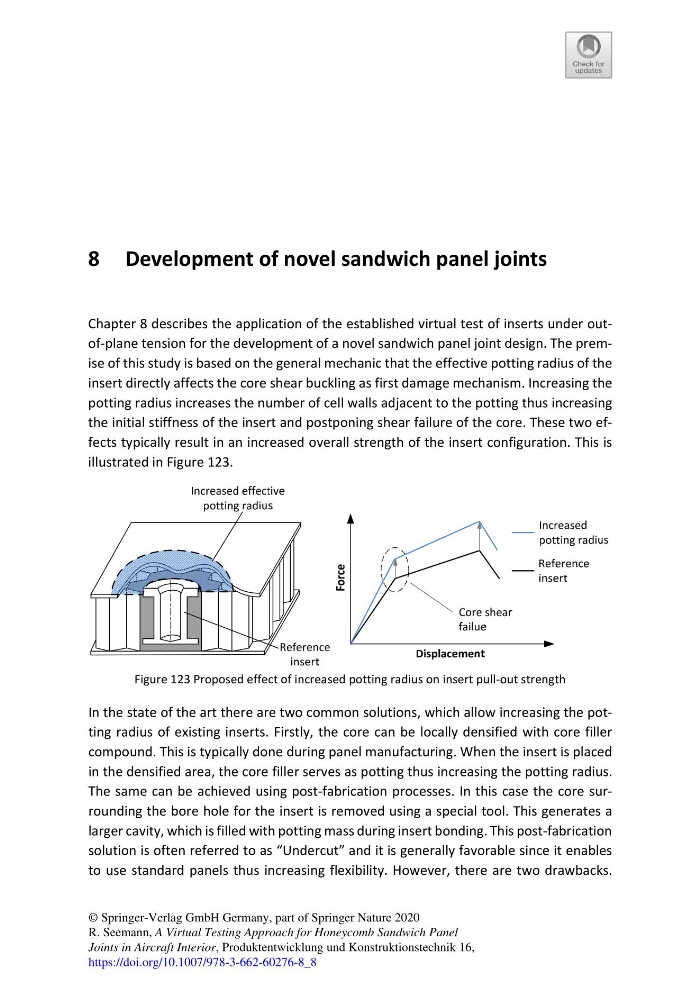
Chapter 8 describes the application of the established virtual test of inserts under outof-plane tension for the development of a novel sandwich panel joint design. The premise of this study is based on the general mechanic that the effective potting radius of the
insert directly affects the core shear buckling as first damage mechanism. Increasing the
potting radius increases the number of cell walls adjacent to the potting thus increasing
the initial stiffness of the insert and postponing shear failure of the core. These two effects typically result in an increased overall strength of the insert configuration. This is
illustrated in Figure 123.
Figure 123 Proposed effect of increased potting radius on insert pull-out strength
In the state of the art there are two common solutions, which allow increasing the potting radius of existing inserts. Firstly, the core can be locally densified with core filler
compound. This is typically done during panel manufacturing. When the insert is placed
in the densified area, the core filler serves as potting thus increasing the potting radius.
The same can be achieved using post-fabrication processes. In this case the core surrounding the bore hole for the insert is removed using a special tool. This generates a
larger cavity, which is filled with potting mass during insert bonding. This post-fabrication
solution is often referred to as “Undercut” and it is generally favorable since it enables
to use standard panels thus increasing flexibility. However, there are two drawbacks.
© Springer-Verlag GmbH Germany, part of Springer Nature 2020
R. Seemann, A Virtual Testing Approach for Honeycomb Sandwich Panel
Joints in Aircraft Interior, Produktentwicklung und Konstruktionstechnik 16,
https://doi.org/10.1007/978-3-662-60276-8_8
Chapter 8 describes the application of the established virtual test of inserts under outof-plane tension for the development of a novel sandwich panel joint design. The premise of this study is based on the general mechanic that the effective potting radius of the
insert directly affects the core shear buckling as first damage mechanism. Increasing the
potting radius increases the number of cell walls adjacent to the potting thus increasing
the initial stiffness of the insert and postponing shear failure of the core. These two effects typically result in an increased overall strength of the insert configuration. This is
illustrated in Figure 123.
Figure 123 Proposed effect of increased potting radius on insert pull-out strength
In the state of the art there are two common solutions, which allow increasing the potting radius of existing inserts. Firstly, the core can be locally densified with core filler
compound. This is typically done during panel manufacturing. When the insert is placed
in the densified area, the core filler serves as potting thus increasing the potting radius.
The same can be achieved using post-fabrication processes. In this case the core surrounding the bore hole for the insert is removed using a special tool. This generates a
larger cavity, which is filled with potting mass during insert bonding. This post-fabrication
solution is often referred to as “Undercut” and it is generally favorable since it enables
to use standard panels thus increasing flexibility. However, there are two drawbacks.
© Springer-Verlag GmbH Germany, part of Springer Nature 2020
R. Seemann, A Virtual Testing Approach for Honeycomb Sandwich Panel
Joints in Aircraft Interior, Produktentwicklung und Konstruktionstechnik 16,
https://doi.org/10.1007/978-3-662-60276-8_8