

8.1 Virtual testing of design alternatives
157
machines have been available in the framework of the present work. This enables flexible manufacturing of complicated insert geometries, such as the proposed novel insert
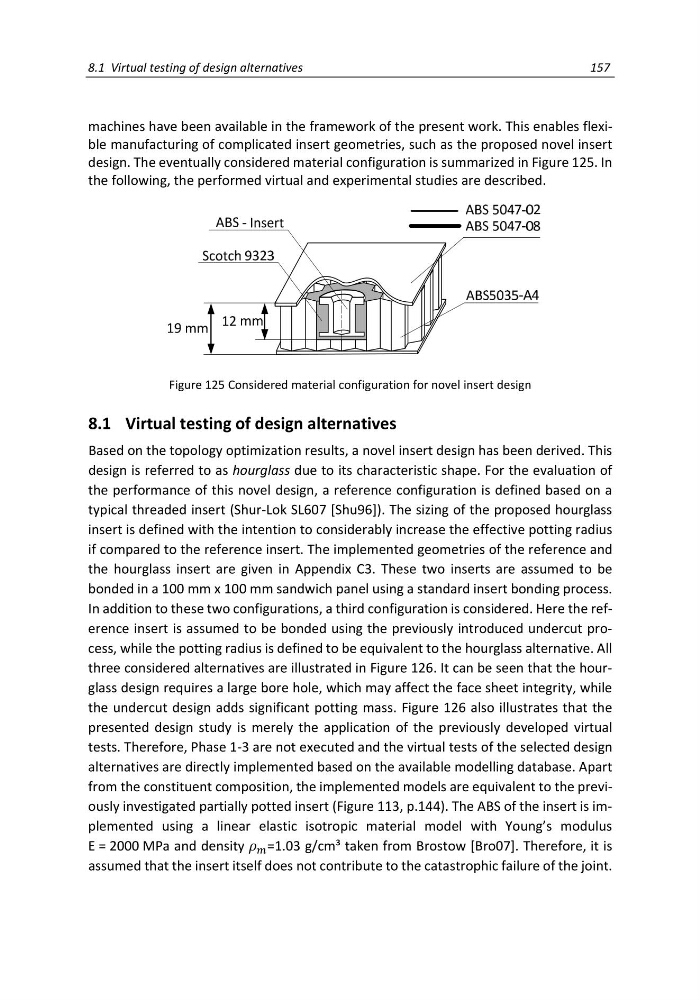
design. The eventually considered material configuration is summarized in Figure 125. In
the following, the performed virtual and experimental studies are described.
8.1 Virtual testing of design alternatives
Based on the topology optimization results, a novel insert design has been derived. This
design is referred to as hourglass due to its characteristic shape. For the evaluation of
the performance of this novel design, a reference configuration is defined based on a
typical threaded insert (Shur-Lok SL607 [Shu96]). The sizing of the proposed hourglass
insert is defined with the intention to considerably increase the effective potting radius
if compared to the reference insert. The implemented geometries of the reference and
the hourglass insert are given in Appendix C3. These two inserts are assumed to be
bonded in a 100 mm x 100 mm sandwich panel using a standard insert bonding process.
In addition to these two configurations, a third configuration is considered. Here the reference insert is assumed to be bonded using the previously introduced undercut process, while the potting radius is defined to be equivalent to the hourglass alternative. All
three considered alternatives are illustrated in Figure 126. It can be seen that the hourglass design requires a large bore hole, which may affect the face sheet integrity, while
the undercut design adds significant potting mass. Figure 126 also illustrates that the
presented design study is merely the application of the previously developed virtual
tests. Therefore, Phase 1-3 are not executed and the virtual tests of the selected design
alternatives are directly implemented based on the available modelling database. Apart
from the constituent composition, the implemented models are equivalent to the previously investigated partially potted insert (Figure 113, p.144). The ABS of the insert is implemented using a linear elastic isotropic material model with Young’s modulus
E = 2000 MPa and density =1.03 g/cm³ taken from Brostow [Bro07]. Therefore, it is
assumed that the insert itself does not contribute to the catastrophic failure of the joint.
Figure 125 Considered material configuration for novel insert design
157
machines have been available in the framework of the present work. This enables flexible manufacturing of complicated insert geometries, such as the proposed novel insert
design. The eventually considered material configuration is summarized in Figure 125. In
the following, the performed virtual and experimental studies are described.
8.1 Virtual testing of design alternatives
Based on the topology optimization results, a novel insert design has been derived. This
design is referred to as hourglass due to its characteristic shape. For the evaluation of
the performance of this novel design, a reference configuration is defined based on a
typical threaded insert (Shur-Lok SL607 [Shu96]). The sizing of the proposed hourglass
insert is defined with the intention to considerably increase the effective potting radius
if compared to the reference insert. The implemented geometries of the reference and
the hourglass insert are given in Appendix C3. These two inserts are assumed to be
bonded in a 100 mm x 100 mm sandwich panel using a standard insert bonding process.
In addition to these two configurations, a third configuration is considered. Here the reference insert is assumed to be bonded using the previously introduced undercut process, while the potting radius is defined to be equivalent to the hourglass alternative. All
three considered alternatives are illustrated in Figure 126. It can be seen that the hourglass design requires a large bore hole, which may affect the face sheet integrity, while
the undercut design adds significant potting mass. Figure 126 also illustrates that the
presented design study is merely the application of the previously developed virtual
tests. Therefore, Phase 1-3 are not executed and the virtual tests of the selected design
alternatives are directly implemented based on the available modelling database. Apart
from the constituent composition, the implemented models are equivalent to the previously investigated partially potted insert (Figure 113, p.144). The ABS of the insert is implemented using a linear elastic isotropic material model with Young’s modulus
E = 2000 MPa and density =1.03 g/cm³ taken from Brostow [Bro07]. Therefore, it is
assumed that the insert itself does not contribute to the catastrophic failure of the joint.
Figure 125 Considered material configuration for novel insert design