

7.4 Phase 3 - Model development
123
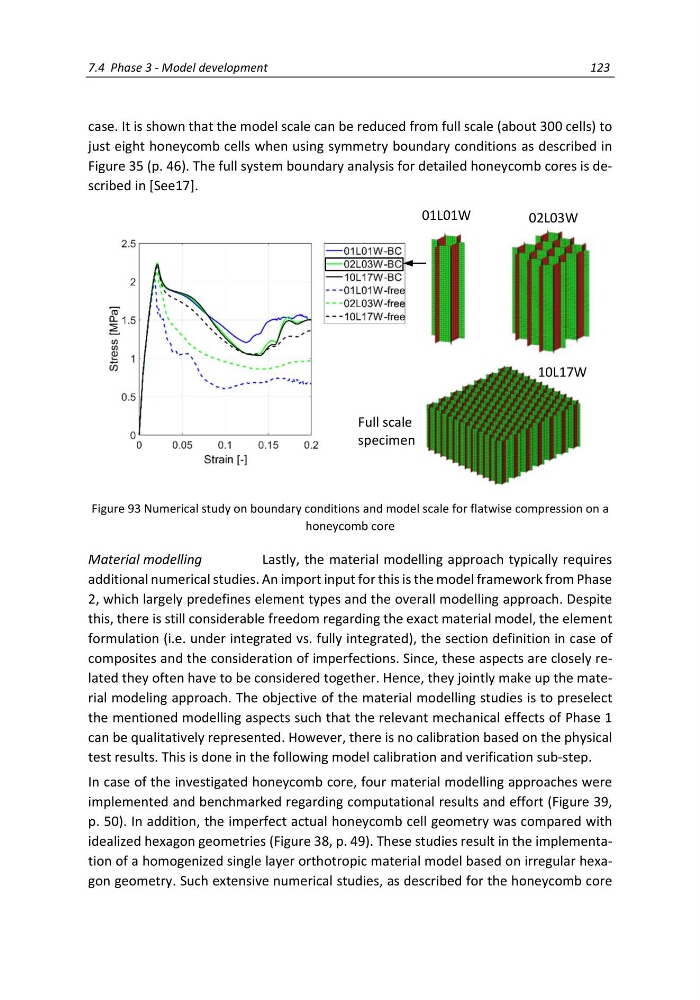
case. It is shown that the model scale can be reduced from full scale (about 300 cells) to
just eight honeycomb cells when using symmetry boundary conditions as described in
Figure 35 (p. 46). The full system boundary analysis for detailed honeycomb cores is described in [See17].
Figure 93 Numerical study on boundary conditions and model scale for flatwise compression on a
honeycomb core
Material modelling
Lastly, the material modelling approach typically requires
additional numerical studies. An import input for this is the model framework from Phase
2, which largely predefines element types and the overall modelling approach. Despite
this, there is still considerable freedom regarding the exact material model, the element
formulation (i.e. under integrated vs. fully integrated), the section definition in case of
composites and the consideration of imperfections. Since, these aspects are closely related they often have to be considered together. Hence, they jointly make up the material modeling approach. The objective of the material modelling studies is to preselect
the mentioned modelling aspects such that the relevant mechanical effects of Phase 1
can be qualitatively represented. However, there is no calibration based on the physical
test results. This is done in the following model calibration and verification sub-step.
In case of the investigated honeycomb core, four material modelling approaches were
implemented and benchmarked regarding computational results and effort (Figure 39,
p. 50). In addition, the imperfect actual honeycomb cell geometry was compared with
idealized hexagon geometries (Figure 38, p. 49). These studies result in the implementation of a homogenized single layer orthotropic material model based on irregular hexagon geometry. Such extensive numerical studies, as described for the honeycomb core
01L01W
02L03W
10L17W
Full scale
specimen
123
case. It is shown that the model scale can be reduced from full scale (about 300 cells) to
just eight honeycomb cells when using symmetry boundary conditions as described in
Figure 35 (p. 46). The full system boundary analysis for detailed honeycomb cores is described in [See17].
Figure 93 Numerical study on boundary conditions and model scale for flatwise compression on a
honeycomb core
Material modelling
Lastly, the material modelling approach typically requires
additional numerical studies. An import input for this is the model framework from Phase
2, which largely predefines element types and the overall modelling approach. Despite
this, there is still considerable freedom regarding the exact material model, the element
formulation (i.e. under integrated vs. fully integrated), the section definition in case of
composites and the consideration of imperfections. Since, these aspects are closely related they often have to be considered together. Hence, they jointly make up the material modeling approach. The objective of the material modelling studies is to preselect
the mentioned modelling aspects such that the relevant mechanical effects of Phase 1
can be qualitatively represented. However, there is no calibration based on the physical
test results. This is done in the following model calibration and verification sub-step.
In case of the investigated honeycomb core, four material modelling approaches were
implemented and benchmarked regarding computational results and effort (Figure 39,
p. 50). In addition, the imperfect actual honeycomb cell geometry was compared with
idealized hexagon geometries (Figure 38, p. 49). These studies result in the implementation of a homogenized single layer orthotropic material model based on irregular hexagon geometry. Such extensive numerical studies, as described for the honeycomb core
01L01W
02L03W
10L17W
Full scale
specimen