

118
7 Virtual testing approach for sandwich panel joints
Regarding the analysis methods, no additional post-test inspection was performed. This
is not necessary since the recorded life examination video images provide sufficient detail regarding the damage mechanism. However, pre-test inspection was performed
based on polished sections of the tested honeycomb cells, which were investigated under a light microscope. This is described in section 4.1.1. As a result of this analysis, the
irregular hexagon shape, cell wall thicknesses and resin distribution are characterized.
In sum, the first step of a building block investigation provides experimental data, which
characterizes a material or a mechanical effect for instance by means of stress-strain or
force-displacement relationships. This is complemented by analysis method results such
as video recordings, which provide reference for the progressive failure behavior. Additional analysis methods such as pre-test light microscopy may provide geometric data
for the FE-model representation.
FE-modelling and numerical studies
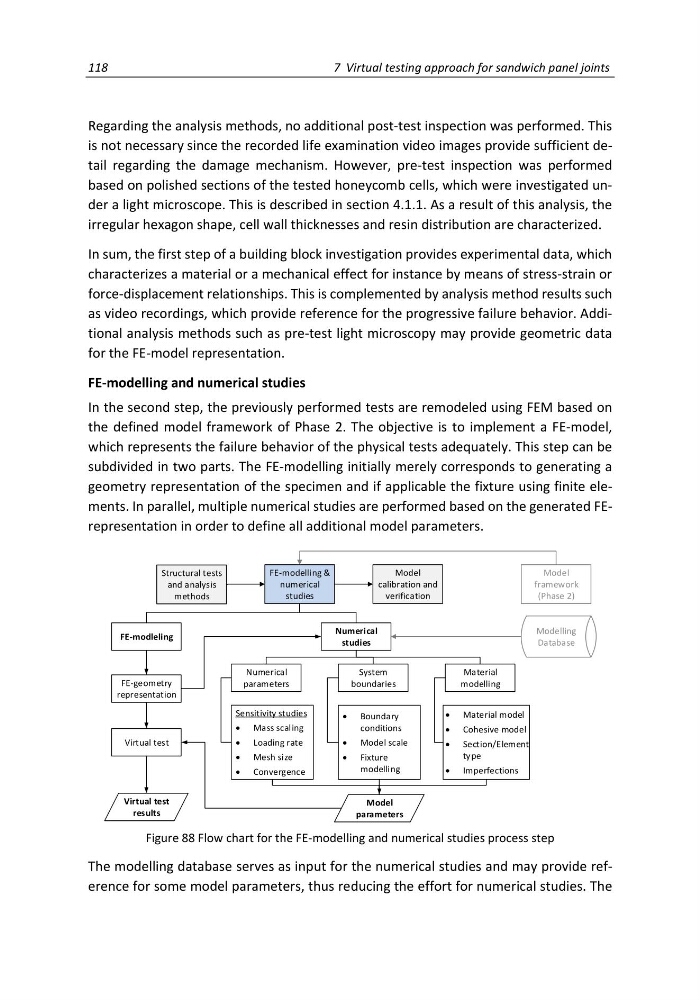
In the second step, the previously performed tests are remodeled using FEM based on
the defined model framework of Phase 2. The objective is to implement a FE-model,
which represents the failure behavior of the physical tests adequately. This step can be
subdivided in two parts. The FE-modelling initially merely corresponds to generating a
geometry representation of the specimen and if applicable the fixture using finite elements. In parallel, multiple numerical studies are performed based on the generated FErepresentation in order to define all additional model parameters.
Structural tests
and analysis
methods
FE-modelling &
numerical
studies
Model
calibration and
verification
FE-modleling
Virtual test
results
Material
modelling
Numerical
parameters
System
boundaries
Numerical
studies
FE-geometry
representation
Sensitivity studies
Mass scaling
Loading rate
Mesh size
Convergence
Boundary
conditions
Model scale
Fixture
modelling
Material model
Cohesive model
Section/Element
type
Imperfections
Model
parameters
Virtual test
Model
framework
(Phase 2)
Modelling
Database
Figure 88 Flow chart for the FE-modelling and numerical studies process step
The modelling database serves as input for the numerical studies and may provide reference for some model parameters, thus reducing the effort for numerical studies. The
7 Virtual testing approach for sandwich panel joints
Regarding the analysis methods, no additional post-test inspection was performed. This
is not necessary since the recorded life examination video images provide sufficient detail regarding the damage mechanism. However, pre-test inspection was performed
based on polished sections of the tested honeycomb cells, which were investigated under a light microscope. This is described in section 4.1.1. As a result of this analysis, the
irregular hexagon shape, cell wall thicknesses and resin distribution are characterized.
In sum, the first step of a building block investigation provides experimental data, which
characterizes a material or a mechanical effect for instance by means of stress-strain or
force-displacement relationships. This is complemented by analysis method results such
as video recordings, which provide reference for the progressive failure behavior. Additional analysis methods such as pre-test light microscopy may provide geometric data
for the FE-model representation.
FE-modelling and numerical studies
In the second step, the previously performed tests are remodeled using FEM based on
the defined model framework of Phase 2. The objective is to implement a FE-model,
which represents the failure behavior of the physical tests adequately. This step can be
subdivided in two parts. The FE-modelling initially merely corresponds to generating a
geometry representation of the specimen and if applicable the fixture using finite elements. In parallel, multiple numerical studies are performed based on the generated FErepresentation in order to define all additional model parameters.
Structural tests
and analysis
methods
FE-modelling &
numerical
studies
Model
calibration and
verification
FE-modleling
Virtual test
results
Material
modelling
Numerical
parameters
System
boundaries
Numerical
studies
FE-geometry
representation
Sensitivity studies
Mass scaling
Loading rate
Mesh size
Convergence
Boundary
conditions
Model scale
Fixture
modelling
Material model
Cohesive model
Section/Element
type
Imperfections
Model
parameters
Virtual test
Model
framework
(Phase 2)
Modelling
Database
Figure 88 Flow chart for the FE-modelling and numerical studies process step
The modelling database serves as input for the numerical studies and may provide reference for some model parameters, thus reducing the effort for numerical studies. The