

116
7 Virtual testing approach for sandwich panel joints
investigation. For instance, more complicated material models (i.e. orthotropic including
fracture) naturally require more structural tests and thus more FE-models and numerical
studies for deriving all material parameters if compared to simple material models (i.e.
isotropic elastic). Similarly, the number and type of analysis methods may differ depending on the composition of the specimen and the failure behavior.
In the following, the three steps are described using the example of the detailed honeycomb core of the reference test configuration. This is an extensive constituent level example, which gives a good overview over the different studies that may be required for
building block investigations. The mechanical characterization of the applied honeycomb
core including the implemented numerical models are described in section 4.1. Therefore, many references to this section are made in the following paragraphs.
Structural tests and analysis methods
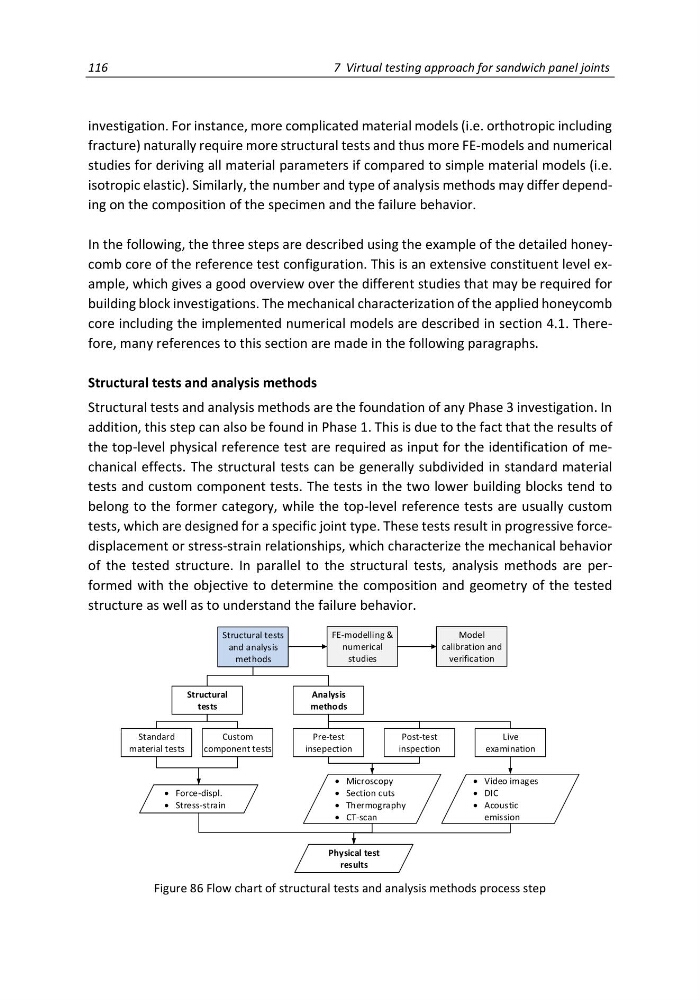
Structural tests and analysis methods are the foundation of any Phase 3 investigation. In
addition, this step can also be found in Phase 1. This is due to the fact that the results of
the top-level physical reference test are required as input for the identification of mechanical effects. The structural tests can be generally subdivided in standard material
tests and custom component tests. The tests in the two lower building blocks tend to
belong to the former category, while the top-level reference tests are usually custom
tests, which are designed for a specific joint type. These tests result in progressive forcedisplacement or stress-strain relationships, which characterize the mechanical behavior
of the tested structure. In parallel to the structural tests, analysis methods are performed with the objective to determine the composition and geometry of the tested
structure as well as to understand the failure behavior.
Structural tests
and analysis
methods
FE-modelling &
numerical
studies
Model
calibration and
verification
Structural
tests
Force-displ.
Stress-strain
Live
examination
Pre-test
insepection
Post-test
inspection
Analysis
methods
Standard
material tests
Custom
component tests
Microscopy
Section cuts
Thermography
CT-scan
Video images
DIC
Acoustic
emission
Physical test
results
Figure 86 Flow chart of structural tests and analysis methods process step
7 Virtual testing approach for sandwich panel joints
investigation. For instance, more complicated material models (i.e. orthotropic including
fracture) naturally require more structural tests and thus more FE-models and numerical
studies for deriving all material parameters if compared to simple material models (i.e.
isotropic elastic). Similarly, the number and type of analysis methods may differ depending on the composition of the specimen and the failure behavior.
In the following, the three steps are described using the example of the detailed honeycomb core of the reference test configuration. This is an extensive constituent level example, which gives a good overview over the different studies that may be required for
building block investigations. The mechanical characterization of the applied honeycomb
core including the implemented numerical models are described in section 4.1. Therefore, many references to this section are made in the following paragraphs.
Structural tests and analysis methods
Structural tests and analysis methods are the foundation of any Phase 3 investigation. In
addition, this step can also be found in Phase 1. This is due to the fact that the results of
the top-level physical reference test are required as input for the identification of mechanical effects. The structural tests can be generally subdivided in standard material
tests and custom component tests. The tests in the two lower building blocks tend to
belong to the former category, while the top-level reference tests are usually custom
tests, which are designed for a specific joint type. These tests result in progressive forcedisplacement or stress-strain relationships, which characterize the mechanical behavior
of the tested structure. In parallel to the structural tests, analysis methods are performed with the objective to determine the composition and geometry of the tested
structure as well as to understand the failure behavior.
Structural tests
and analysis
methods
FE-modelling &
numerical
studies
Model
calibration and
verification
Structural
tests
Force-displ.
Stress-strain
Live
examination
Pre-test
insepection
Post-test
inspection
Analysis
methods
Standard
material tests
Custom
component tests
Microscopy
Section cuts
Thermography
CT-scan
Video images
DIC
Acoustic
emission
Physical test
results
Figure 86 Flow chart of structural tests and analysis methods process step