

7.4 Phase 3 - Model development
115
The procedure for the investigations is based on close interaction between simulation
and available physical test data with the objective to virtually represent the physical
tests. The building blocks and the corresponding investigations are continued until the
top-level and thus the reference test is implemented as virtual test. The gained
knowledge of the investigations is transferred into the modelling database. Therefore,
the effort in future virtual test implementations is reduced in case existing material properties and modelling aspects can be adopted. A flow chart for Phase 3 is given in Figure
84. In the following, the general procedure for investigations is described before the
building blocks and the modelling database are described.
7.4.1 Investigation
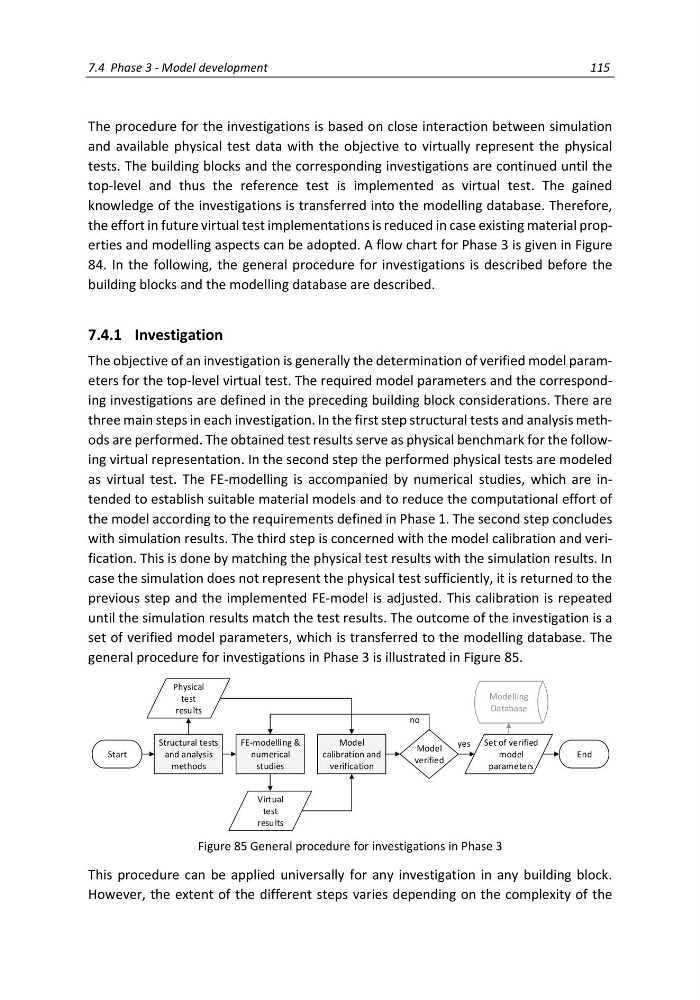
The objective of an investigation is generally the determination of verified model parameters for the top-level virtual test. The required model parameters and the corresponding investigations are defined in the preceding building block considerations. There are
three main steps in each investigation. In the first step structural tests and analysis methods are performed. The obtained test results serve as physical benchmark for the following virtual representation. In the second step the performed physical tests are modeled
as virtual test. The FE-modelling is accompanied by numerical studies, which are intended to establish suitable material models and to reduce the computational effort of
the model according to the requirements defined in Phase 1. The second step concludes
with simulation results. The third step is concerned with the model calibration and verification. This is done by matching the physical test results with the simulation results. In
case the simulation does not represent the physical test sufficiently, it is returned to the
previous step and the implemented FE-model is adjusted. This calibration is repeated
until the simulation results match the test results. The outcome of the investigation is a
set of verified model parameters, which is transferred to the modelling database. The
general procedure for investigations in Phase 3 is illustrated in Figure 85.
This procedure can be applied universally for any investigation in any building block.
However, the extent of the different steps varies depending on the complexity of the
Physical
test
results
Structural tests
and analysis
methods
FE-modelling &
numerical
studies
Model
calibration and
verification
Model
verified
no
Start
yes
Virtual
test
results
Set of verified
model
parameters
End
Modelling
Database
Figure 85 General procedure for investigations in Phase 3
115
The procedure for the investigations is based on close interaction between simulation
and available physical test data with the objective to virtually represent the physical
tests. The building blocks and the corresponding investigations are continued until the
top-level and thus the reference test is implemented as virtual test. The gained
knowledge of the investigations is transferred into the modelling database. Therefore,
the effort in future virtual test implementations is reduced in case existing material properties and modelling aspects can be adopted. A flow chart for Phase 3 is given in Figure
84. In the following, the general procedure for investigations is described before the
building blocks and the modelling database are described.
7.4.1 Investigation
The objective of an investigation is generally the determination of verified model parameters for the top-level virtual test. The required model parameters and the corresponding investigations are defined in the preceding building block considerations. There are
three main steps in each investigation. In the first step structural tests and analysis methods are performed. The obtained test results serve as physical benchmark for the following virtual representation. In the second step the performed physical tests are modeled
as virtual test. The FE-modelling is accompanied by numerical studies, which are intended to establish suitable material models and to reduce the computational effort of
the model according to the requirements defined in Phase 1. The second step concludes
with simulation results. The third step is concerned with the model calibration and verification. This is done by matching the physical test results with the simulation results. In
case the simulation does not represent the physical test sufficiently, it is returned to the
previous step and the implemented FE-model is adjusted. This calibration is repeated
until the simulation results match the test results. The outcome of the investigation is a
set of verified model parameters, which is transferred to the modelling database. The
general procedure for investigations in Phase 3 is illustrated in Figure 85.
This procedure can be applied universally for any investigation in any building block.
However, the extent of the different steps varies depending on the complexity of the
Physical
test
results
Structural tests
and analysis
methods
FE-modelling &
numerical
studies
Model
calibration and
verification
Model
verified
no
Start
yes
Virtual
test
results
Set of verified
model
parameters
End
Modelling
Database
Figure 85 General procedure for investigations in Phase 3