

8.7 Intestinal Development
483
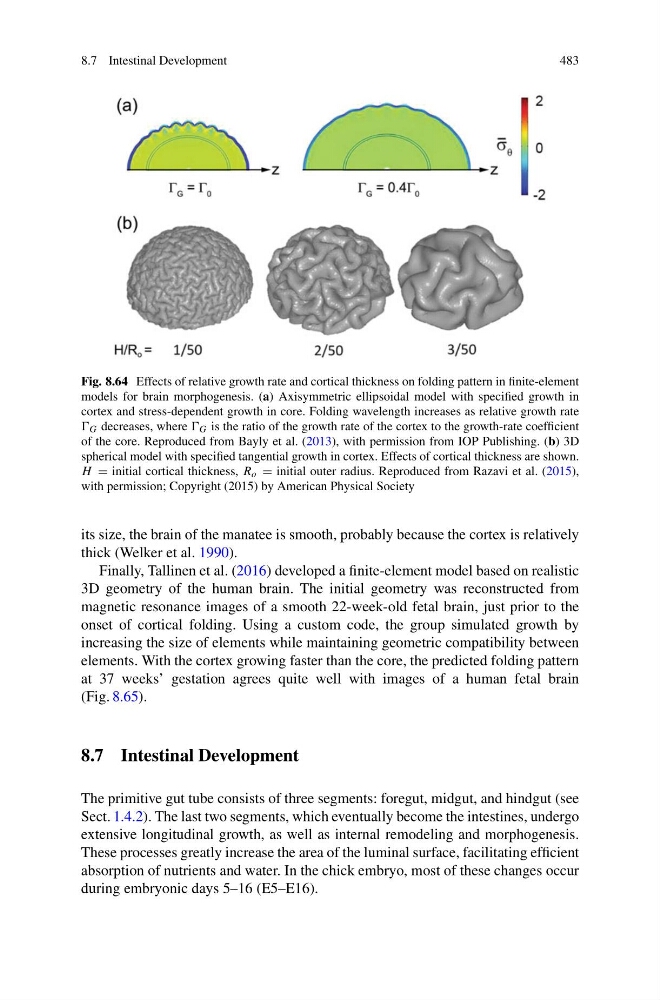
Fig. 8.64 Effects of relative growth rate and cortical thickness on folding pattern in finite-element
models for brain morphogenesis. (a) Axisymmetric ellipsoidal model with specified growth in
cortex and stress-dependent growth in core. Folding wavelength increases as relative growth rate
G decreases, where G is the ratio of the growth rate of the cortex to the growth-rate coefficient
of the core. Reproduced from Bayly et al. (2013), with permission from IOP Publishing. (b) 3D
spherical model with specified tangential growth in cortex. Effects of cortical thickness are shown.
H = initial cortical thickness, R o = initial outer radius. Reproduced from Razavi et al. (2015),
with permission; Copyright (2015) by American Physical Society
its size, the brain of the manatee is smooth, probably because the cortex is relatively
thick (Welker et al. 1990).
Finally, Tallinen et al. (2016) developed a finite-element model based on realistic
3D geometry of the human brain. The initial geometry was reconstructed from
magnetic resonance images of a smooth 22-week-old fetal brain, just prior to the
onset of cortical folding. Using a custom code, the group simulated growth by
increasing the size of elements while maintaining geometric compatibility between
elements. With the cortex growing faster than the core, the predicted folding pattern
at 37 weeks’ gestation agrees quite well with images of a human fetal brain
(Fig. 8.65).
8.7 Intestinal Development
The primitive gut tube consists of three segments: foregut, midgut, and hindgut (see
Sect. 1.4.2). The last two segments, which eventually become the intestines, undergo
extensive longitudinal growth, as well as internal remodeling and morphogenesis.
These processes greatly increase the area of the luminal surface, facilitating efficient
absorption of nutrients and water. In the chick embryo, most of these changes occur
during embryonic days 5–16 (E5–E16).
483
Fig. 8.64 Effects of relative growth rate and cortical thickness on folding pattern in finite-element
models for brain morphogenesis. (a) Axisymmetric ellipsoidal model with specified growth in
cortex and stress-dependent growth in core. Folding wavelength increases as relative growth rate
G decreases, where G is the ratio of the growth rate of the cortex to the growth-rate coefficient
of the core. Reproduced from Bayly et al. (2013), with permission from IOP Publishing. (b) 3D
spherical model with specified tangential growth in cortex. Effects of cortical thickness are shown.
H = initial cortical thickness, R o = initial outer radius. Reproduced from Razavi et al. (2015),
with permission; Copyright (2015) by American Physical Society
its size, the brain of the manatee is smooth, probably because the cortex is relatively
thick (Welker et al. 1990).
Finally, Tallinen et al. (2016) developed a finite-element model based on realistic
3D geometry of the human brain. The initial geometry was reconstructed from
magnetic resonance images of a smooth 22-week-old fetal brain, just prior to the
onset of cortical folding. Using a custom code, the group simulated growth by
increasing the size of elements while maintaining geometric compatibility between
elements. With the cortex growing faster than the core, the predicted folding pattern
at 37 weeks’ gestation agrees quite well with images of a human fetal brain
(Fig. 8.65).
8.7 Intestinal Development
The primitive gut tube consists of three segments: foregut, midgut, and hindgut (see
Sect. 1.4.2). The last two segments, which eventually become the intestines, undergo
extensive longitudinal growth, as well as internal remodeling and morphogenesis.
These processes greatly increase the area of the luminal surface, facilitating efficient
absorption of nutrients and water. In the chick embryo, most of these changes occur
during embryonic days 5–16 (E5–E16).