

112
3 Continuum Mechanics and Nonlinear Elasticity
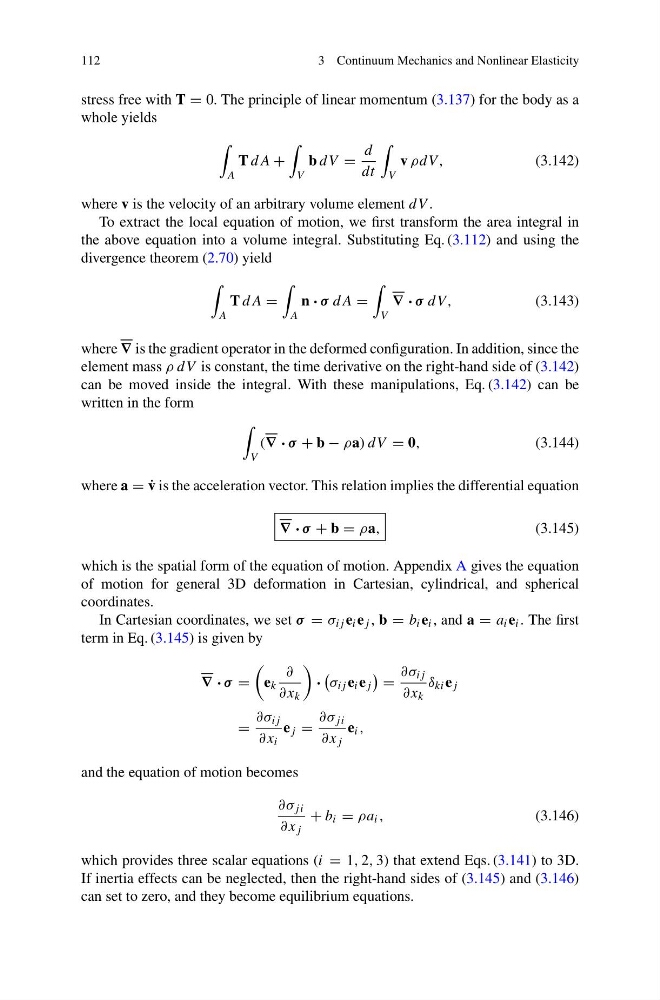
stress free with T = 0. The principle of linear momentum (3.137) for the body as a
whole yields
A
T dA +
V
b dV =
d
dt
V
v ρdV ,
(3.142)
where v is the velocity of an arbitrary volume element dV .
To extract the local equation of motion, we first transform the area integral in
the above equation into a volume integral. Substituting Eq. (3.112) and using the
divergence theorem (2.70) yield
A
T dA =
A
n · σ dA =
V
∇ · σ dV ,
(3.143)
where ∇ is the gradient operator in the deformed configuration. In addition, since the
element mass ρ dV is constant, the time derivative on the right-hand side of (3.142)
can be moved inside the integral. With these manipulations, Eq. (3.142) can be
written in the form
V
(∇ · σ + b − ρa) dV = 0,
(3.144)
where a = ˙
v is the acceleration vector. This relation implies the differential equation
∇ · σ + b = ρa,
(3.145)
which is the spatial form of the equation of motion. Appendix A gives the equation
of motion for general 3D deformation in Cartesian, cylindrical, and spherical
coordinates.
In Cartesian coordinates, we set σ = σ ij e i e j , b = b i e i , and a = a i e i . The first
term in Eq. (3.145) is given by
∇ · σ =
e k
∂
∂x k
·
σ ij e i e j
=
∂σ ij
∂x k
δ ki e j
=
∂σ ij
∂x i
e j =
∂σ ji
∂x j
e i ,
and the equation of motion becomes
∂σ ji
∂x j
+ b i = ρa i ,
(3.146)
which provides three scalar equations (i = 1, 2, 3) that extend Eqs. (3.141) to 3D.
If inertia effects can be neglected, then the right-hand sides of (3.145) and (3.146)
can set to zero, and they become equilibrium equations.
3 Continuum Mechanics and Nonlinear Elasticity
stress free with T = 0. The principle of linear momentum (3.137) for the body as a
whole yields
A
T dA +
V
b dV =
d
dt
V
v ρdV ,
(3.142)
where v is the velocity of an arbitrary volume element dV .
To extract the local equation of motion, we first transform the area integral in
the above equation into a volume integral. Substituting Eq. (3.112) and using the
divergence theorem (2.70) yield
A
T dA =
A
n · σ dA =
V
∇ · σ dV ,
(3.143)
where ∇ is the gradient operator in the deformed configuration. In addition, since the
element mass ρ dV is constant, the time derivative on the right-hand side of (3.142)
can be moved inside the integral. With these manipulations, Eq. (3.142) can be
written in the form
V
(∇ · σ + b − ρa) dV = 0,
(3.144)
where a = ˙
v is the acceleration vector. This relation implies the differential equation
∇ · σ + b = ρa,
(3.145)
which is the spatial form of the equation of motion. Appendix A gives the equation
of motion for general 3D deformation in Cartesian, cylindrical, and spherical
coordinates.
In Cartesian coordinates, we set σ = σ ij e i e j , b = b i e i , and a = a i e i . The first
term in Eq. (3.145) is given by
∇ · σ =
e k
∂
∂x k
·
σ ij e i e j
=
∂σ ij
∂x k
δ ki e j
=
∂σ ij
∂x i
e j =
∂σ ji
∂x j
e i ,
and the equation of motion becomes
∂σ ji
∂x j
+ b i = ρa i ,
(3.146)
which provides three scalar equations (i = 1, 2, 3) that extend Eqs. (3.141) to 3D.
If inertia effects can be neglected, then the right-hand sides of (3.145) and (3.146)
can set to zero, and they become equilibrium equations.