

3.5 Balance Laws
111
For the element shown in Fig. 3.18, summing forces in the x-direction yields
−σ xx dydz +
σ xx +
∂σ xx
∂x
dx
dydz − σ yx dxdz
+
σ yx +
∂σ yx
∂y
dy
dxdz + b x dxdydz = (ρ dxdydz) a x ,
with a similar expression for the y-direction. With a x and a y being acceleration
components, simplifying these equations gives
∂σ xx
∂x
+
∂σ yx
∂y
+ b x = ρa x
∂σ xy
∂x
+
∂σ yy
∂y
+ b y = ρa y ,
(3.141)
which represent the spatial form of the differential equations of motion in 2D.
Equation of Motion in 3D
It should be relatively easy to see how Eqs. (3.141) can be extended to 3D, but here
we begin with the equation of motion for an entire solid body. Treating the body as a
collection of particles, we set the net force acting on the body equal to the time rate
of change of the total momentum for all its particles. Since all the internal contact
forces cancel themselves out via Newton’s third law of action-reaction, the net force
is determined by summing all surface and body forces acting on the body.
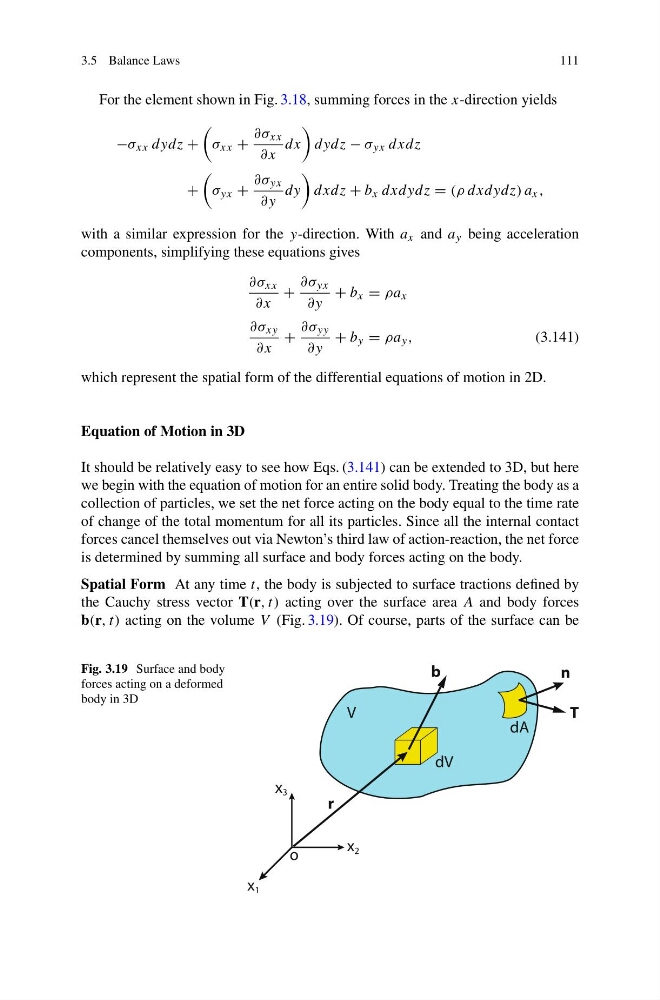
Spatial Form At any time t, the body is subjected to surface tractions defined by
the Cauchy stress vector T(r, t) acting over the surface area A and body forces
b(r, t) acting on the volume V (Fig. 3.19). Of course, parts of the surface can be
Fig. 3.19 Surface and body
forces acting on a deformed
body in 3D
n
T
b
V
r
dV
dA
x 2
x 1
x 3
o
111
For the element shown in Fig. 3.18, summing forces in the x-direction yields
−σ xx dydz +
σ xx +
∂σ xx
∂x
dx
dydz − σ yx dxdz
+
σ yx +
∂σ yx
∂y
dy
dxdz + b x dxdydz = (ρ dxdydz) a x ,
with a similar expression for the y-direction. With a x and a y being acceleration
components, simplifying these equations gives
∂σ xx
∂x
+
∂σ yx
∂y
+ b x = ρa x
∂σ xy
∂x
+
∂σ yy
∂y
+ b y = ρa y ,
(3.141)
which represent the spatial form of the differential equations of motion in 2D.
Equation of Motion in 3D
It should be relatively easy to see how Eqs. (3.141) can be extended to 3D, but here
we begin with the equation of motion for an entire solid body. Treating the body as a
collection of particles, we set the net force acting on the body equal to the time rate
of change of the total momentum for all its particles. Since all the internal contact
forces cancel themselves out via Newton’s third law of action-reaction, the net force
is determined by summing all surface and body forces acting on the body.
Spatial Form At any time t, the body is subjected to surface tractions defined by
the Cauchy stress vector T(r, t) acting over the surface area A and body forces
b(r, t) acting on the volume V (Fig. 3.19). Of course, parts of the surface can be
Fig. 3.19 Surface and body
forces acting on a deformed
body in 3D
n
T
b
V
r
dV
dA
x 2
x 1
x 3
o