

3.5 Balance Laws
113
Material Form For small deformation of a body at rest, the undeformed and
deformed configurations differ only slightly, and differences between material and
spatial coordinates can be neglected when taking derivatives. This approximation
simplifies the analysis considerably, because derivatives are taken relative to
the known undeformed coordinates. For problems involving large deformation,
however, derivatives must be taken with respect to spatial coordinates, which are
not known a priori. One way around this complication is to use the material form
of the governing equations.
To derive the equation of motion in material form, we first change the spatial
variables in Eq. (3.142) to material variables defined relative to the initial geometry.
Inserting T dA = T 0 dA 0 from (3.116) and defining the body force b 0 (R, t) and
mass density ρ 0 (R, t) relative to the undeformed volume V 0 yield
A 0
T
0 dA
0
+
V 0
b 0 dV
0
=
d
dt
V 0
vρ 0 dV
0 .
(3.147)
The rest of the derivation parallels that given above for the spatial form. First, we
use Eqs. (3.115) 1 and (2.70) to transform the surface integral to a volume integral,
i.e.,
A 0
T
0 dA
0
=
A 0
N · P dA
0
=
V 0
∇ · P dV
0 ,
(3.148)
where ∇ is the gradient operator in the undeformed configuration. The inertia term
becomes
d
dt
V 0
v ρ 0 dV
0
=
V 0
a ρ 0 dV
0 ,
(3.149)
since ρ 0 dV 0 is the constant mass of an element. Combining these expressions yields
V 0
(∇ · P + b 0 − ρ 0 a) dV
0
= 0,
(3.150)
which gives the differential equation of motion
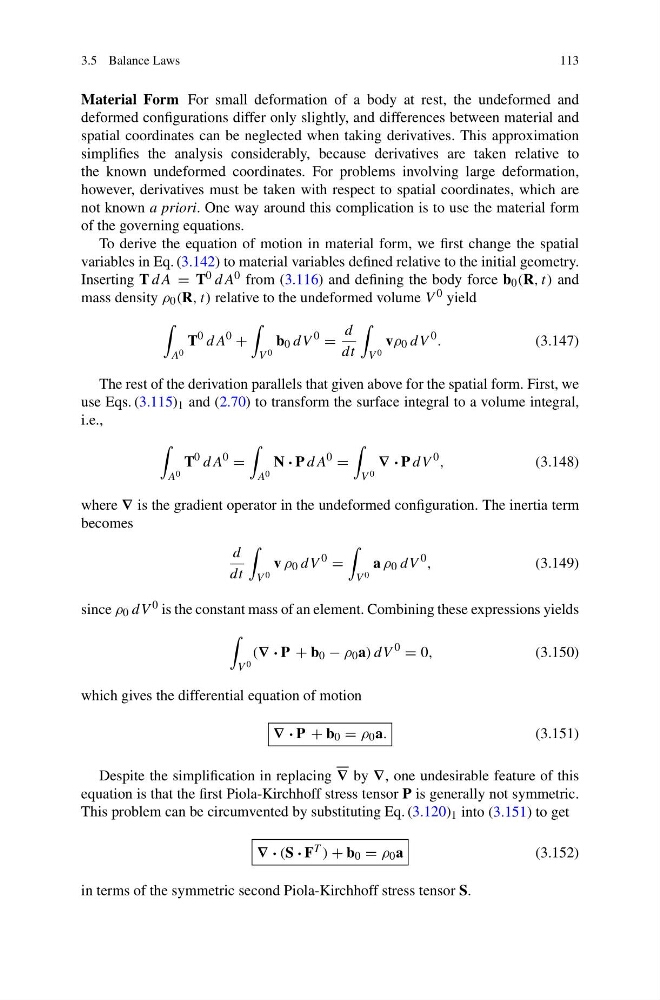
∇ · P + b 0 = ρ 0 a.
(3.151)
Despite the simplification in replacing ∇ by ∇, one undesirable feature of this
equation is that the first Piola-Kirchhoff stress tensor P is generally not symmetric.
This problem can be circumvented by substituting Eq. (3.120) 1 into (3.151) to get
∇ · (S · F T ) + b 0 = ρ 0 a
(3.152)
in terms of the symmetric second Piola-Kirchhoff stress tensor S.
113
Material Form For small deformation of a body at rest, the undeformed and
deformed configurations differ only slightly, and differences between material and
spatial coordinates can be neglected when taking derivatives. This approximation
simplifies the analysis considerably, because derivatives are taken relative to
the known undeformed coordinates. For problems involving large deformation,
however, derivatives must be taken with respect to spatial coordinates, which are
not known a priori. One way around this complication is to use the material form
of the governing equations.
To derive the equation of motion in material form, we first change the spatial
variables in Eq. (3.142) to material variables defined relative to the initial geometry.
Inserting T dA = T 0 dA 0 from (3.116) and defining the body force b 0 (R, t) and
mass density ρ 0 (R, t) relative to the undeformed volume V 0 yield
A 0
T
0 dA
0
+
V 0
b 0 dV
0
=
d
dt
V 0
vρ 0 dV
0 .
(3.147)
The rest of the derivation parallels that given above for the spatial form. First, we
use Eqs. (3.115) 1 and (2.70) to transform the surface integral to a volume integral,
i.e.,
A 0
T
0 dA
0
=
A 0
N · P dA
0
=
V 0
∇ · P dV
0 ,
(3.148)
where ∇ is the gradient operator in the undeformed configuration. The inertia term
becomes
d
dt
V 0
v ρ 0 dV
0
=
V 0
a ρ 0 dV
0 ,
(3.149)
since ρ 0 dV 0 is the constant mass of an element. Combining these expressions yields
V 0
(∇ · P + b 0 − ρ 0 a) dV
0
= 0,
(3.150)
which gives the differential equation of motion
∇ · P + b 0 = ρ 0 a.
(3.151)
Despite the simplification in replacing ∇ by ∇, one undesirable feature of this
equation is that the first Piola-Kirchhoff stress tensor P is generally not symmetric.
This problem can be circumvented by substituting Eq. (3.120) 1 into (3.151) to get
∇ · (S · F T ) + b 0 = ρ 0 a
(3.152)
in terms of the symmetric second Piola-Kirchhoff stress tensor S.