

6.4 Reaction with Acetone and Formaldehyde
89
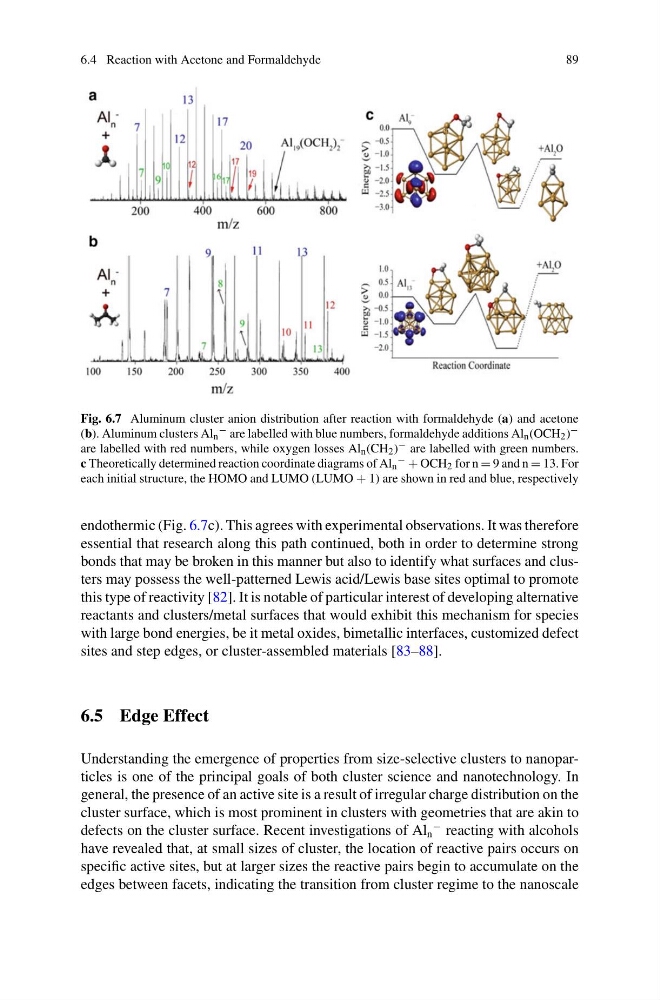
Fig. 6.7 Aluminum cluster anion distribution after reaction with formaldehyde (a) and acetone
(b). Aluminum clusters Al n
− are labelled with blue numbers, formaldehyde additions Al n (OCH 2 ) −
are labelled with red numbers, while oxygen losses Al n (CH 2 ) − are labelled with green numbers.
c Theoretically determined reaction coordinate diagrams of Al n
− + OCH 2 for n = 9 and n = 13. For
each initial structure, the HOMO and LUMO (LUMO + 1) are shown in red and blue, respectively
endothermic (Fig. 6.7c). This agrees with experimental observations. It was therefore
essential that research along this path continued, both in order to determine strong
bonds that may be broken in this manner but also to identify what surfaces and clusters may possess the well-patterned Lewis acid/Lewis base sites optimal to promote
this type of reactivity [82]. It is notable of particular interest of developing alternative
reactants and clusters/metal surfaces that would exhibit this mechanism for species
with large bond energies, be it metal oxides, bimetallic interfaces, customized defect
sites and step edges, or cluster-assembled materials [83–88].
6.5 Edge Effect
Understanding the emergence of properties from size-selective clusters to nanoparticles is one of the principal goals of both cluster science and nanotechnology. In
general, the presence of an active site is a result of irregular charge distribution on the
cluster surface, which is most prominent in clusters with geometries that are akin to
defects on the cluster surface. Recent investigations of Al n
− reacting with alcohols
have revealed that, at small sizes of cluster, the location of reactive pairs occurs on
specific active sites, but at larger sizes the reactive pairs begin to accumulate on the
edges between facets, indicating the transition from cluster regime to the nanoscale
89
Fig. 6.7 Aluminum cluster anion distribution after reaction with formaldehyde (a) and acetone
(b). Aluminum clusters Al n
− are labelled with blue numbers, formaldehyde additions Al n (OCH 2 ) −
are labelled with red numbers, while oxygen losses Al n (CH 2 ) − are labelled with green numbers.
c Theoretically determined reaction coordinate diagrams of Al n
− + OCH 2 for n = 9 and n = 13. For
each initial structure, the HOMO and LUMO (LUMO + 1) are shown in red and blue, respectively
endothermic (Fig. 6.7c). This agrees with experimental observations. It was therefore
essential that research along this path continued, both in order to determine strong
bonds that may be broken in this manner but also to identify what surfaces and clusters may possess the well-patterned Lewis acid/Lewis base sites optimal to promote
this type of reactivity [82]. It is notable of particular interest of developing alternative
reactants and clusters/metal surfaces that would exhibit this mechanism for species
with large bond energies, be it metal oxides, bimetallic interfaces, customized defect
sites and step edges, or cluster-assembled materials [83–88].
6.5 Edge Effect
Understanding the emergence of properties from size-selective clusters to nanoparticles is one of the principal goals of both cluster science and nanotechnology. In
general, the presence of an active site is a result of irregular charge distribution on the
cluster surface, which is most prominent in clusters with geometries that are akin to
defects on the cluster surface. Recent investigations of Al n
− reacting with alcohols
have revealed that, at small sizes of cluster, the location of reactive pairs occurs on
specific active sites, but at larger sizes the reactive pairs begin to accumulate on the
edges between facets, indicating the transition from cluster regime to the nanoscale