

88
6 Cooperative Active-Sites Mechanism
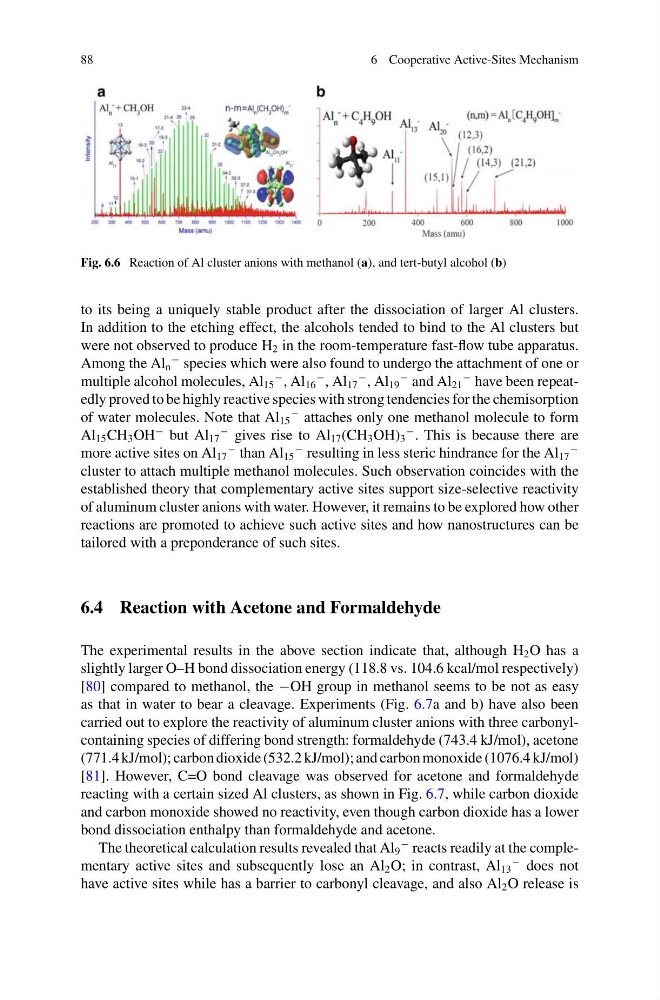
Fig. 6.6 Reaction of Al cluster anions with methanol (a), and tert-butyl alcohol (b)
to its being a uniquely stable product after the dissociation of larger Al clusters.
In addition to the etching effect, the alcohols tended to bind to the Al clusters but
were not observed to produce H 2 in the room-temperature fast-flow tube apparatus.
Among the Al n
− species which were also found to undergo the attachment of one or
multiple alcohol molecules, Al 15
− , Al 16
− , Al 17
− , Al 19
− and Al 21
− have been repeatedly proved to be highly reactive species with strong tendencies for the chemisorption
of water molecules. Note that Al 15
− attaches only one methanol molecule to form
Al 15 CH 3 OH
− but Al 17
− gives rise to Al 17 (CH 3 OH) 3
− . This is because there are
more active sites on Al 17
− than Al 15
− resulting in less steric hindrance for the Al 17
−
cluster to attach multiple methanol molecules. Such observation coincides with the
established theory that complementary active sites support size-selective reactivity
of aluminum cluster anions with water. However, it remains to be explored how other
reactions are promoted to achieve such active sites and how nanostructures can be
tailored with a preponderance of such sites.
6.4 Reaction with Acetone and Formaldehyde
The experimental results in the above section indicate that, although H 2 O has a
slightly larger O–H bond dissociation energy (118.8 vs. 104.6 kcal/mol respectively)
[80] compared to methanol, the −OH group in methanol seems to be not as easy
as that in water to bear a cleavage. Experiments (Fig. 6.7a and b) have also been
carried out to explore the reactivity of aluminum cluster anions with three carbonylcontaining species of differing bond strength: formaldehyde (743.4 kJ/mol), acetone
(771.4 kJ/mol); carbon dioxide (532.2 kJ/mol); and carbon monoxide (1076.4 kJ/mol)
[81]. However, C=O bond cleavage was observed for acetone and formaldehyde
reacting with a certain sized Al clusters, as shown in Fig. 6.7, while carbon dioxide
and carbon monoxide showed no reactivity, even though carbon dioxide has a lower
bond dissociation enthalpy than formaldehyde and acetone.
The theoretical calculation results revealed that Al 9
− reacts readily at the complementary active sites and subsequently lose an Al 2 O; in contrast, Al 13
− does not
have active sites while has a barrier to carbonyl cleavage, and also Al 2 O release is
6 Cooperative Active-Sites Mechanism
Fig. 6.6 Reaction of Al cluster anions with methanol (a), and tert-butyl alcohol (b)
to its being a uniquely stable product after the dissociation of larger Al clusters.
In addition to the etching effect, the alcohols tended to bind to the Al clusters but
were not observed to produce H 2 in the room-temperature fast-flow tube apparatus.
Among the Al n
− species which were also found to undergo the attachment of one or
multiple alcohol molecules, Al 15
− , Al 16
− , Al 17
− , Al 19
− and Al 21
− have been repeatedly proved to be highly reactive species with strong tendencies for the chemisorption
of water molecules. Note that Al 15
− attaches only one methanol molecule to form
Al 15 CH 3 OH
− but Al 17
− gives rise to Al 17 (CH 3 OH) 3
− . This is because there are
more active sites on Al 17
− than Al 15
− resulting in less steric hindrance for the Al 17
−
cluster to attach multiple methanol molecules. Such observation coincides with the
established theory that complementary active sites support size-selective reactivity
of aluminum cluster anions with water. However, it remains to be explored how other
reactions are promoted to achieve such active sites and how nanostructures can be
tailored with a preponderance of such sites.
6.4 Reaction with Acetone and Formaldehyde
The experimental results in the above section indicate that, although H 2 O has a
slightly larger O–H bond dissociation energy (118.8 vs. 104.6 kcal/mol respectively)
[80] compared to methanol, the −OH group in methanol seems to be not as easy
as that in water to bear a cleavage. Experiments (Fig. 6.7a and b) have also been
carried out to explore the reactivity of aluminum cluster anions with three carbonylcontaining species of differing bond strength: formaldehyde (743.4 kJ/mol), acetone
(771.4 kJ/mol); carbon dioxide (532.2 kJ/mol); and carbon monoxide (1076.4 kJ/mol)
[81]. However, C=O bond cleavage was observed for acetone and formaldehyde
reacting with a certain sized Al clusters, as shown in Fig. 6.7, while carbon dioxide
and carbon monoxide showed no reactivity, even though carbon dioxide has a lower
bond dissociation enthalpy than formaldehyde and acetone.
The theoretical calculation results revealed that Al 9
− reacts readily at the complementary active sites and subsequently lose an Al 2 O; in contrast, Al 13
− does not
have active sites while has a barrier to carbonyl cleavage, and also Al 2 O release is