

6.1 Reaction of Aluminum Clusters with Water
83
pair of adjacent Al atoms is responsible for the dissociative chemisorption of water
molecules. Considering the initial interaction between water and Al n
− clusters is
the nucleophilic attack of a water molecule on the Al surface, this reaction requires
the donation of lone-pair electrons from water to the LUMO of the Al cluster (or
LUMO + 1 for odd-electron systems as the lone pair interacts most strongly with
the levels where both spin states are unoccupied) where the probability density of
the vacant orbital protrudes out from the cluster structure into vacuum [7]. Further,
the transition state for splitting water in an Eley–Rideal-type mechanism requires
the previously dissociated H atom to act as the Lewis acid, rather than an Al atom,
which is consistent with the size selectivity for Al n
− clusters reacting with water
whether or not giving rise to H 2 release. A free H atom on the cluster surface with
a neighboring Lewis acid site is likely to be attained in many clusters after reacting
with a single water molecule, but only those with paired active sites result in the
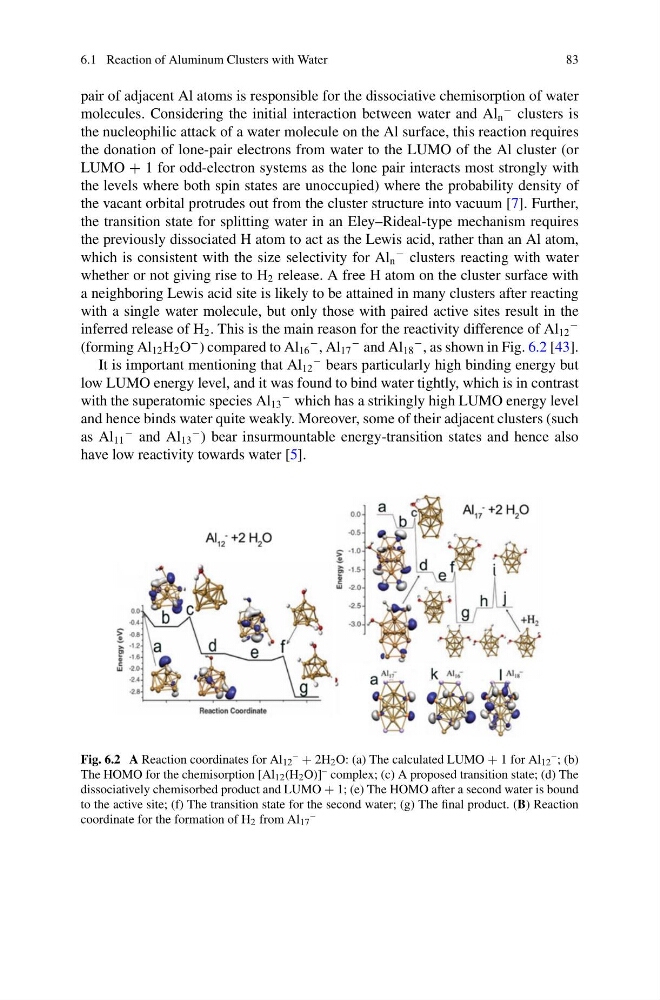
inferred release of H 2 . This is the main reason for the reactivity difference of Al 12
−
(forming Al 12 H 2 O
− ) compared to Al 16
− , Al 17
− and Al 18
− , as shown in Fig. 6.2 [43].
It is important mentioning that Al 12
− bears particularly high binding energy but
low LUMO energy level, and it was found to bind water tightly, which is in contrast
with the superatomic species Al 13
− which has a strikingly high LUMO energy level
and hence binds water quite weakly. Moreover, some of their adjacent clusters (such
as Al 11
− and Al 13
− ) bear insurmountable energy-transition states and hence also
have low reactivity towards water [5].
Fig. 6.2 A Reaction coordinates for Al 12
– + 2H 2 O: (a) The calculated LUMO + 1 for Al 12
– ; (b)
The HOMO for the chemisorption [Al 12 (H 2 O)] – complex; (c) A proposed transition state; (d) The
dissociatively chemisorbed product and LUMO + 1; (e) The HOMO after a second water is bound
to the active site; (f) The transition state for the second water; (g) The final product. (B) Reaction
coordinate for the formation of H 2 from Al 17
–
83
pair of adjacent Al atoms is responsible for the dissociative chemisorption of water
molecules. Considering the initial interaction between water and Al n
− clusters is
the nucleophilic attack of a water molecule on the Al surface, this reaction requires
the donation of lone-pair electrons from water to the LUMO of the Al cluster (or
LUMO + 1 for odd-electron systems as the lone pair interacts most strongly with
the levels where both spin states are unoccupied) where the probability density of
the vacant orbital protrudes out from the cluster structure into vacuum [7]. Further,
the transition state for splitting water in an Eley–Rideal-type mechanism requires
the previously dissociated H atom to act as the Lewis acid, rather than an Al atom,
which is consistent with the size selectivity for Al n
− clusters reacting with water
whether or not giving rise to H 2 release. A free H atom on the cluster surface with
a neighboring Lewis acid site is likely to be attained in many clusters after reacting
with a single water molecule, but only those with paired active sites result in the
inferred release of H 2 . This is the main reason for the reactivity difference of Al 12
−
(forming Al 12 H 2 O
− ) compared to Al 16
− , Al 17
− and Al 18
− , as shown in Fig. 6.2 [43].
It is important mentioning that Al 12
− bears particularly high binding energy but
low LUMO energy level, and it was found to bind water tightly, which is in contrast
with the superatomic species Al 13
− which has a strikingly high LUMO energy level
and hence binds water quite weakly. Moreover, some of their adjacent clusters (such
as Al 11
− and Al 13
− ) bear insurmountable energy-transition states and hence also
have low reactivity towards water [5].
Fig. 6.2 A Reaction coordinates for Al 12
– + 2H 2 O: (a) The calculated LUMO + 1 for Al 12
– ; (b)
The HOMO for the chemisorption [Al 12 (H 2 O)] – complex; (c) A proposed transition state; (d) The
dissociatively chemisorbed product and LUMO + 1; (e) The HOMO after a second water is bound
to the active site; (f) The transition state for the second water; (g) The final product. (B) Reaction
coordinate for the formation of H 2 from Al 17
–