

82
6 Cooperative Active-Sites Mechanism
6.1 Reaction of Aluminum Clusters with Water
Abundant theoretical and experimental investigations on the reactivity of metal clusters with water have attracted reasonable research interest partly due to the importance of hydrogen evolution being involved [23–42]. Among the extensive literature
reports, there is an interesting study by Castleman, Khanna and their colleagues [7]
who reported the size selectivity of aluminum cluster anion reacting with water. They
found that identical arrangements of multiple sites in Al 16
− , Al 17
− , and Al 18
− result in
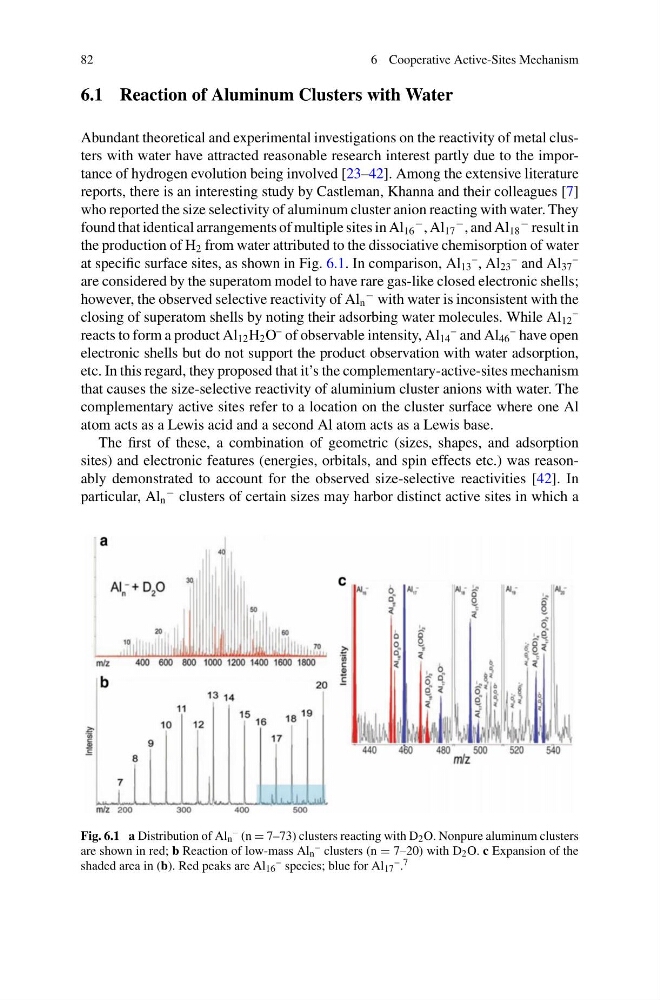
the production of H 2 from water attributed to the dissociative chemisorption of water
at specific surface sites, as shown in Fig. 6.1. In comparison, Al 13
– , Al 23
– and Al 37
–
are considered by the superatom model to have rare gas-like closed electronic shells;
however, the observed selective reactivity of Al n
− with water is inconsistent with the
closing of superatom shells by noting their adsorbing water molecules. While Al 12
–
reacts to form a product Al 12 H 2 O
– of observable intensity, Al 14
– and Al 46
– have open
electronic shells but do not support the product observation with water adsorption,
etc. In this regard, they proposed that it’s the complementary-active-sites mechanism
that causes the size-selective reactivity of aluminium cluster anions with water. The
complementary active sites refer to a location on the cluster surface where one Al
atom acts as a Lewis acid and a second Al atom acts as a Lewis base.
The first of these, a combination of geometric (sizes, shapes, and adsorption
sites) and electronic features (energies, orbitals, and spin effects etc.) was reasonably demonstrated to account for the observed size-selective reactivities [42]. In
particular, Al n
− clusters of certain sizes may harbor distinct active sites in which a
Fig. 6.1 a Distribution of Al n
– (n = 7–73) clusters reacting with D 2 O. Nonpure aluminum clusters
are shown in red; b Reaction of low-mass Al n
– clusters (n = 7–20) with D 2 O. c Expansion of the
shaded area in (b). Red peaks are Al 16
– species; blue for Al 17
– . 7
6 Cooperative Active-Sites Mechanism
6.1 Reaction of Aluminum Clusters with Water
Abundant theoretical and experimental investigations on the reactivity of metal clusters with water have attracted reasonable research interest partly due to the importance of hydrogen evolution being involved [23–42]. Among the extensive literature
reports, there is an interesting study by Castleman, Khanna and their colleagues [7]
who reported the size selectivity of aluminum cluster anion reacting with water. They
found that identical arrangements of multiple sites in Al 16
− , Al 17
− , and Al 18
− result in
the production of H 2 from water attributed to the dissociative chemisorption of water
at specific surface sites, as shown in Fig. 6.1. In comparison, Al 13
– , Al 23
– and Al 37
–
are considered by the superatom model to have rare gas-like closed electronic shells;
however, the observed selective reactivity of Al n
− with water is inconsistent with the
closing of superatom shells by noting their adsorbing water molecules. While Al 12
–
reacts to form a product Al 12 H 2 O
– of observable intensity, Al 14
– and Al 46
– have open
electronic shells but do not support the product observation with water adsorption,
etc. In this regard, they proposed that it’s the complementary-active-sites mechanism
that causes the size-selective reactivity of aluminium cluster anions with water. The
complementary active sites refer to a location on the cluster surface where one Al
atom acts as a Lewis acid and a second Al atom acts as a Lewis base.
The first of these, a combination of geometric (sizes, shapes, and adsorption
sites) and electronic features (energies, orbitals, and spin effects etc.) was reasonably demonstrated to account for the observed size-selective reactivities [42]. In
particular, Al n
− clusters of certain sizes may harbor distinct active sites in which a
Fig. 6.1 a Distribution of Al n
– (n = 7–73) clusters reacting with D 2 O. Nonpure aluminum clusters
are shown in red; b Reaction of low-mass Al n
– clusters (n = 7–20) with D 2 O. c Expansion of the
shaded area in (b). Red peaks are Al 16
– species; blue for Al 17
– . 7