

84
6 Cooperative Active-Sites Mechanism
6.2 Reaction with H 2 S and NH 3
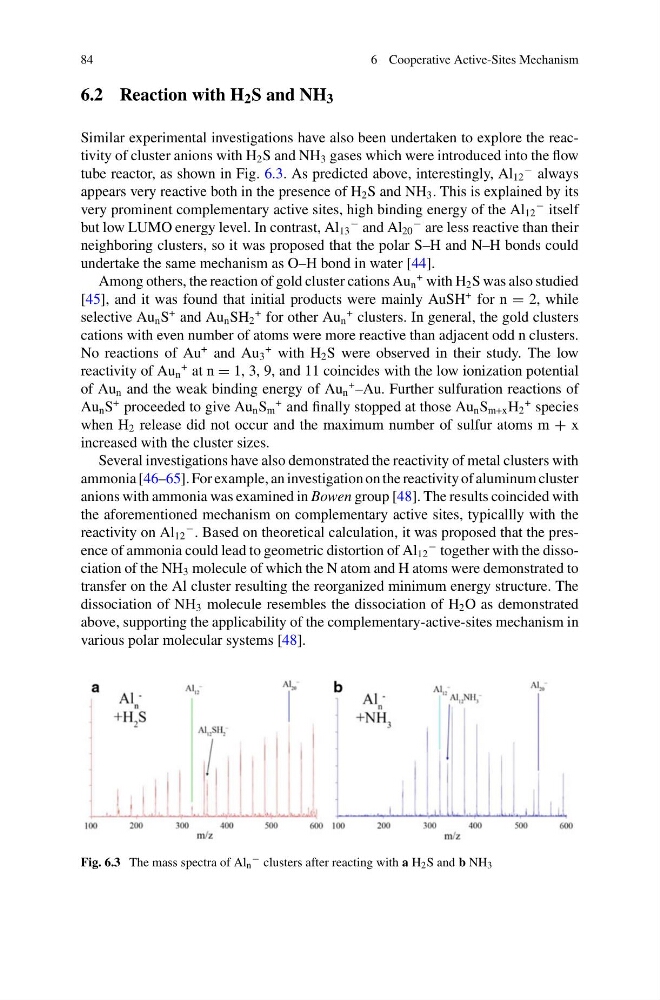
Similar experimental investigations have also been undertaken to explore the reactivity of cluster anions with H 2 S and NH 3 gases which were introduced into the flow
tube reactor, as shown in Fig. 6.3. As predicted above, interestingly, Al 12
− always
appears very reactive both in the presence of H 2 S and NH 3 . This is explained by its
very prominent complementary active sites, high binding energy of the Al 12
− itself
but low LUMO energy level. In contrast, Al 13
− and Al 20
− are less reactive than their
neighboring clusters, so it was proposed that the polar S–H and N–H bonds could
undertake the same mechanism as O–H bond in water [44].
Among others, the reaction of gold cluster cations Au n
+ with H 2 S was also studied
[45], and it was found that initial products were mainly AuSH
+ for n = 2, while
selective Au n S
+ and Au n SH 2
+ for other Au n
+ clusters. In general, the gold clusters
cations with even number of atoms were more reactive than adjacent odd n clusters.
No reactions of Au
+ and Au 3
+ with H 2 S were observed in their study. The low
reactivity of Au n
+ at n = 1, 3, 9, and 11 coincides with the low ionization potential
of Au n and the weak binding energy of Au n
+ –Au. Further sulfuration reactions of
Au n S
+ proceeded to give Au n S m
+ and finally stopped at those Au n S m+x H 2
+ species
when H 2 release did not occur and the maximum number of sulfur atoms m + x
increased with the cluster sizes.
Several investigations have also demonstrated the reactivity of metal clusters with
ammonia [46–65]. For example, an investigation on the reactivity of aluminum cluster
anions with ammonia was examined in Bowen group [48]. The results coincided with
the aforementioned mechanism on complementary active sites, typicallly with the
reactivity on Al 12
− . Based on theoretical calculation, it was proposed that the presence of ammonia could lead to geometric distortion of Al 12
− together with the dissociation of the NH 3 molecule of which the N atom and H atoms were demonstrated to
transfer on the Al cluster resulting the reorganized minimum energy structure. The
dissociation of NH 3 molecule resembles the dissociation of H 2 O as demonstrated
above, supporting the applicability of the complementary-active-sites mechanism in
various polar molecular systems [48].
Fig. 6.3 The mass spectra of Al n
− clusters after reacting with a H 2 S and b NH 3
6 Cooperative Active-Sites Mechanism
6.2 Reaction with H 2 S and NH 3
Similar experimental investigations have also been undertaken to explore the reactivity of cluster anions with H 2 S and NH 3 gases which were introduced into the flow
tube reactor, as shown in Fig. 6.3. As predicted above, interestingly, Al 12
− always
appears very reactive both in the presence of H 2 S and NH 3 . This is explained by its
very prominent complementary active sites, high binding energy of the Al 12
− itself
but low LUMO energy level. In contrast, Al 13
− and Al 20
− are less reactive than their
neighboring clusters, so it was proposed that the polar S–H and N–H bonds could
undertake the same mechanism as O–H bond in water [44].
Among others, the reaction of gold cluster cations Au n
+ with H 2 S was also studied
[45], and it was found that initial products were mainly AuSH
+ for n = 2, while
selective Au n S
+ and Au n SH 2
+ for other Au n
+ clusters. In general, the gold clusters
cations with even number of atoms were more reactive than adjacent odd n clusters.
No reactions of Au
+ and Au 3
+ with H 2 S were observed in their study. The low
reactivity of Au n
+ at n = 1, 3, 9, and 11 coincides with the low ionization potential
of Au n and the weak binding energy of Au n
+ –Au. Further sulfuration reactions of
Au n S
+ proceeded to give Au n S m
+ and finally stopped at those Au n S m+x H 2
+ species
when H 2 release did not occur and the maximum number of sulfur atoms m + x
increased with the cluster sizes.
Several investigations have also demonstrated the reactivity of metal clusters with
ammonia [46–65]. For example, an investigation on the reactivity of aluminum cluster
anions with ammonia was examined in Bowen group [48]. The results coincided with
the aforementioned mechanism on complementary active sites, typicallly with the
reactivity on Al 12
− . Based on theoretical calculation, it was proposed that the presence of ammonia could lead to geometric distortion of Al 12
− together with the dissociation of the NH 3 molecule of which the N atom and H atoms were demonstrated to
transfer on the Al cluster resulting the reorganized minimum energy structure. The
dissociation of NH 3 molecule resembles the dissociation of H 2 O as demonstrated
above, supporting the applicability of the complementary-active-sites mechanism in
various polar molecular systems [48].
Fig. 6.3 The mass spectra of Al n
− clusters after reacting with a H 2 S and b NH 3