

5.2 The Reactivity with Nitrogen
75
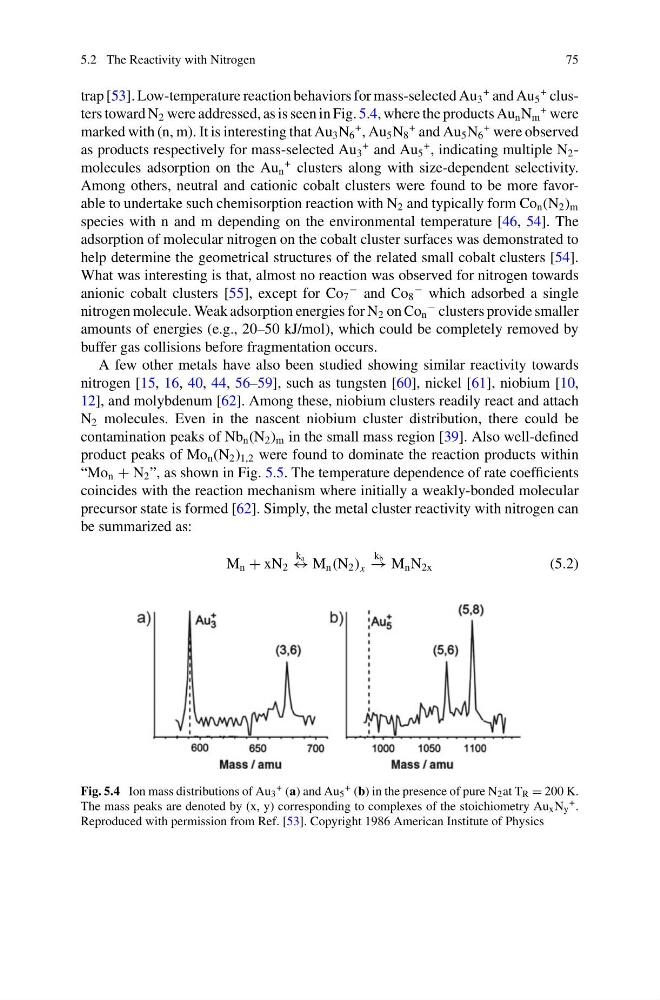
trap [53]. Low-temperature reaction behaviors for mass-selected Au 3
+ and Au 5
+ clusters toward N 2 were addressed, as is seen in Fig. 5.4, where the products Au n N m
+ were
marked with (n, m). It is interesting that Au 3 N 6
+ , Au 5 N 8
+ and Au 5 N 6
+ were observed
as products respectively for mass-selected Au 3
+ and Au 5
+ , indicating multiple N 2 -
molecules adsorption on the Au n
+ clusters along with size-dependent selectivity.
Among others, neutral and cationic cobalt clusters were found to be more favorable to undertake such chemisorption reaction with N 2 and typically form Co n (N 2 ) m
species with n and m depending on the environmental temperature [46, 54]. The
adsorption of molecular nitrogen on the cobalt cluster surfaces was demonstrated to
help determine the geometrical structures of the related small cobalt clusters [54].
What was interesting is that, almost no reaction was observed for nitrogen towards
anionic cobalt clusters [55], except for Co 7
− and Co 8
− which adsorbed a single
nitrogen molecule. Weak adsorption energies for N 2 on Co n
− clusters provide smaller
amounts of energies (e.g., 20–50 kJ/mol), which could be completely removed by
buffer gas collisions before fragmentation occurs.
A few other metals have also been studied showing similar reactivity towards
nitrogen [15, 16, 40, 44, 56–59], such as tungsten [60], nickel [61], niobium [10,
12], and molybdenum [62]. Among these, niobium clusters readily react and attach
N 2 molecules. Even in the nascent niobium cluster distribution, there could be
contamination peaks of Nb n (N 2 ) m in the small mass region [39]. Also well-defined
product peaks of Mo n (N 2 ) 1,2 were found to dominate the reaction products within
“Mo n + N 2 ”, as shown in Fig. 5.5. The temperature dependence of rate coefficients
coincides with the reaction mechanism where initially a weakly-bonded molecular
precursor state is formed [62]. Simply, the metal cluster reactivity with nitrogen can
be summarized as:
M n + xN 2
k a
↔ M n (N 2 ) x
k b
→ M n N 2x
(5.2)
Fig. 5.4 Ion mass distributions of Au 3
+ (a) and Au 5
+ (b) in the presence of pure N 2 at T R = 200 K.
The mass peaks are denoted by (x, y) corresponding to complexes of the stoichiometry Au x N y
+ .
Reproduced with permission from Ref. [53]. Copyright 1986 American Institute of Physics
75
trap [53]. Low-temperature reaction behaviors for mass-selected Au 3
+ and Au 5
+ clusters toward N 2 were addressed, as is seen in Fig. 5.4, where the products Au n N m
+ were
marked with (n, m). It is interesting that Au 3 N 6
+ , Au 5 N 8
+ and Au 5 N 6
+ were observed
as products respectively for mass-selected Au 3
+ and Au 5
+ , indicating multiple N 2 -
molecules adsorption on the Au n
+ clusters along with size-dependent selectivity.
Among others, neutral and cationic cobalt clusters were found to be more favorable to undertake such chemisorption reaction with N 2 and typically form Co n (N 2 ) m
species with n and m depending on the environmental temperature [46, 54]. The
adsorption of molecular nitrogen on the cobalt cluster surfaces was demonstrated to
help determine the geometrical structures of the related small cobalt clusters [54].
What was interesting is that, almost no reaction was observed for nitrogen towards
anionic cobalt clusters [55], except for Co 7
− and Co 8
− which adsorbed a single
nitrogen molecule. Weak adsorption energies for N 2 on Co n
− clusters provide smaller
amounts of energies (e.g., 20–50 kJ/mol), which could be completely removed by
buffer gas collisions before fragmentation occurs.
A few other metals have also been studied showing similar reactivity towards
nitrogen [15, 16, 40, 44, 56–59], such as tungsten [60], nickel [61], niobium [10,
12], and molybdenum [62]. Among these, niobium clusters readily react and attach
N 2 molecules. Even in the nascent niobium cluster distribution, there could be
contamination peaks of Nb n (N 2 ) m in the small mass region [39]. Also well-defined
product peaks of Mo n (N 2 ) 1,2 were found to dominate the reaction products within
“Mo n + N 2 ”, as shown in Fig. 5.5. The temperature dependence of rate coefficients
coincides with the reaction mechanism where initially a weakly-bonded molecular
precursor state is formed [62]. Simply, the metal cluster reactivity with nitrogen can
be summarized as:
M n + xN 2
k a
↔ M n (N 2 ) x
k b
→ M n N 2x
(5.2)
Fig. 5.4 Ion mass distributions of Au 3
+ (a) and Au 5
+ (b) in the presence of pure N 2 at T R = 200 K.
The mass peaks are denoted by (x, y) corresponding to complexes of the stoichiometry Au x N y
+ .
Reproduced with permission from Ref. [53]. Copyright 1986 American Institute of Physics