

74
5 The Reactivity with Hydrogen and Nitrogen
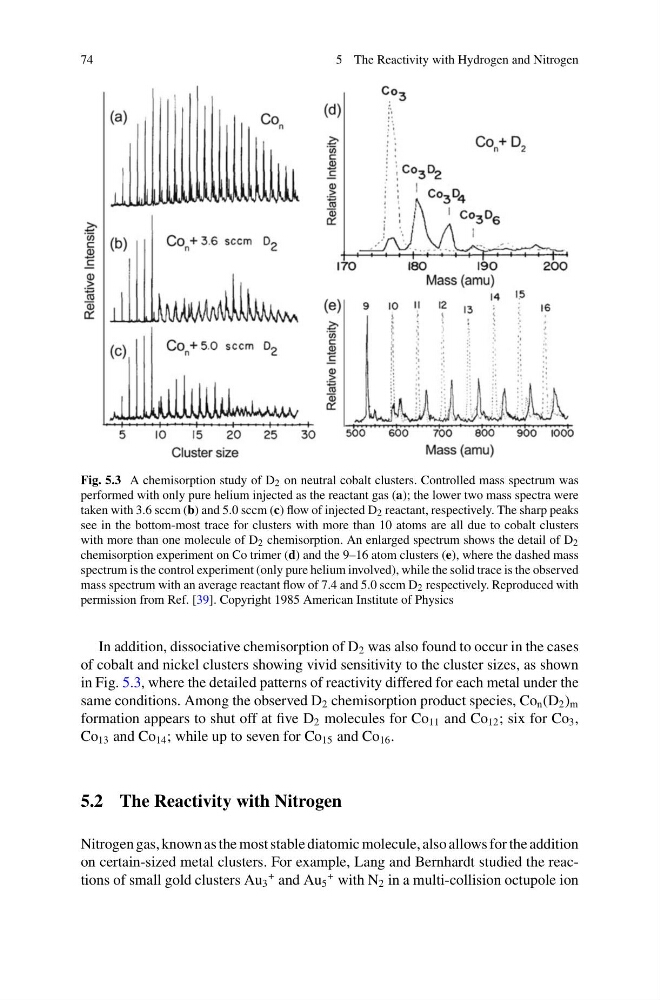
Fig. 5.3 A chemisorption study of D 2 on neutral cobalt clusters. Controlled mass spectrum was
performed with only pure helium injected as the reactant gas (a); the lower two mass spectra were
taken with 3.6 sccm (b) and 5.0 sccm (c) flow of injected D 2 reactant, respectively. The sharp peaks
see in the bottom-most trace for clusters with more than 10 atoms are all due to cobalt clusters
with more than one molecule of D 2 chemisorption. An enlarged spectrum shows the detail of D 2
chemisorption experiment on Co trimer (d) and the 9–16 atom clusters (e), where the dashed mass
spectrum is the control experiment (only pure helium involved), while the solid trace is the observed
mass spectrum with an average reactant flow of 7.4 and 5.0 sccm D 2 respectively. Reproduced with
permission from Ref. [39]. Copyright 1985 American Institute of Physics
In addition, dissociative chemisorption of D 2 was also found to occur in the cases
of cobalt and nickel clusters showing vivid sensitivity to the cluster sizes, as shown
in Fig. 5.3, where the detailed patterns of reactivity differed for each metal under the
same conditions. Among the observed D 2 chemisorption product species, Co n (D 2 ) m
formation appears to shut off at five D 2 molecules for Co 11 and Co 12 ; six for Co 3 ,
Co 13 and Co 14 ; while up to seven for Co 15 and Co 16 .
5.2 The Reactivity with Nitrogen
Nitrogen gas, known as the most stable diatomic molecule, also allows for the addition
on certain-sized metal clusters. For example, Lang and Bernhardt studied the reactions of small gold clusters Au 3
+ and Au 5
+ with N 2 in a multi-collision octupole ion
5 The Reactivity with Hydrogen and Nitrogen
Fig. 5.3 A chemisorption study of D 2 on neutral cobalt clusters. Controlled mass spectrum was
performed with only pure helium injected as the reactant gas (a); the lower two mass spectra were
taken with 3.6 sccm (b) and 5.0 sccm (c) flow of injected D 2 reactant, respectively. The sharp peaks
see in the bottom-most trace for clusters with more than 10 atoms are all due to cobalt clusters
with more than one molecule of D 2 chemisorption. An enlarged spectrum shows the detail of D 2
chemisorption experiment on Co trimer (d) and the 9–16 atom clusters (e), where the dashed mass
spectrum is the control experiment (only pure helium involved), while the solid trace is the observed
mass spectrum with an average reactant flow of 7.4 and 5.0 sccm D 2 respectively. Reproduced with
permission from Ref. [39]. Copyright 1985 American Institute of Physics
In addition, dissociative chemisorption of D 2 was also found to occur in the cases
of cobalt and nickel clusters showing vivid sensitivity to the cluster sizes, as shown
in Fig. 5.3, where the detailed patterns of reactivity differed for each metal under the
same conditions. Among the observed D 2 chemisorption product species, Co n (D 2 ) m
formation appears to shut off at five D 2 molecules for Co 11 and Co 12 ; six for Co 3 ,
Co 13 and Co 14 ; while up to seven for Co 15 and Co 16 .
5.2 The Reactivity with Nitrogen
Nitrogen gas, known as the most stable diatomic molecule, also allows for the addition
on certain-sized metal clusters. For example, Lang and Bernhardt studied the reactions of small gold clusters Au 3
+ and Au 5
+ with N 2 in a multi-collision octupole ion