

76
5 The Reactivity with Hydrogen and Nitrogen
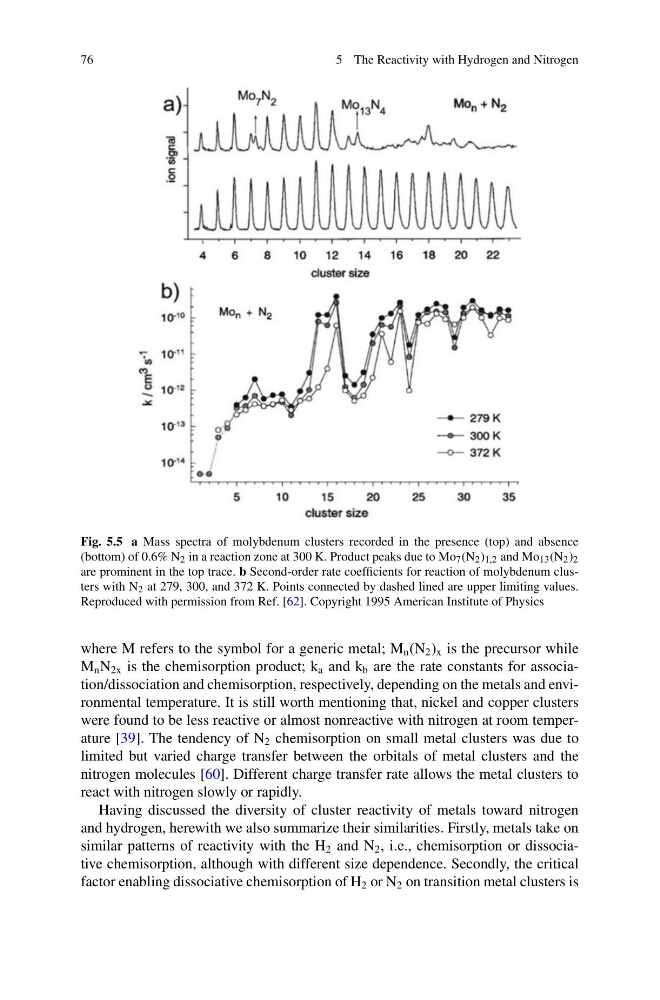
Fig. 5.5 a Mass spectra of molybdenum clusters recorded in the presence (top) and absence
(bottom) of 0.6% N 2 in a reaction zone at 300 K. Product peaks due to Mo 7 (N 2 ) 1,2 and Mo 13 (N 2 ) 2
are prominent in the top trace. b Second-order rate coefficients for reaction of molybdenum clusters with N 2 at 279, 300, and 372 K. Points connected by dashed lined are upper limiting values.
Reproduced with permission from Ref. [62]. Copyright 1995 American Institute of Physics
where M refers to the symbol for a generic metal; M n (N 2 ) x is the precursor while
M n N 2x is the chemisorption product; k a and k b are the rate constants for association/dissociation and chemisorption, respectively, depending on the metals and environmental temperature. It is still worth mentioning that, nickel and copper clusters
were found to be less reactive or almost nonreactive with nitrogen at room temperature [39]. The tendency of N 2 chemisorption on small metal clusters was due to
limited but varied charge transfer between the orbitals of metal clusters and the
nitrogen molecules [60]. Different charge transfer rate allows the metal clusters to
react with nitrogen slowly or rapidly.
Having discussed the diversity of cluster reactivity of metals toward nitrogen
and hydrogen, herewith we also summarize their similarities. Firstly, metals take on
similar patterns of reactivity with the H 2 and N 2 , i.e., chemisorption or dissociative chemisorption, although with different size dependence. Secondly, the critical
factor enabling dissociative chemisorption of H 2 or N 2 on transition metal clusters is
5 The Reactivity with Hydrogen and Nitrogen
Fig. 5.5 a Mass spectra of molybdenum clusters recorded in the presence (top) and absence
(bottom) of 0.6% N 2 in a reaction zone at 300 K. Product peaks due to Mo 7 (N 2 ) 1,2 and Mo 13 (N 2 ) 2
are prominent in the top trace. b Second-order rate coefficients for reaction of molybdenum clusters with N 2 at 279, 300, and 372 K. Points connected by dashed lined are upper limiting values.
Reproduced with permission from Ref. [62]. Copyright 1995 American Institute of Physics
where M refers to the symbol for a generic metal; M n (N 2 ) x is the precursor while
M n N 2x is the chemisorption product; k a and k b are the rate constants for association/dissociation and chemisorption, respectively, depending on the metals and environmental temperature. It is still worth mentioning that, nickel and copper clusters
were found to be less reactive or almost nonreactive with nitrogen at room temperature [39]. The tendency of N 2 chemisorption on small metal clusters was due to
limited but varied charge transfer between the orbitals of metal clusters and the
nitrogen molecules [60]. Different charge transfer rate allows the metal clusters to
react with nitrogen slowly or rapidly.
Having discussed the diversity of cluster reactivity of metals toward nitrogen
and hydrogen, herewith we also summarize their similarities. Firstly, metals take on
similar patterns of reactivity with the H 2 and N 2 , i.e., chemisorption or dissociative chemisorption, although with different size dependence. Secondly, the critical
factor enabling dissociative chemisorption of H 2 or N 2 on transition metal clusters is