

62
4 Halogenation of Metal Clusters
4.3.2 Al n I x
− Reacting with Methyl Iodide
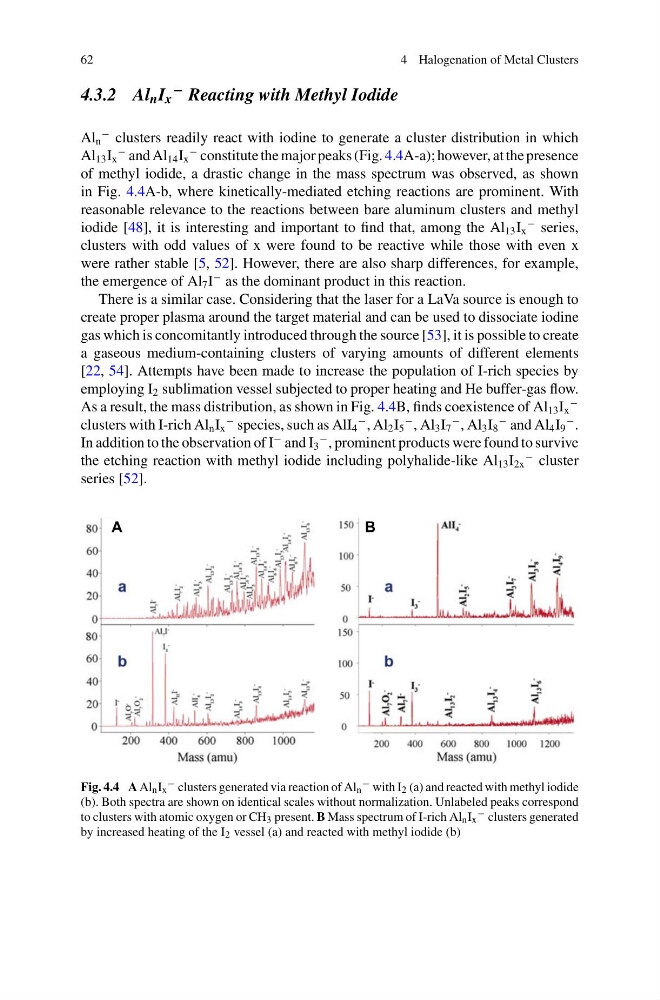
Al n
− clusters readily react with iodine to generate a cluster distribution in which
Al 13 I x
− and Al 14 I x
− constitute the major peaks (Fig. 4.4A-a); however, at the presence
of methyl iodide, a drastic change in the mass spectrum was observed, as shown
in Fig. 4.4A-b, where kinetically-mediated etching reactions are prominent. With
reasonable relevance to the reactions between bare aluminum clusters and methyl
iodide [48], it is interesting and important to find that, among the Al 13 I x
− series,
clusters with odd values of x were found to be reactive while those with even x
were rather stable [5, 52]. However, there are also sharp differences, for example,
the emergence of Al 7 I
− as the dominant product in this reaction.
There is a similar case. Considering that the laser for a LaVa source is enough to
create proper plasma around the target material and can be used to dissociate iodine
gas which is concomitantly introduced through the source [53], it is possible to create
a gaseous medium-containing clusters of varying amounts of different elements
[22, 54]. Attempts have been made to increase the population of I-rich species by
employing I 2 sublimation vessel subjected to proper heating and He buffer-gas flow.
As a result, the mass distribution, as shown in Fig. 4.4B, finds coexistence of Al 13 I x
−
clusters with I-rich Al n I x
− species, such as AlI 4
− , Al 2 I 5
− , Al 3 I 7
− , Al 3 I 8
− and Al 4 I 9
− .
In addition to the observation of I
− and I 3
− , prominent products were found to survive
the etching reaction with methyl iodide including polyhalide-like Al 13 I 2x
− cluster
series [52].
A
B
Fig. 4.4 A Al n I x
− clusters generated via reaction of Al n
− with I 2 (a) and reacted with methyl iodide
(b). Both spectra are shown on identical scales without normalization. Unlabeled peaks correspond
to clusters with atomic oxygen or CH 3 present. B Mass spectrum of I-rich Al n I x
− clusters generated
by increased heating of the I 2 vessel (a) and reacted with methyl iodide (b)
4 Halogenation of Metal Clusters
4.3.2 Al n I x
− Reacting with Methyl Iodide
Al n
− clusters readily react with iodine to generate a cluster distribution in which
Al 13 I x
− and Al 14 I x
− constitute the major peaks (Fig. 4.4A-a); however, at the presence
of methyl iodide, a drastic change in the mass spectrum was observed, as shown
in Fig. 4.4A-b, where kinetically-mediated etching reactions are prominent. With
reasonable relevance to the reactions between bare aluminum clusters and methyl
iodide [48], it is interesting and important to find that, among the Al 13 I x
− series,
clusters with odd values of x were found to be reactive while those with even x
were rather stable [5, 52]. However, there are also sharp differences, for example,
the emergence of Al 7 I
− as the dominant product in this reaction.
There is a similar case. Considering that the laser for a LaVa source is enough to
create proper plasma around the target material and can be used to dissociate iodine
gas which is concomitantly introduced through the source [53], it is possible to create
a gaseous medium-containing clusters of varying amounts of different elements
[22, 54]. Attempts have been made to increase the population of I-rich species by
employing I 2 sublimation vessel subjected to proper heating and He buffer-gas flow.
As a result, the mass distribution, as shown in Fig. 4.4B, finds coexistence of Al 13 I x
−
clusters with I-rich Al n I x
− species, such as AlI 4
− , Al 2 I 5
− , Al 3 I 7
− , Al 3 I 8
− and Al 4 I 9
− .
In addition to the observation of I
− and I 3
− , prominent products were found to survive
the etching reaction with methyl iodide including polyhalide-like Al 13 I 2x
− cluster
series [52].
A
B
Fig. 4.4 A Al n I x
− clusters generated via reaction of Al n
− with I 2 (a) and reacted with methyl iodide
(b). Both spectra are shown on identical scales without normalization. Unlabeled peaks correspond
to clusters with atomic oxygen or CH 3 present. B Mass spectrum of I-rich Al n I x
− clusters generated
by increased heating of the I 2 vessel (a) and reacted with methyl iodide (b)