

4.3 Reactivity and Stability of Al n I x
− Clusters
61
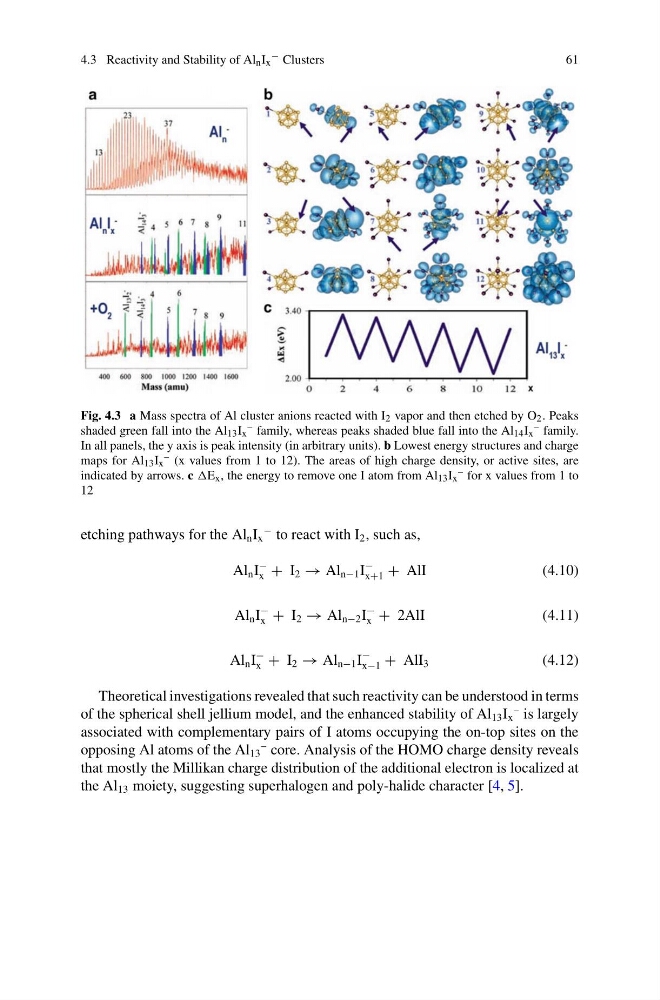
Fig. 4.3 a Mass spectra of Al cluster anions reacted with I 2 vapor and then etched by O 2 . Peaks
shaded green fall into the Al 13 I x
– family, whereas peaks shaded blue fall into the Al 14 I x
– family.
In all panels, the y axis is peak intensity (in arbitrary units). b Lowest energy structures and charge
maps for Al 13 I x
– (x values from 1 to 12). The areas of high charge density, or active sites, are
indicated by arrows. c E x , the energy to remove one I atom from Al 13 I x
– for x values from 1 to
12
etching pathways for the Al n I x
− to react with I 2 , such as,
Al n I
−
x + I 2 → Al n−1 I
−
x+1 + AlI
(4.10)
Al n I
−
x + I 2 → Al n−2 I
−
x + 2AlI
(4.11)
Al n I
−
x + I 2 → Al n−1 I
−
x−1 + AlI 3
(4.12)
Theoretical investigations revealed that such reactivity can be understood in terms
of the spherical shell jellium model, and the enhanced stability of Al 13 I x
– is largely
associated with complementary pairs of I atoms occupying the on-top sites on the
opposing Al atoms of the Al 13
– core. Analysis of the HOMO charge density reveals
that mostly the Millikan charge distribution of the additional electron is localized at
the Al 13 moiety, suggesting superhalogen and poly-halide character [4, 5].
− Clusters
61
Fig. 4.3 a Mass spectra of Al cluster anions reacted with I 2 vapor and then etched by O 2 . Peaks
shaded green fall into the Al 13 I x
– family, whereas peaks shaded blue fall into the Al 14 I x
– family.
In all panels, the y axis is peak intensity (in arbitrary units). b Lowest energy structures and charge
maps for Al 13 I x
– (x values from 1 to 12). The areas of high charge density, or active sites, are
indicated by arrows. c E x , the energy to remove one I atom from Al 13 I x
– for x values from 1 to
12
etching pathways for the Al n I x
− to react with I 2 , such as,
Al n I
−
x + I 2 → Al n−1 I
−
x+1 + AlI
(4.10)
Al n I
−
x + I 2 → Al n−2 I
−
x + 2AlI
(4.11)
Al n I
−
x + I 2 → Al n−1 I
−
x−1 + AlI 3
(4.12)
Theoretical investigations revealed that such reactivity can be understood in terms
of the spherical shell jellium model, and the enhanced stability of Al 13 I x
– is largely
associated with complementary pairs of I atoms occupying the on-top sites on the
opposing Al atoms of the Al 13
– core. Analysis of the HOMO charge density reveals
that mostly the Millikan charge distribution of the additional electron is localized at
the Al 13 moiety, suggesting superhalogen and poly-halide character [4, 5].