

52
3 Metal Cluster Reacting with Oxygen
Utilizing a customized reflection time-of-flight mass spectrometer (Re-TOFMS)
[69], we have prepared well-resolved vanadium clusters V n
+/0 (n = 1–30), on which
we conducted a comprehensive study on the reactivity with oxygen. It is illustrated
that, cationic V n
+ clusters readily react with oxygen leading to the production of
both etched building blocks and oxygen-rich V n O m
+ (n < m) species profiting from
the ion–molecule attraction [70]. As for the neutral V n clusters, the etching effect of
V n + O 2 → V n−1 O 2 + V dominates the reaction pathway [69].
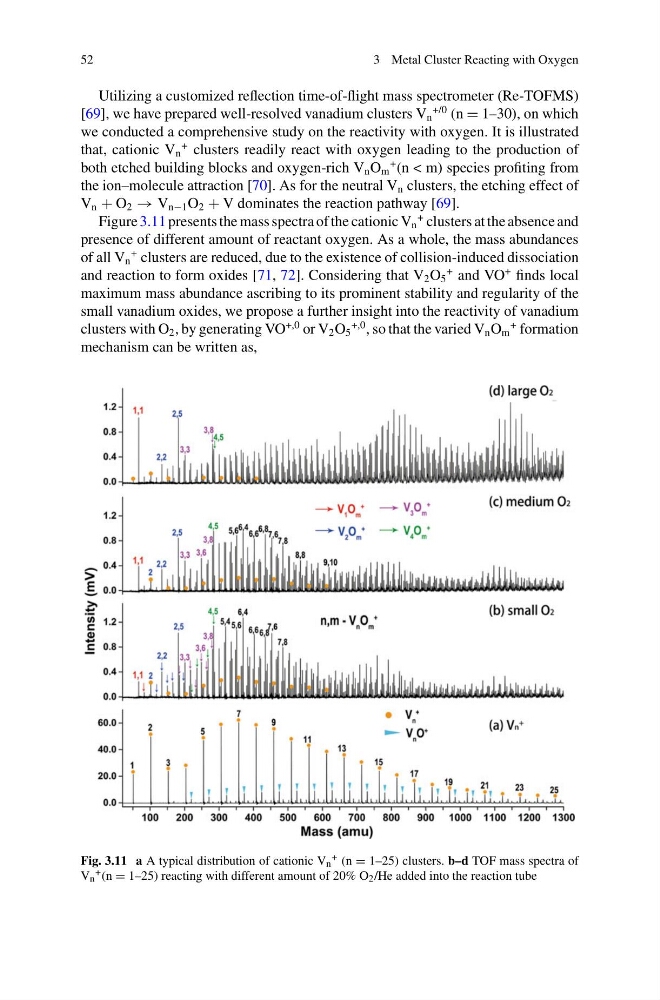
Figure 3.11 presents the mass spectra of the cationic V n
+ clusters at the absence and
presence of different amount of reactant oxygen. As a whole, the mass abundances
of all V n
+ clusters are reduced, due to the existence of collision-induced dissociation
and reaction to form oxides [71, 72]. Considering that V 2 O 5
+ and VO
+ finds local
maximum mass abundance ascribing to its prominent stability and regularity of the
small vanadium oxides, we propose a further insight into the reactivity of vanadium
clusters with O 2 , by generating VO
+,0 or V 2 O 5
+,0 , so that the varied V n O m
+ formation
mechanism can be written as,
Fig. 3.11 a A typical distribution of cationic V n
+ (n = 1–25) clusters. b–d TOF mass spectra of
V n
+ (n = 1–25) reacting with different amount of 20% O 2 /He added into the reaction tube
3 Metal Cluster Reacting with Oxygen
Utilizing a customized reflection time-of-flight mass spectrometer (Re-TOFMS)
[69], we have prepared well-resolved vanadium clusters V n
+/0 (n = 1–30), on which
we conducted a comprehensive study on the reactivity with oxygen. It is illustrated
that, cationic V n
+ clusters readily react with oxygen leading to the production of
both etched building blocks and oxygen-rich V n O m
+ (n < m) species profiting from
the ion–molecule attraction [70]. As for the neutral V n clusters, the etching effect of
V n + O 2 → V n−1 O 2 + V dominates the reaction pathway [69].
Figure 3.11 presents the mass spectra of the cationic V n
+ clusters at the absence and
presence of different amount of reactant oxygen. As a whole, the mass abundances
of all V n
+ clusters are reduced, due to the existence of collision-induced dissociation
and reaction to form oxides [71, 72]. Considering that V 2 O 5
+ and VO
+ finds local
maximum mass abundance ascribing to its prominent stability and regularity of the
small vanadium oxides, we propose a further insight into the reactivity of vanadium
clusters with O 2 , by generating VO
+,0 or V 2 O 5
+,0 , so that the varied V n O m
+ formation
mechanism can be written as,
Fig. 3.11 a A typical distribution of cationic V n
+ (n = 1–25) clusters. b–d TOF mass spectra of
V n
+ (n = 1–25) reacting with different amount of 20% O 2 /He added into the reaction tube