

3.5 Competition of Oxygen Etching Versus Oxygen Addition
53
V n
+
+ yO 2 → [V n−1 O 2y−1 ]
0,+
+ VO
+,0
(3.4)
V n
+
+ yO 2 → [V n−2 O 2y−5 ]
0,+
+ V 2 O 5
+,0
(3.5)
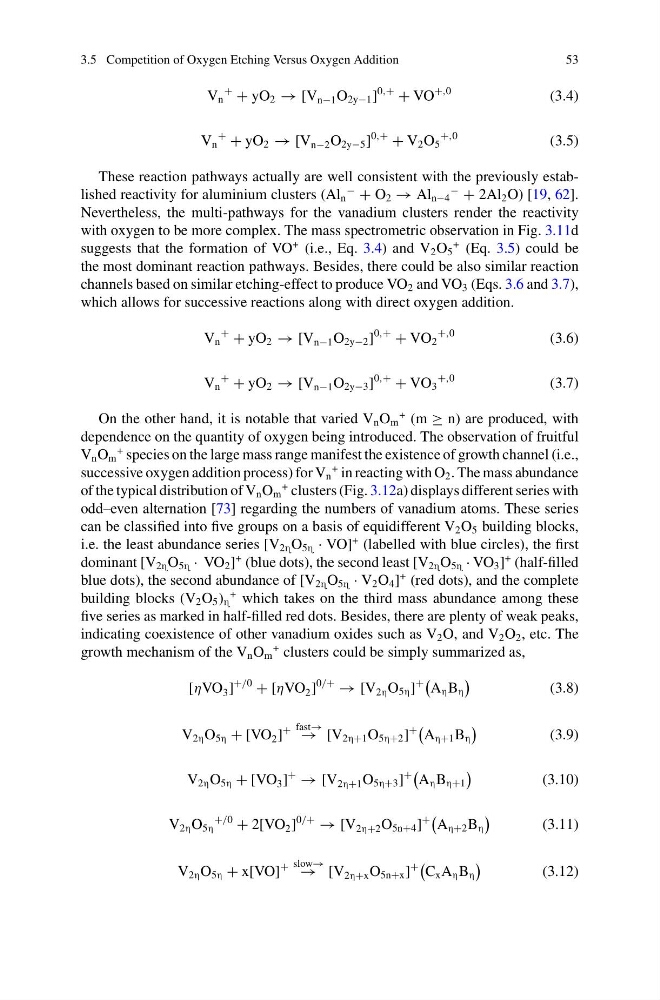
These reaction pathways actually are well consistent with the previously established reactivity for aluminium clusters (Al n
−
+ O 2 → Al n−4
−
+ 2Al 2 O) [19, 62].
Nevertheless, the multi-pathways for the vanadium clusters render the reactivity
with oxygen to be more complex. The mass spectrometric observation in Fig. 3.11d
suggests that the formation of VO
+ (i.e., Eq. 3.4) and V 2 O 5
+ (Eq. 3.5) could be
the most dominant reaction pathways. Besides, there could be also similar reaction
channels based on similar etching-effect to produce VO 2 and VO 3 (Eqs. 3.6 and 3.7),
which allows for successive reactions along with direct oxygen addition.
V n
+
+ yO 2 → [V n−1 O 2y−2 ]
0,+
+ VO 2
+,0
(3.6)
V n
+
+ yO 2 → [V n−1 O 2y−3 ]
0,+
+ VO 3
+,0
(3.7)
On the other hand, it is notable that varied V n O m
+ (m ≥ n) are produced, with
dependence on the quantity of oxygen being introduced. The observation of fruitful
V n O m
+ species on the large mass range manifest the existence of growth channel (i.e.,
successive oxygen addition process) for V n
+ in reacting with O 2 . The mass abundance
of the typical distribution of V n O m
+ clusters (Fig. 3.12a) displays different series with
odd–even alternation [73] regarding the numbers of vanadium atoms. These series
can be classified into five groups on a basis of equidifferent V 2 O 5 building blocks,
i.e. the least abundance series [V 2ï O 5ï · VO]
+ (labelled with blue circles), the first
dominant [V 2ï O 5ï · VO 2 ]
+ (blue dots), the second least [V 2ï O 5ï · VO 3 ]
+ (half-filled
blue dots), the second abundance of [V 2ï O 5ï · V 2 O 4 ]
+ (red dots), and the complete
building blocks (V 2 O 5 ) ï
+ which takes on the third mass abundance among these
five series as marked in half-filled red dots. Besides, there are plenty of weak peaks,
indicating coexistence of other vanadium oxides such as V 2 O, and V 2 O 2 , etc. The
growth mechanism of the V n O m
+ clusters could be simply summarized as,
[ηVO 3 ]
+/0
+ [ηVO 2 ]
0/+
→ [V 2η O 5η ]
+
A η B η
(3.8)
V 2η O 5η + [VO 2 ]
+ fast→
→ [V 2η+1 O 5η+2 ]
+
A η+1 B η
(3.9)
V 2η O 5η + [VO 3 ]
+
→ [V 2η+1 O 5η+3 ]
+
A η B η+1
(3.10)
V 2η O 5η
+/0
+ 2[VO 2 ]
0/+
→ [V 2η+2 O 5n+4 ]
+
A η+2 B η
(3.11)
V 2η O 5η + x[VO]
+ slow→
→ [V 2η+x O 5n+x ]
+
C x A η B η
(3.12)
53
V n
+
+ yO 2 → [V n−1 O 2y−1 ]
0,+
+ VO
+,0
(3.4)
V n
+
+ yO 2 → [V n−2 O 2y−5 ]
0,+
+ V 2 O 5
+,0
(3.5)
These reaction pathways actually are well consistent with the previously established reactivity for aluminium clusters (Al n
−
+ O 2 → Al n−4
−
+ 2Al 2 O) [19, 62].
Nevertheless, the multi-pathways for the vanadium clusters render the reactivity
with oxygen to be more complex. The mass spectrometric observation in Fig. 3.11d
suggests that the formation of VO
+ (i.e., Eq. 3.4) and V 2 O 5
+ (Eq. 3.5) could be
the most dominant reaction pathways. Besides, there could be also similar reaction
channels based on similar etching-effect to produce VO 2 and VO 3 (Eqs. 3.6 and 3.7),
which allows for successive reactions along with direct oxygen addition.
V n
+
+ yO 2 → [V n−1 O 2y−2 ]
0,+
+ VO 2
+,0
(3.6)
V n
+
+ yO 2 → [V n−1 O 2y−3 ]
0,+
+ VO 3
+,0
(3.7)
On the other hand, it is notable that varied V n O m
+ (m ≥ n) are produced, with
dependence on the quantity of oxygen being introduced. The observation of fruitful
V n O m
+ species on the large mass range manifest the existence of growth channel (i.e.,
successive oxygen addition process) for V n
+ in reacting with O 2 . The mass abundance
of the typical distribution of V n O m
+ clusters (Fig. 3.12a) displays different series with
odd–even alternation [73] regarding the numbers of vanadium atoms. These series
can be classified into five groups on a basis of equidifferent V 2 O 5 building blocks,
i.e. the least abundance series [V 2ï O 5ï · VO]
+ (labelled with blue circles), the first
dominant [V 2ï O 5ï · VO 2 ]
+ (blue dots), the second least [V 2ï O 5ï · VO 3 ]
+ (half-filled
blue dots), the second abundance of [V 2ï O 5ï · V 2 O 4 ]
+ (red dots), and the complete
building blocks (V 2 O 5 ) ï
+ which takes on the third mass abundance among these
five series as marked in half-filled red dots. Besides, there are plenty of weak peaks,
indicating coexistence of other vanadium oxides such as V 2 O, and V 2 O 2 , etc. The
growth mechanism of the V n O m
+ clusters could be simply summarized as,
[ηVO 3 ]
+/0
+ [ηVO 2 ]
0/+
→ [V 2η O 5η ]
+
A η B η
(3.8)
V 2η O 5η + [VO 2 ]
+ fast→
→ [V 2η+1 O 5η+2 ]
+
A η+1 B η
(3.9)
V 2η O 5η + [VO 3 ]
+
→ [V 2η+1 O 5η+3 ]
+
A η B η+1
(3.10)
V 2η O 5η
+/0
+ 2[VO 2 ]
0/+
→ [V 2η+2 O 5n+4 ]
+
A η+2 B η
(3.11)
V 2η O 5η + x[VO]
+ slow→
→ [V 2η+x O 5n+x ]
+
C x A η B η
(3.12)